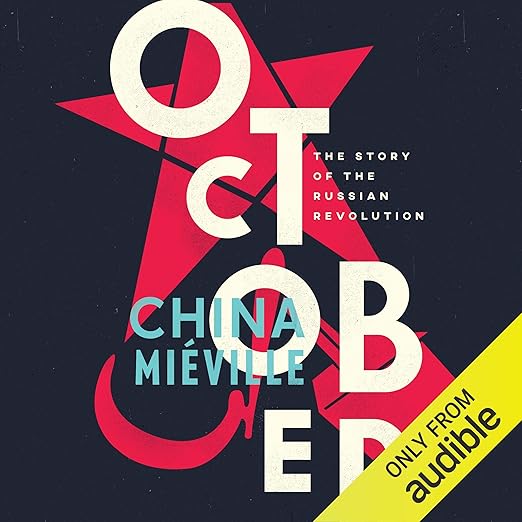
Quick Take
- Narration: John Banks brings appropriate gravitas to Mieville’s dense historical prose, managing the large cast of revolutionary figures with consistent clarity across eleven-plus hours.
- Themes: The contingency of historical change, revolutionary idealism versus institutional reality, the gap between what a revolution promises and what it delivers
- Mood: Dense and intellectually charged, with flashes of genuine narrative drama breaking through the historiography
- Verdict: An unusual and valuable thing: a historian’s account written by a novelist’s sensibility, which makes 1917’s nine extraordinary months both comprehensible and genuinely strange.
I was halfway through my morning commute when John Banks read the passage where Lenin, returning to Russia by sealed train through Germany in April 1917, arrives at the Finland Station and delivers a speech that confounds even his own party. Mieville’s writing at that moment stops being historiography and becomes something closer to drama, and Banks’ narration rises to meet it. I sat in my car in the parking garage for ten extra minutes because I needed to hear what happened next. That kind of response, to a history book, is what Mieville has achieved in October.
China Mieville is best known as a novelist, and specifically as one of the more intellectually ambitious writers working in science fiction and fantasy. His political commitments are no secret: he has long been sympathetic to the ideals of the revolutionary left, and he wrote October on the centenary of the Russian Revolution as an explicitly partisan account, one that does not pretend to the false objectivity of the view from nowhere. That transparency is one of the book’s virtues. Mieville is honest about his sympathies and honest about the revolution’s failures. The combination produces something more trustworthy than a neutral account would be, because you know exactly where the author is standing when he makes his judgments.
Nine Months That Remade a World
The specific territory of October is the period between the February Revolution, which ended Tsarist autocracy, and the October Revolution, which brought the Bolsheviks to power. Mieville calls this a story of extraordinary months, and the word extraordinary is doing real work in that description. The speed of change during this period, a country moving from medieval autocracy to the first socialist state in nine months, while fighting a devastating and deeply unpopular war, while managing the ambitions of a dozen competing political factions, while attempting to hold together an empire already disintegrating along ethnic and regional lines, is almost impossible to hold in the mind as real events rather than literary invention. Mieville’s gift is making it feel both real and incomprehensible simultaneously.
The cast of historical figures is enormous, and one of the book’s genuine technical achievements is keeping them distinguishable and alive as individuals rather than allowing them to collapse into representative types. Lenin is not merely Lenin-as-historical-force but Lenin as a specific person with specific rhetorical habits, specific political instincts, and specific blind spots. Trotsky, Kerensky, Kornilov, and dozens of lesser-known figures are given the same individualizing treatment. John Banks manages this in the audio by maintaining consistent vocal signatures for the major figures without tipping into theatrical characterization, which would have been wrong for a history book even an ambitious and stylized one.
What a Novelist Brings to Historical Contingency
The novelist’s sensibility that Mieville brings to this history has a specific cost that one reviewer named directly: it can feel dry and frustrating for readers who want the book to function as a political argument or a structural sociological analysis of why revolution was possible. Mieville is less interested in the deep conditions that made revolution possible than he is in the specific human choices, negotiations, miscalculations, and moments of dramatic contingency that determined which revolution would actually happen out of the many that could have. The history of ideas and the history of forces is present but subordinated to the history of events and decisions. That choice produces a more readable book than most comparable historical accounts, but it can feel thin to readers expecting a more theoretical framework.
Another reviewer named something the book does particularly well: subverting familiar narratives. Lenin is present throughout but the book resists making him the sole explanatory engine of October. The revolution is shown as a collective process, contested and uncertain at every stage, rather than a teleological march toward a predetermined outcome. The sense of contingency, the awareness that things could have gone differently and nearly did several times, is what gives the book its sustained tension even when you know, as every listener does, how the story ends. The coup by telegram sequence that Mieville describes, the Bolshevik seizure of power conducted partly through telegraph communication, is one of the book’s genuinely strange moments, and Banks’ pacing in that section reflects exactly the right register of historical strangeness.
John Banks and Eleven Hours of Revolutionary Ensemble
Eleven hours and thirty-seven minutes of dense political history places demanding requirements on a narrator. Banks succeeds primarily through discipline: he does not try to compensate for the material’s complexity with expressive performance, but he does not flatten it into monotone either. The pacing varies appropriately, slowing for the complex political negotiations between competing socialist factions and accelerating for the sequences of street-level action that punctuate the period. The Russian names and political party names are rendered consistently throughout, which matters considerably for a cast that includes Mensheviks, Socialist Revolutionaries, Bolsheviks, Left Socialist Revolutionaries, and dozens of named individuals whose names are unfamiliar to most English-speaking listeners.
The Right Entry Point into 1917 and Its Consequences
October is not an introductory history of Russia. Mieville states explicitly that it is for those new to the events, but the sheer density of names, factions, and political positions makes it significantly more rewarding for listeners who bring at least some contextual awareness of the period. Those who want to understand the extraordinary nine months of 1917 with a guide who writes beautifully and thinks honestly about political idealism and its consequences will find this free audiobook one of the most intellectually satisfying history listens available. Those who need their history to stay comfortably neutral, or who want deep structural analysis rather than narrative drama, will be better served by a different account of the same events. But for the story of how it actually felt to be there, month by month, Mieville’s is the version worth hearing.
Frequently Asked Questions
Does October require prior knowledge of Russian history, or can a complete newcomer follow it?
Mieville designed the book for newcomers to the events, but the density of political factions, the many competing revolutionary organizations, and the large cast of named figures make prior orientation helpful. Listeners who know basic Russian geography, who Tsar Nicholas II was, and the outline of World War One’s eastern front will find the material significantly easier to track. A brief orientation before starting is a reasonable preparation investment.
How does Mieville’s political sympathy for the revolutionary left affect the reliability of the historical account?
Mieville is transparent about his sympathies from the beginning, which is more honest than a falsely neutral account would be. Reviewers with a range of political orientations found the historical research solid and the major events accurately represented. His partisanship manifests more in which details he finds worth dwelling on than in factual distortion. He is also candid about the revolution’s failures, which prevents the account from becoming simple celebration.
Is October primarily a narrative history or does it engage with historiographical debates about the revolution’s causes and necessity?
It is primarily narrative. Mieville is interested in the specific events, the human decisions and contingencies of those nine months, more than in the structural or theoretical debates that have occupied historians for a century. Those debates are acknowledged but are not the book’s main project. Readers wanting deep structural analysis of why the revolution happened would be better served by a more conventional historiographical work, but for the story of how it actually unfolded, October is more engaging than most alternatives.
How does John Banks handle the large number of Russian names and the competing political factions in the narration?
Banks is reliable with Russian pronunciation throughout, which matters considerably for a cast that includes factions and individuals with names unfamiliar to most English-speaking listeners. He maintains consistent identification through vocal emphasis and rhythm rather than theatrical vocal distinction, which suits Mieville’s academic-but-accessible register. Listeners who lose track of faction affiliations in the middle portions will find the narration consistent enough to rewind and clarify without the additional confusion that poorly differentiated ensemble reading can produce.