Quick Take
- Narration: R.M. McLeod narrates with controlled authority, lending the conspiratorial framing a credibility it may not always earn on its own merits.
- Themes: Esoteric history of women’s movements, occult influence on social change, anti-feminist critique
- Mood: Provocative and partisan, pitched as revelatory throughout
- Verdict: A polarizing listen that requires critical distance; the historical research into esoteric influences on feminism is genuinely interesting, but the ideological framing is tendentious and should not be taken as scholarship.
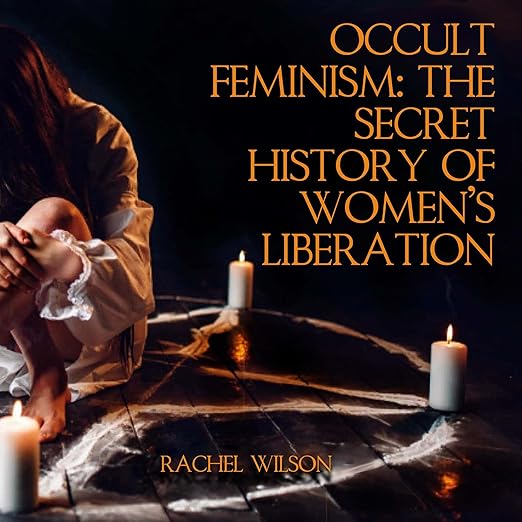
I want to be transparent about something before I go further: reviewing Rachel Wilson’s Occult Feminism requires me to hold two things at once. On one hand, the genuine historical thread the book follows, specifically the documented involvement of spiritualist and esoteric traditions in 19th and early 20th-century women’s movements, is a real and underexplored area of social history. On the other hand, the ideological scaffolding Wilson builds around that research, including the argument that feminism itself was a conspiracy against women rather than an imperfect but genuine movement for rights, is not scholarship. It is polemic presented as scholarship. Those two things exist in the same book, and listeners deserve to know which they are getting before they press play.
R.M. McLeod narrates with a steady, composed authority that gives the material a surface credibility. The narration never tips into outrage or breathlessness, which is the right choice for this kind of content. The controlled delivery lets listeners engage with the actual claims rather than react to theatrical presentation. Whether that is a virtue depends on how much you think the listener needs to be held at some narrative distance from Wilson’s conclusions.
The Historical Thread Worth Taking Seriously
One reviewer summarized the book’s more defensible argument this way: that occult and mystical traditions were meaningful arenas where women could experiment with power, authority, and intellectual independence in environments that largely excluded them from institutional religion, academia, and politics. That argument has genuine historical support. Figures like Helena Blavatsky and Annie Besant, and the broader 19th-century spiritualist movement, did provide women with platforms for public authority that the mainstream social order denied them. The connection between suffragist networks and esoteric communities is documented in serious academic work, and Wilson’s sourcing of this material, when she stays within the territory, is genuinely interesting rather than merely provocative.
The stories about spirit mediums, the CIA’s documented interest in parapsychology, and the involvement of charismatic and sometimes manipulative religious movements in the countercultural feminism of the 1960s and 70s are, in several cases, factually grounded. Wilson is correct that mainstream feminist historiography has sometimes smoothed over the stranger and more complicated figures in the movement’s past. That observation is fair, and the book is most compelling when it is making that case.
Where the Argument Becomes Tendentious
The problem is the frame Wilson imposes on all of this. The synopsis asks whether feminism liberated women or was a cunning deception that turned them into wage slaves. That is not a neutral historical question. It is a conclusion dressed as an inquiry. Wilson’s rhetorical move throughout is to present a curated selection of unusual historical figures as representative of the entire movement, and then to use those figures to delegitimize the movement’s outcomes wholesale. The argument that women’s liberation left women more vulnerable than ever by destroying the family is stated as conclusion rather than demonstrated through comparative historical evidence.
The framing of traditional family structure as women’s natural source of stability, security, and purpose is ideological, not historical. Listeners who come to this book looking for a genuinely revisionist history will find that Wilson’s revision runs in a specific political direction, and that direction shapes which evidence gets selected and how it gets weighted throughout the five-hour runtime.
What a Critical Listener Takes Away
R.M. McLeod’s narration is consistently polished, and that polish is actually one of the book’s rhetorical tools. The composed delivery smooths over the moments where Wilson’s argument makes logical leaps, and a listener without prior knowledge of feminist history may not notice where the documented evidence ends and the interpretive construction begins. The book is most useful as a case study in how conspiratorial argument constructs itself as history: the method is visible if you know to look for it, and examining that method is itself educational.
What Critical Listening Actually Looks Like Here
Listeners with an existing interest in the history of women’s esoteric and spiritual movements will find parts of this illuminating, provided they maintain the critical distance to separate the historical material from the interpretive framework. Those curious about how conspiracy-adjacent arguments build themselves as scholarship will also find it instructive, precisely because Wilson’s method is so visible once you know to look. Readers seeking genuine scholarly treatment of women and occultism should look to academic histories instead. And those who are likely to receive Wilson’s ideological conclusions as verified fact should approach with significant caution and supplementary reading.
The practical question for a prospective listener is: what do I want to take away? If the answer is a better understanding of how esoteric and spiritual traditions intersected with the early feminist movement in America and Britain, this book offers genuine starting points, though they should be followed up with academic reading that brings more methodological care. If the answer is a comprehensive history of those intersections, you will find the selection too curated and the framing too settled in its conclusions before the evidence is fully presented. If the answer is an understanding of how conspiratorial arguments about social movements construct themselves as history, this book is actually quite instructive, because Wilson’s method is visible enough to analyze. R.M. McLeod’s controlled narration will not help you see the seams, but knowing to look for them will.
The five-hour runtime is dense enough that a single listen will not resolve every question the material raises. That is not a defect. A book that asks genuinely large historical and sociological questions should leave the listener with more to think about than it provided, and Occult Feminism does that, even when its conclusions are ones the attentive listener is right to resist.
Frequently Asked Questions
Does Occult Feminism cite historical sources for its claims, or are the connections speculative?
Some of the historical connections are grounded in documented relationships between esoteric movements and feminist figures. Others are speculative or rely on guilt-by-association logic. The quality of sourcing varies significantly throughout the book.
How does R.M. McLeod’s narration affect the book’s more extreme claims about feminist history?
McLeod’s composed, authoritative delivery smooths over the more tendentious passages without dramatic emphasis. This works in the book’s favor stylistically but may reduce the natural critical friction a listener would otherwise apply to extraordinary claims.
Is this book primarily a history of the occult, a critique of feminism, or something in between?
It is primarily an anti-feminist argument that uses occult history as its evidential foundation. Listeners expecting a balanced history of esoteric influences on social movements will find the book’s frame more polemical than that description suggests.
At just over five hours, does the runtime allow Wilson to fully develop her argument?
The runtime is sufficient for the breadth of territory she covers, though some reviewers noted they wished contemporary examples were developed further. The book moves quickly from figure to figure without dwelling at length on any single case.