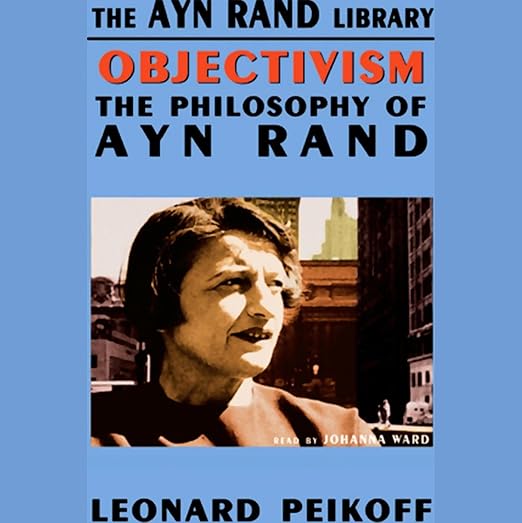
Quick Take
- Narration: Johanna Ward brings measured intelligence to a dense philosophical text, reading with the kind of precision that Rand and Peikoff’s argument demands, this is not a narrator who lends warmth where the text offers none.
- Themes: Reason as epistemological foundation, ethics of rational self-interest, capitalism as the only moral social system
- Mood: Dense and demanding, systematically rigorous
- Verdict: The most complete and authoritative presentation of Rand’s philosophy in audio form, essential for serious students of Objectivism, though readers who encountered Atlas Shrugged and want to understand it philosophically will find this more rewarding than expecting a defense of their existing views.
I came to Objectivism, Leonard Peikoff’s comprehensive presentation of Ayn Rand’s philosophical system, with a reading history that included Atlas Shrugged at eighteen, a long departure from Rand through graduate study in continental philosophy, and a return in my thirties that involved considerably more critical distance. The distance helps. At eighteen, Rand’s ideas arrive with the force of revelation; in your thirties, they arrive as a coherent and challengeable philosophical system that deserves engagement on its own terms rather than wholesale adoption or rejection. Peikoff’s 1976 lecture course, which Rand attended and whose accuracy she personally endorsed, provides exactly the systematic presentation that the novels, deliberately, do not.
Rand wrote that until or unless she produced a comprehensive philosophical treatise, Peikoff’s course was “the only authorized presentation of the entire theoretical structure of Objectivism” and the only one she knew from her own knowledge to be fully accurate. That is a specific and significant endorsement. This audiobook, running at nearly twenty hours, is the audio version of the book derived from those lectures, and it remains the standard reference for anyone seeking to understand Objectivism as a complete philosophical system rather than an attitude or a cultural identity.
Our Take on Objectivism
Peikoff organizes the material across the traditional divisions of philosophy: metaphysics (the nature of reality), epistemology (the nature and validity of knowledge), ethics (the nature and basis of value), and politics (the proper structure of human society). Each section builds from the previous one in what Peikoff and Rand considered a rigorously integrated architecture, and the book rewards reading in sequence rather than dipping into individual chapters. One reviewer noted that the book provides an excellent presentation of epistemology, specifically, the theory of concepts and how we know that something is true, and that section is indeed among the strongest, particularly the refutation of the claim that truth is subjective.
The sections on ethics and politics will be where readers with different philosophical commitments meet the most resistance. Rand’s egoistic ethics, the claim that rational self-interest is the proper moral standard, and her defense of laissez-faire capitalism as the only social system consistent with individual rights are presented here not as opinions but as logical conclusions from prior philosophical premises. Peikoff’s approach is to make the architecture visible: if you accept the metaphysics and epistemology, he argues, the ethics and politics follow. Whether you find that architecture sound is a question the book invites rather than forecloses, though it won’t lead your hand toward skeptical conclusions.
Why Listen to Objectivism
Johanna Ward’s narration is well-chosen for philosophical prose. She reads with a precision that honors Rand and Peikoff’s insistence on the exact meaning of each term, never blurring distinctions that the text has worked to establish. The trade-off is a certain austerity, this is not warm or encouraging narration, and the nineteen-hour runtime is dense rather than pleasurable in any conventional sense. Ward’s tone is appropriate to a text that is making arguments rather than telling stories.
One reviewer who had first read Atlas Shrugged and disliked fiction described finding in this book the condensed and logical presentation of Rand’s ideas they had been looking for. That is an accurate characterization of the book’s purpose. The fictional novels dramatize the philosophy; this one states it outright. For readers who want the argument without the dramatization, Objectivism is the right place to start.
What to Watch For in Objectivism
The book contains material that goes beyond what Rand published in her own writing, including philosophical points from private conversations between Rand and Peikoff. This makes it simultaneously more complete and more dependent on trust in Peikoff’s role as authorized interpreter. Readers interested in critiques of Objectivism will need to look elsewhere, the book does not engage with philosophical objections from outside the system in any systematic way, though it does address Kant and several other philosophers as part of its own argument.
One reviewer raised the issue of circular reasoning in the treatment of theism versus atheism, which is a noted criticism of Rand’s epistemology from multiple philosophical traditions. The charge is worth taking seriously, and listeners who come from religious or spiritually inclined backgrounds should know that Rand’s atheism is not incidental to her philosophy but structurally embedded in it, the rejection of faith as a mode of knowledge is foundational to the entire Objectivist epistemology.
Who Should Listen to Objectivism
Readers who have encountered Rand through her novels and want to understand the philosophical architecture behind them will find this essential. Students of philosophy who want to engage seriously with Objectivism as a systematic position rather than a political attitude will benefit from the precision and completeness Peikoff brings. This is not for casual readers or for those who want a quick overview; at nineteen hours, it is a genuine philosophical education and demands to be treated accordingly.
Frequently Asked Questions
Do I need to have read Ayn Rand’s novels before listening to this?
Not strictly required, but Atlas Shrugged in particular will give you the dramatized version of the ideas that makes Peikoff’s systematic presentation click into context. Most readers who find this most rewarding have read at least one major Rand novel first.
Is Ayn Rand’s Objectivism accurately described as a history book, given how it’s categorized here?
The history tag is a metadata mismatch. This is a systematic presentation of a philosophical system, metaphysics, epistemology, ethics, politics, not a historical survey. Approach it as philosophy.
How does Johanna Ward handle Peikoff’s dense philosophical prose across nearly 20 hours?
With precision and consistency rather than warmth. She honors the exactness of Rand and Peikoff’s language without softening it. This is appropriate for the material but means you are in for a demanding listen rather than a pleasant one.
Does this audiobook engage seriously with critiques of Objectivism, or is it advocacy?
It is advocacy. Peikoff presents Objectivism as a coherent and correct philosophical system, engaging with competing philosophical traditions primarily to argue against them. If you want serious engagement with critiques from outside the system, you will need supplementary reading.