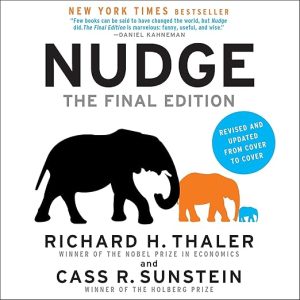
Nudge is one of the rare books that actually changed things. Since Richard Thaler and Cass Sunstein published the original in 2008, more than 200 nudge units have been established in governments around the world. Thaler won the Nobel Prize in Economics in 2017, in part for the work the book represents. The concept of choice architecture, designing the environments in which people make decisions so that better choices become easier rather than mandated, has entered the vocabulary of policymakers, healthcare systems, retirement planning, and consumer behavior research. This audiobook, which Thaler and Sunstein have called the final edition, rewrites the book substantially to incorporate what those years of real-world application revealed, including entirely new domains the 2008 version could not have addressed. Sean Pratt narrates, bringing professional clarity to a text that is already accessible but benefits from assured delivery.
The conceptual core remains. The Econs and the Humans distinction, the economists' idealized rational actor versus actual human beings with predictable cognitive biases, is still the foundation, and the authors are still arguing for libertarian paternalism: the position that it is both possible and legitimate to design choice environments in ways that nudge people toward better outcomes while preserving their full freedom to choose otherwise. That argument is still contentious, and Thaler and Sunstein address the criticisms more directly in this edition than they did in the original. The word 'sludge', paperwork, friction, and bureaucratic obstruction that blocks people from getting what they want, is introduced as the negative counterpart to nudge, and it is a useful conceptual addition that gives the book a sharper critical vocabulary for anti-nudge phenomena.
COVID Compliance Joins the Evidence Base
What distinguishes this final edition from the 2008 original is the accumulated weight of evidence. When the first Nudge argued that defaults matter, that whether someone has to opt in or opt out of a pension scheme dramatically affects enrollment rates, it was making a theoretical case backed by limited real-world data. Now there are decades of nudge units in dozens of countries applying these principles to actual policy, and the authors can draw on that evidence to refine, correct, and strengthen their arguments. The COVID-19 chapter is new and particularly interesting: how do you nudge compliance with public health measures when the stakes are high, the uncertainty is genuine, and the political environment is polarized? The climate change and retirement savings sections are also substantially updated.
One reviewer with deep expertise in behavioral economics described this as one of their favorite books in the field, arguing it is essential for lawyers, managers, leaders, parents, and salespeople, anyone who structures environments in which other people make decisions. That is an accurate account of the book's scope. Choice architecture is not limited to government policy; it operates wherever defaults, framing, and information presentation shape behavior. The retail environment, the school cafeteria, the software interface, the health insurance enrollment form, all of these are choice architectures, and understanding how they work changes how you read every designed environment you move through.
Pratt Handles Both Policy and Punchlines
At 11 hours and 33 minutes, this is a substantial audiobook for behavioral economics content, but Thaler and Sunstein write with deliberate accessibility and a dry humor that makes the length feel manageable. The original book was praised for being easy to read, and the final edition maintains that quality. Pratt's narration handles the tonal range, from technical policy discussion to genuinely funny anecdotes about cab tipping and retirement savings, without losing the intellectual register that keeps the book from feeling like a podcast. The PDF companion available with the audio is noted in the metadata, and visual aids may be useful for some of the more data-dense policy sections.
A second reviewer described the book as generating authentic complexity when pressed on real-world applications, the 'nudge or sludge' distinction becomes genuinely complicated when applied to phenomena we encounter daily, like tip prompts, default subscription renewals, and paperwork requirements for benefits programs. That complexity is not a flaw but a feature: the book provides a vocabulary for analyzing those encounters rather than pretending that nudge is always benign. The authors engage honestly with the line between helpful default-setting and manipulative design, which keeps the argument more interesting than pure advocacy would be.
Libertarian Paternalism Still Draws Fire from Both Sides
Listeners who read the 2008 edition will want to know specifically what is new here. The authors note that the first four chapters are substantially the same, establishing the foundational framework of choice architecture and libertarian paternalism. The majority of new content appears in the expanded chapters on specific domains, retirement savings, healthcare, organ donation, credit, mortgages, and the new additions around COVID-19, climate change, and digital sludge. The final chapters on criticisms of nudge theory are also substantially revised. If you know the original well, the areas of substantive update are the policy application chapters rather than the theoretical framework.
The term 'libertarian paternalism' continues to generate resistance from both directions, libertarians who object to the paternalism and paternalists who object to the libertarian constraints, and the authors address this directly. The argument is nuanced enough that listeners who engage critically with it will find genuine positions to push back on, which is more intellectually honest than books that present behavioral economics as purely value-neutral science. The choice of default matters morally as well as practically, and Thaler and Sunstein are clear about that.
Eleven Hours Made Accessible by Pratt and a PDF
This audiobook serves listeners with any interest in behavioral economics, public policy, organizational behavior, or the designed environments that shape everyday decisions. The 2008 original has already proven its staying power, and listeners who encountered it then will find genuine new substance in this final edition rather than a simple reissue. Those new to the subject will find this a more complete and evidence-rich introduction than the original. The PDF companion makes the audio format more complete for policy-dense sections, and Sean Pratt's narration keeps the intellectual content accessible across more than eleven hours.
How much new content is in this final edition compared to the original 2008 Nudge audiobook?
Thaler and Sunstein describe rewriting the book from cover to cover. The first four foundational chapters are substantially similar to the original. The largest additions are in policy application chapters covering COVID-19, climate change, and digital sludge, plus substantially revised coverage of criticisms and the retirement savings, healthcare, and organ donation domains.
Is a PDF companion available with this audiobook, and is it necessary?
Yes, a PDF companion is included with the audio. For most of the book's content, the audio is self-sufficient. The PDF may be useful for the more data-dense policy analysis sections where visual aids support the argument.
Do I need an economics background to get value from this audiobook?
No prior economics training is required. Thaler and Sunstein write with deliberate accessibility, avoiding jargon and using everyday examples, cab tipping, cafeteria layouts, retirement enrollment, to ground abstract principles. The book is specifically designed for a general educated audience.