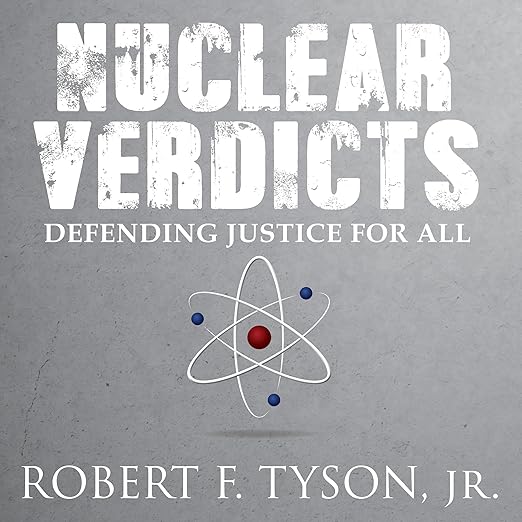
Quick Take
- Narration: Robert F. Tyson Jr. reading his own book brings three decades of courtroom presence to the audio; he speaks like someone who has argued these points to real juries, which makes the material feel tested rather than theoretical.
- Themes: Civil trial strategy, runaway jury verdicts, defense litigation philosophy
- Mood: Assertive and tactical, like a thorough pre-trial preparation session
- Verdict: Whether you are a defense attorney, a corporate risk manager, or simply someone curious about how legal outcomes get shaped before a word of testimony is spoken, Tyson’s playbook is more revealing than most legal nonfiction manages to be.
I am not a lawyer. I am also not the target audience for Nuclear Verdicts, which is written explicitly for defense attorneys and the clients who hire them. And yet I found myself more engaged with this book than I expected, partly because Tyson writes in a way that does not condescend to non-specialists and partly because the mechanics of a civil jury trial, once explained from the inside, turn out to be far more deliberately constructed than most people who have never been in one understand.
Robert F. Tyson Jr. has thirty years of defense trial work behind him, and this book grew directly from that practice. The premise is specific: runaway jury verdicts in civil liability cases, sometimes reaching into the hundreds of millions of dollars, have become what Tyson calls a national epidemic. He believes these verdicts are often the product of plaintiff attorneys’ deliberate psychological manipulation of juries rather than of the facts or the law. His book is a technical response to that problem.
Our Take on Nuclear Verdicts: Defending Justice for All
The organizing framework Tyson builds around is a three-part philosophy: Responsibility, Reasonableness, and Common Sense. The responsibility principle is counterintuitive from a defense standpoint. Tyson argues that defendants and their counsel should acknowledge what they actually did rather than fighting everything. Juries, he contends, respond to honesty about culpability far more favorably than to denial or deflection, and the attempt to minimize every fact burns credibility that would be better spent on the damages argument. This is not the instinctive defense posture, and Tyson knows it. He spends considerable time explaining why the traditional defense approach of contesting every point is a strategic error in nuclear verdict territory.
The reasonableness principle asks defense counsel to be the most measured, human presence in the courtroom. Plaintiff attorneys, Tyson argues, are often expert at generating emotional momentum. The defense’s best counter is not counter-emotion but visible, grounded rationality. The common sense framework is about finding the framework within a case that allows a jury to reach a verdict that feels just by their own standards rather than by the legal standards the instructions describe. This is sophisticated stuff, and it is presented with enough case-specific illustration to feel concrete rather than abstract.
Why Listen to Nuclear Verdicts: Defending Justice for All
Tyson narrating his own work is an asset in this context. He has argued these positions to actual juries, and that experience shows in how he delivers the material. When he describes the voir dire process, opening statement construction, or the art of cross-examination, he speaks with the confidence of someone who has done these things hundreds of times. The audiobook has a professional quality that matches the courtroom authority he describes. One reviewer with direct legal experience described it as well-written, concise, and engaging, which is accurate.
The book is also genuinely accessible to non-lawyers. Multiple reviewers without legal backgrounds described finding it illuminating for understanding how verdicts get shaped before and during trial. The title’s reference to nuclear verdicts might suggest highly technical legal content, but Tyson writes to be understood by anyone who has ever served on a jury or who has had any interaction with the civil justice system.
What to Watch For in Nuclear Verdicts: Defending Justice for All
One reviewer with overall positive impressions noted that some sections felt repetitive and that parts of the presentation occasionally broke the narrative flow. This is a real characteristic of the book. Tyson’s three-principle framework is introduced, developed, and revisited multiple times across the chapters. Whether this feels like reinforcement or redundancy will depend on how familiar you already are with trial strategy. For readers who are new to the subject, the repetition probably serves a clarifying function. For experienced defense practitioners, some sections will feel like review of ground already covered.
The book’s perspective is explicitly and unambiguously pro-defense. Tyson believes that nuclear verdicts represent a systemic problem and that plaintiff attorneys bear significant responsibility for creating conditions in which juries are manipulated rather than guided. This is a position, not a neutral observation. Readers who approach civil litigation from a plaintiff’s perspective, or who see large jury verdicts as an appropriate mechanism for corporate accountability, will find the framing requires some critical distance.
Who Should Listen to Nuclear Verdicts: Defending Justice for All
Defense attorneys and corporate legal departments are the obvious audience. The specific techniques around voir dire, opening statements, witness handling, and closing arguments are directly applicable to professional practice, and Tyson’s track record of thirty years of trial work gives the advice a practical foundation that classroom theory cannot replicate.
Beyond the legal profession, this is genuinely interesting for anyone who wants to understand the mechanics beneath high-profile civil verdicts. The next time a nine-figure verdict appears in the news, the framework Tyson provides for understanding why it happened, and whether it was the product of facts or of courtroom psychology, will change how you read the coverage.
Frequently Asked Questions
Is Nuclear Verdicts useful for non-lawyers, or is it primarily a technical legal resource?
Multiple reviewers without legal backgrounds described it as accessible and enlightening. Tyson writes for defense attorneys but explains enough foundational context that the strategic logic is followable for anyone interested in how civil trials actually work rather than how they are portrayed in media.
Does Tyson’s self-narration add anything specific to the listening experience?
Yes. Tyson has thirty years of courtroom experience and reads with the authority of someone who has tested these arguments in front of actual juries. The performance has a practiced confidence that complements the book’s argument about how credibility is built and maintained in a courtroom context.
Does the book’s pro-defense framing affect its usefulness for readers who are not defense attorneys?
The perspective is clearly and consistently pro-defense, which is worth knowing before you start. Tyson believes nuclear verdicts are often unjust outcomes driven by plaintiff-side manipulation. Readers who disagree with that premise will still find the technical material about trial strategy illuminating, but they will need to engage with the framing critically.
Is this the first book written from a defense perspective on nuclear verdicts?
Tyson describes it as the first book ever written for the defense on how to avoid runaway jury verdicts. Whether that claim is precisely accurate, the book does address a genuine gap in the trial strategy literature, which has historically been more extensively developed on the plaintiff side of civil litigation.