Quick Take
- Narration: Tom Brooks delivers the kind of measured, authoritative read that works well for structured test prep content, clear enough for active listening during study sessions without the distancing effect of overly formal delivery.
- Themes: Law enforcement career preparation, reading and writing proficiency, applied reasoning under pressure
- Mood: Focused and encouraging, the guide maintains a tone of competent preparation without manufactured urgency
- Verdict: A well-rounded 6-hour NPOST preparation guide that covers every exam section with practical strategy, backed by a strong 5-star rating across 49 reviews.
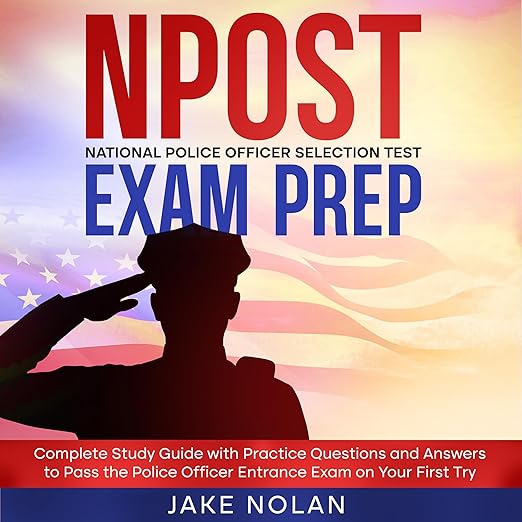
Law enforcement exam prep is a category I find myself returning to partly because of what it reveals about the candidates preparing for these tests. They’re not students with unlimited study time. They’re people working shifts, managing families, preparing for a career transition that requires passing a standardized cognitive and communication assessment that was designed to be genuinely selective. The NPOST, National Police Officer Selection Test, tests reading comprehension, grammar, vocabulary, mathematics, and incident report writing. That’s a broader cognitive sweep than most professional certification exams, and it requires a study guide that can actually teach across all those domains rather than just listing content for them.
Jake Nolan’s guide does that reasonably well within its six-hour runtime. The 5.0 rating from 49 reviews is a meaningful signal in the exam prep category, where reviewers tend to be pragmatic: did this help me pass? That question is asked more often than any other, and a near-perfect rating from nearly fifty people suggests the answer has been yes consistently enough to matter.
Reading Comprehension and Incident Reports: The Two Critical Sections
I want to spend time on the sections the synopsis frames as most developed, because they reveal the most about what this guide understands about the NPOST specifically. The reading comprehension section teaches analysis of passages and identification of key details, standard enough, but the synopsis also mentions teaching candidates to avoid common traps. That’s important. The NPOST reading comprehension section is specifically designed to catch candidates who read too quickly, conflate implied meaning with stated content, or confuse the author’s position with information presented neutrally. A guide that addresses trap avoidance is doing more than content coverage; it’s developing test-taking judgment.
The incident report writing section is where this guide may offer its clearest practical value. Model reports, writing exercises, and tips for clarity and accuracy are exactly what candidates need, because incident report writing is simultaneously the most professionally important skill the NPOST measures and the most difficult to develop through content review alone. The guide provides exercises rather than just examples, which is the right instinct. Knowing what a well-structured report looks like is different from being able to produce one under time pressure.
Mathematics Without the Intimidation
The framing around the math section is worth noting. The synopsis describes breaking fractions, ratios, percentages, and applied reasoning into simple steps, and the explicit acknowledgment that math can be challenging signals awareness that a significant portion of NPOST candidates arrive with math anxiety that interferes with their ability to demonstrate knowledge they actually have. Confidence-building approach is part of the guide’s explicit methodology, not just its marketing language. For a test that includes word problems and estimation tasks under timed conditions, that psychological dimension of preparation is as relevant as content review.
Tom Brooks’ narration handles the mathematical content clearly, which is a specific concern for audio exam prep, numbers, ratios, and percentage calculations can become ambiguous when spoken rather than written, particularly in word problem format. The listening sessions I’ve spent with Brooks across various test prep audiobooks confirm that he paces this kind of content well enough to allow mental calculation without rushing the listener past the relevant figures.
Stress Reduction as a Structured Component
The guide includes explicit treatment of time management, stress reduction, and test-taking strategies as standalone content rather than a brief appendix. For candidates who have not taken a high-stakes standardized test recently, and many NPOST candidates fall into this category, the gap between subject knowledge and exam performance can be substantial. The test environment itself creates interference that study content cannot address. A guide that treats this as a legitimate preparation domain earns credibility with its audience.
The six-hour runtime is appropriate for the scope. It doesn’t try to cover every possible NPOST question type exhaustively but gives candidates the framework to approach each section with a practiced methodology. Whether you’re testing for the first time or retaking, as the synopsis notes, the structure holds: content review, then strategy, then confidence in execution.
Frequently Asked Questions
Does this guide cover the specific incident report writing format required by the NPOST, or a general approach to police report writing?
The guide focuses on the incident report writing section as it appears on the NPOST specifically, including model reports and writing exercises. The emphasis is on clarity, accuracy, and professional structure as evaluated on the exam rather than any particular agency’s specific report format.
How does the mathematics content in this guide address candidates who have been out of school for several years?
The guide explicitly addresses math anxiety and breaks down fractions, ratios, percentages, and applied reasoning into simple steps designed to rebuild confidence alongside content knowledge. The approach is oriented toward candidates who may have practical math skills from work experience but need to reconnect those skills with formal test-taking formats.
Is the NPOST used by all police agencies, or only specific departments?
The NPOST is one of several standardized law enforcement selection tests used across the country, primarily by smaller and mid-sized agencies that don’t administer proprietary tests. The guide notes it is appropriate for candidates pursuing careers in agencies that use the NPOST specifically. Candidates should verify which test their target agency uses before committing to this preparation resource.
Does Tom Brooks’ narration handle the reading comprehension passages in a way that allows active analysis, or does it move too quickly?
Brooks’ pacing is measured and well-suited to study listening. The reading comprehension section requires active cognitive engagement, and the narration provides enough of a natural reading pace to allow the mental processing that comprehension practice demands. Most listeners find his delivery effective for this type of content.