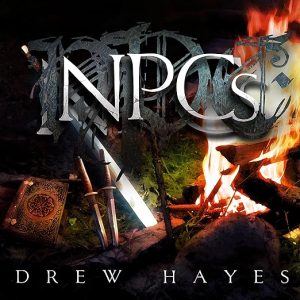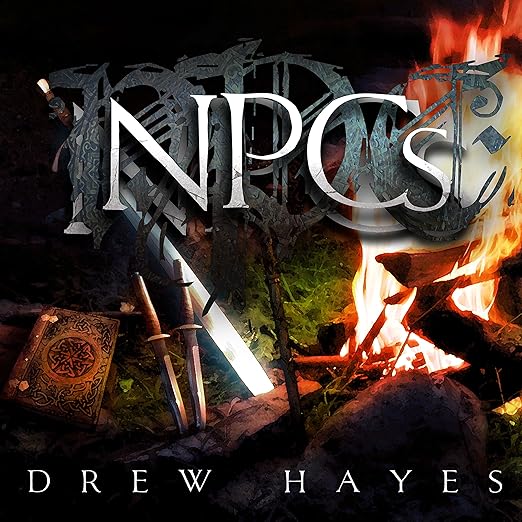
I came to NPCs the same way I suspect a lot of people do: sideways, on a recommendation from someone who described it as funny but not jokey. That distinction matters, and it is the first thing that becomes clear in Drew Hayes's opening chapters. This is not a parody of role-playing games. It is a story told from the perspective of the people who live inside one, and the comedy comes almost entirely from character rather than from genre in-jokes. You do not need to have ever sat around a table with dice to understand what it means to be four ordinary people who have no idea why their world keeps doing strange things.
The setup is quietly brilliant. In the town of Maplebark, a group of non-player characters, an innkeeper, a blacksmith, and two others, are minding their business when a party of adventurers comes through and dies spectacularly. The aftermath leaves these four NPCs with a problem: complete the dead adventurers' quest or watch their town be destroyed. They have salvaged equipment, second-hand knowledge, and no business being anywhere near a dungeon. What they do have is genuine personality, which turns out to be considerably more interesting than heroic competence.
The Review
Hayes understands something about this kind of story that writers who try to be cleverer about it often miss: the joke is not the premise, it is the people. Thistle, Eric, Gabrielle, and Grumph are not archetypes deployed for satirical effect. They are characters with specific fears, specific skills, and specific blind spots. The humor emerges from watching people who are fundamentally unsuited to adventure attempt it anyway with the tools and knowledge they actually have, which is a comedy formula that predates tabletop gaming by centuries. It is, at its core, a story about competence and its absence.
One reviewer drew an explicit comparison to Terry Pratchett's Discworld, noting that NPCs does not quite reach those heights but occupies genuinely similar territory in its willingness to take a silly premise seriously. That feels accurate. Hayes does not mock the conventions of fantasy role-playing; he interrogates them from the inside, which is a considerably more interesting approach. Another reviewer flagged a hint of deus ex machina in the resolution, and that is fair, but it lands within what the reviewer called the delightfully silly premises of the book, which insulates it somewhat.
What Makes NPCs Worth Hearing
Roger Wayne's narration is well-suited to the material. Hayes's comedy depends on understatement and timing, and Wayne does not oversell it. The ensemble cast is differentiated without resorting to exaggerated voice work, which is the right call for a story that wants to be taken at least somewhat seriously. At under eight hours, the audiobook is also refreshingly efficient for a fantasy opener, establishing the world and the characters without overstaying its welcome.
For listeners who are not gamers, the question of accessibility is real and worth addressing directly. The answer is that NPCs works fine without the referential layer because Hayes never actually requires you to understand game mechanics. The rules of the world are explained through the characters' confusion rather than assumed as background knowledge. If anything, coming to it without RPG familiarity might make the ordinary-person stakes land more cleanly.
The Caveats
This is book one of the Spells, Swords, Stealth series, and the ending is designed to invite continuation. Listeners looking for a fully resolved standalone will find enough closure here, but the world and the characters are clearly built to sustain a longer arc. The tonal consistency, warm and comedic without becoming saccharine or cynical, is its biggest asset and the thing most likely to determine whether a listener continues into the series.
Hayes also makes a choice that not all comic fantasy writers are willing to make: he lets the danger be real. The adventurers who die at the start of the story are not just setup. The threat to Maplebark is not a background joke. This keeps the stakes from evaporating even as the humor escalates, and it is a more disciplined piece of craft than the premise might suggest.
Should You Listen to NPCs?
This is a strong choice for listeners who enjoy comic fantasy with genuine heart rather than constant winking at the audience. Pratchett fans who are looking for something in a similar vein but lighter will find a comfortable landing here. Non-gamers can approach it without hesitation. Listeners who require their fantasy to take itself seriously at all times should probably look elsewhere, but anyone willing to spend eight hours with four deeply unqualified adventurers will likely find themselves reaching for book two.
In Brief
- Narrator: Roger Wayne handles the ensemble cast with clarity and dry humor, a good match for Drew Hayes's comedic but never parodic tone.
- Subjects: Role-playing game satire, ordinary people thrust into extraordinary circumstances, the nature of heroism
- Tone: Light, warm, and genuinely funny without tipping into farce
- Bottom line: A deceptively sharp comic fantasy that works whether or not you have ever touched a tabletop RPG, built around a premise that earns its laughs through character rather than reference.
Before You Listen
Do I need to be a tabletop RPG player to appreciate NPCs?
No. Hayes uses the game-world setting as a backdrop, but the humor comes from character and situation rather than from gaming references. Multiple reviewers who describe themselves as casual or non-gamers report enjoying it fully.
How does Roger Wayne handle the ensemble cast of four main characters?
Wayne keeps the four NPCs clearly differentiated without resorting to broad voice acting. His underplayed delivery suits the book's comedic register, which relies on timing and character rather than performance.
Is NPCs a parody of fantasy role-playing games?
It is more of an interrogation from the inside than a parody. Hayes takes the premise seriously enough that the story works as genuine comic fantasy, not just as genre satire. The game-world logic is consistent rather than mocked.
Does the story resolve completely, or does it end on a cliffhanger for the series?
The central quest reaches a resolution, but the world and character arcs are clearly positioned to continue. Most listeners describe the ending as satisfying enough to stand alone while making the sequel appealing.