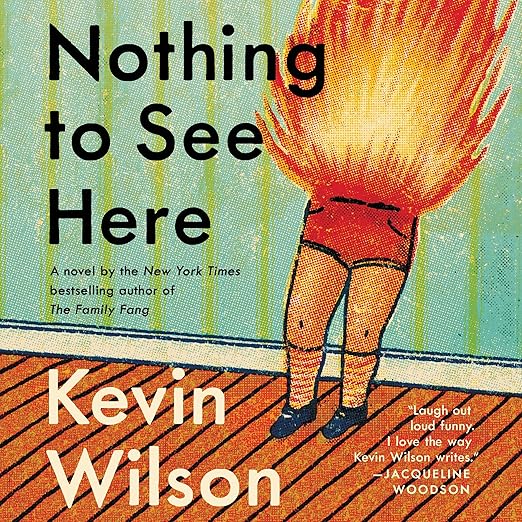
Nothing to See Here
Audiobook & Ebook

Nothing to See Here by Kevin Wilson | Free Audiobook

By Kevin Wilson

Narrated by Marin Ireland

🎧 6 hours and 40 minutes 📘 Ecco 📅 October 29, 2019 🌐 English
🎧 Listen Free on Audible 📖 Read on Kindle

Free 30-day trial · Cancel anytime

About This Audiobook

2020 Audie Winner – Best Female Narrator

An Earphone Award Winner

Audiobook performed by Marin Ireland

A Read with Jenna Today Show Book Club Pick!

“I can’t believe how good this book is…. It’s wholly original. It’s also perfect…. Wilson writes with such a light touch…. The brilliance of the novel [is] that it distracts you with these weirdo characters and mesmerizing and funny sentences and then hits you in a way you didn’t see coming. You’re laughing so hard you don’t even realize that you’ve suddenly caught fire.” —Taffy Brodesser-Akner, New York Times Book Review

Kevin Wilson’s best book yet—a poignant and often humorous novel about a woman who finds meaning in her life when she begins caring for two children with remarkable abilities.

Lillian and Madison were unlikely roommates and yet inseparable friends at their elite boarding school. But then Lillian had to leave the school unexpectedly in the wake of a scandal and they’ve barely spoken since. Until now, when Lillian gets a letter from Madison pleading for her help.

Madison’s twin stepkids are moving in with her family and she wants Lillian to be their caretaker. However, there’s a catch: the twins catch fire when they get agitated, flames igniting from their skin in a startling but beautiful way. Lillian is convinced Madison is pulling her leg, but it’s the truth.

Thinking of her dead-end life at home, Lillian figures she has nothing to lose. Over the course of one summer, Lillian and the twins learn to trust each other while also staying out of the way of Madison’s buttoned-up politician husband. Surprised by her own ingenuity yet unused to the intense feelings of protectiveness she feels for them, Lillian ultimately begins to accept that she needs these strange children as much as they need her—urgently and fiercely. Couldn’t this be the start of the amazing life she’d always hoped for?

With sharp humor and genuine warmth, Kevin Wilson has written his best book yet—a most unique story of parental love.

🎧 Listen Free on Audible

Free 30-day trial · Cancel anytime

Quick Take

  • Narration: Marin Ireland won the 2020 Audie Award for Best Female Narrator for this performance, and she earns it, she plays Lillian’s disaffected exterior and protective tenderness with a precision that the novel depends on.
  • Themes: Nontraditional family and chosen love, class and the costs of privilege, the transformative power of caring for someone else
  • Mood: Wry and quietly devastating, funnier than expected and sadder than it looks
  • Verdict: Kevin Wilson has written a novel that uses an absurd premise to tell one of the most honest stories about class, love, and self-worth that recent American fiction has produced.

I finished Nothing to See Here on a Sunday evening and then sat with the strange feeling that the book had done something to me that I hadn’t consented to. I’d gone in for a quirky character comedy about children who spontaneously combust when agitated. I came out thinking about class, about the particular damage that elite institutions do to the people they discard, and about what it actually means to choose someone. Kevin Wilson has written a novel that wears its absurdism as a kind of cover story for something much sharper.

Narrated by Marin Ireland, whose performance won the 2020 Audie Award for Best Female Narrator, and running six hours and forty minutes, this is a book that delivers its weight incrementally. The first third feels like a comedy. By the final third, something has changed without your quite noticing when it happened. Taffy Brodesser-Akner, writing in the New York Times Book Review, put it perfectly: you’re laughing so hard you don’t realize you’ve caught fire. The metaphor is apt.

Our Take on Nothing to See Here

The premise: Lillian and Madison were close friends at an elite New England boarding school until a scandal, one that reflects far worse on Madison’s family than on Lillian, resulted in Lillian being removed and Madison carrying on into the life of money and advantage she was always going to have. Years later, Madison writes to ask Lillian to come and care for her husband’s twin children from a previous relationship. The catch: Roland and Bessie catch fire when agitated. Actual fire. From their skin. They are, medically and otherwise, perfectly fine afterward.

What Wilson is doing with this premise becomes clear about a third of the way in, when the reader understands that Roland and Bessie’s combustibility is less a fantasy element and more a physical metaphor for what happens to children who feel intensely but have been given no safe container for that feeling. The twins are the children of a woman who died without adequate care, passed between institutions and guardians, caught in the bureaucratic machinery of a politician father’s rising career. Their fire is the honest expression of what they’ve been through. Lillian, who is also, in her own way, someone who burns, understands this in a way that Madison, with all her resources, cannot.

Why Listen to Nothing to See Here

Marin Ireland’s performance is the reason this novel works in audio the way it does. Lillian is not a sympathetic protagonist in the conventional sense, she’s prickly, deliberately self-limiting, and carries the particular bitterness of someone who knows they were smart enough for a different life and was denied it on someone else’s terms. Ireland plays all of that without making Lillian unlikable, which requires the kind of calibration that most actors can’t manage. The warmth she develops toward Roland and Bessie arrives slowly and then becomes the emotional center of the whole book; Ireland tracks that shift so carefully that listeners never feel manipulated by it.

The novel’s humor is essential rather than decorative, and Ireland handles it with a dry precision that matches Wilson’s prose. The comic exchanges between Lillian and Madison, two women who still genuinely care for each other and are separated by a chasm of class and circumstance, are among the best-written dialogue in recent American fiction, and they land with particular force in audio because Ireland understands the difference between a joke that’s also a wound and a joke that’s just a joke.

What to Watch For in Nothing to See Here

The novel’s relationship to genre is genuinely unusual. It’s been shelved as literary fiction, as humor and satire, and as a Read with Jenna book club pick, all of which are accurate and none of which quite capture what it is. Listeners who come expecting a straight comedy will be surprised by the emotional weight. Listeners who approach it as literary fiction expecting gravity will be surprised by how consistently and skillfully Wilson uses comedy as a delivery mechanism for things that would be almost unbearable in a different register. One reviewer described it as “3.5 Super Odd Stars” and wasn’t wrong: the book is genuinely strange, and whether that strangeness resolves into something satisfying depends on how a listener relates to unresolved category tension.

The novel is also not about the combustion in the way that a fantasy novel would be. If you want the children’s fire to be explained, examined, or resolved as a magical phenomenon, this is the wrong book. Wilson is not interested in those questions. The combustion is a given, like grief or poverty, a condition the characters must manage rather than a puzzle they must solve.

Who Should Listen to Nothing to See Here

Readers who like literary fiction that uses absurdist elements seriously, not as genre worldbuilding but as metaphorical pressure, will find this one of the stronger examples in recent years. Fans of Wilson’s earlier work will find this, as the publisher suggests, his best book. The class critique is not subtle but it’s not heavy-handed either; it’s built into the structure of the story rather than stated. Skip it if you want the combustion to be the real subject, or if you prefer emotional transparency to the oblique approach Wilson favors. Come to it if you want something that will still be sitting with you three days after you finish.

Frequently Asked Questions

Does Marin Ireland’s award-winning narration significantly enhance the experience of Nothing to See Here?

Substantially. Ireland’s performance of Lillian’s voice, specifically the balance between defensive bitterness and emerging tenderness, is load-bearing for the novel’s emotional arc. The comedy in the dialogue lands with particular precision in her reading, and the shift in Lillian’s relationship with the twins is tracked with enough subtlety that the emotional payoff feels earned rather than manufactured.

Is Nothing to See Here really a comedy, or does the humor take a back seat to the emotional drama?

Both are present throughout, and Wilson uses them against each other rather than in sequence. The humor is at its highest in the early sections; the emotional weight accumulates gradually. By the end, the comedy hasn’t disappeared but the book’s priorities have clarified. Listeners who want consistent tonal lightness should be aware that the register shifts as it progresses.

How seriously does the novel take its premise of children who catch fire?

The combustion is taken as given, a real physical phenomenon in the world of the novel, but it is never explained or treated as a mystery to be solved. Wilson uses it as a metaphor for emotional intensity and the consequences of being an unloved or inadequately cared-for child. Listeners looking for fantasy worldbuilding around the combustion will not find it.

Is the class critique in Nothing to See Here heavy-handed or does it emerge organically from the story?

It emerges from the structure. The Lillian-Madison dynamic is built entirely on the divergence produced by their boarding school incident, what happened to each of them because of it, what advantages Madison’s wealth provided her and what Lillian was denied. The critique is present throughout but rarely stated directly; it’s in the texture of the characters’ relationship and Lillian’s dry observations about the world Madison inhabits.

Ready to listen?

🎧 Listen to Nothing to See Here for free

Free 30-day trial · Cancel anytime

What Listeners Are Saying

★★★★★

A breeze to read, with deceptively powerful messages on the human condition

I loved this book. I wouldn’t have found it without a recommendation from The Atlantic, which recently featured a segment on “The Great American Novels.” I remember thinking that the premise was absurd, but hey, if the story is good and the characters are interesting, who cares?Of course, Nothing to…

– John M.
★★★★☆

An easy read

An enjoyable read even though it was unrealistic. I mean… kids that catch on fire? Really? Just go with it.

– RetiredProf
★★★☆☆

3.5 Super Odd Stars

This is kind of an odd book to rate. I’m not sure what I feel about it. It’s both really interesting and witty, but also incredibly weird and the sort of thing that leaves you wondering what it was all about.The premise is that chronically disillusioned mess up and underachiever,…

– J-Phi
★★★★★

Love my special kids, and these are really special kids.

I read everything, except bodice rippers. Ask anyone who knows me. But I digress. The story starts out with absolutely no mention of these kids or how special they really are. A grave injustice is done early on, radically changing the course of two lives. The two people involved have…

– Kindle Customer, Voracious Reader.
★★★★★

An Adult/Serious Comfort Read!!!

I had heard good things about this book, but I picked it in a whim, and it's so good!!! The more I think of it, the more I loved it!!! This is a weird little book, but with so much care and love there!!!All the characters are complicated, but you…

– Joana

Start Listening: Nothing to See Here


Free 30-day trial · Cancel anytime

Alexandra Reed

Written by Alexandra Reed

Founder & Literary Critic