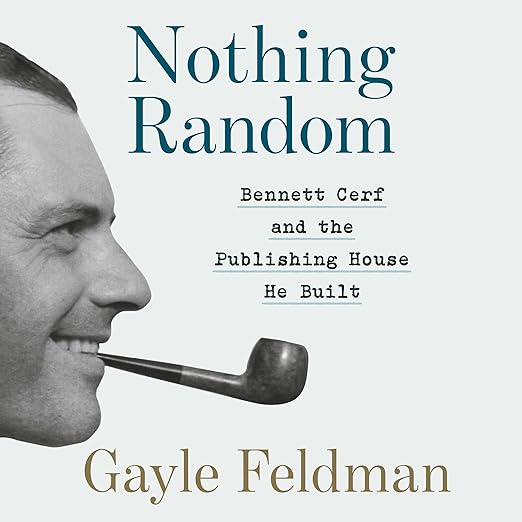
- Performance: Lisa Flanagan brings appropriate authority and warmth to a 35-hour biography, maintaining listener investment across a sprawling cast of literary and cultural figures without losing the connective tissue.
- What it covers: American publishing history, celebrity and influence, the making of literary culture
- Feel: Sweeping and absorbing, with a glamour that feels earned rather than invented
- Our call: Nothing Random is the kind of biography that makes you want to call someone and tell them about it, and at 35 hours it earns that investment by never treating Cerf's story as smaller than it actually was.
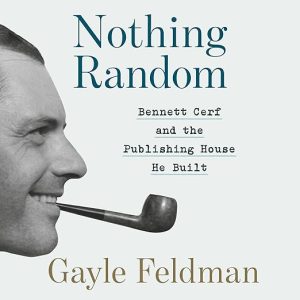
Picture Bennett Cerf at a party in 1935, midway between signing William Faulkner and discovering Dr. Seuss, surrounded by everyone from Truman Capote to Ayn Rand, already famous as a wit and columnist, not yet the television personality who would land in American living rooms via What's My Line? That party is essentially what Nothing Random: A Biography of Bennett Cerf is, and this audiobook narrated by Lisa Flanagan runs for 35 hours and 27 minutes because that party had that many people in it and all of them were interesting. Gayle Feldman's biography of the Random House founder is a New York Times Book Review Editors' Choice for good reason: it is the rare publishing history that reads as American cultural history from the inside.
Flanagan Keeps Two Hundred Voices Distinct
Cerf occupies a peculiar and underexamined position in twentieth-century American letters. He was the publisher who fought the landmark censorship case that allowed Americans to legally read James Joyce's Ulysses, which is a significant enough act on its own. He was also a bestselling author of joke books, a TV celebrity, and a social networker of such relentless energy that his name appears in connection with virtually every cultural moment from the Roaring Twenties through the Swinging Sixties. Feldman tracks this paradox without simplifying it. Cerf was brilliant and occasionally shallow, democratizing and sometimes commercially calculating, a champion of serious literature who understood that celebrity was a tool for selling it.
Lisa Flanagan's narration is calibrated for sustained listening at a book that demands endurance. The 35-hour runtime is not padding; Feldman is working through interviews with more than two hundred individuals plus archival material and letters from private collections not previously available. Flanagan keeps the pacing steady and the voices distinct enough that the enormous cast of supporting figures, from George Gershwin to Frank Sinatra to the Knopfs to Donald Klopfer, register as individuals rather than names to be catalogued. The biography's Washington Post notice that Feldman depicts a lost world, at times a lost paradise, is accurate, and Flanagan's reading captures that elegy without slowing the book into mournfulness.
Reconstructing the Risk Inside the Ulysses Trial
The structure of the biography is largely chronological, and that chronology works as cultural history does when it has a genuinely interesting figure at its center: events accumulate meaning because we know how Cerf sees and processes them. The Modern Library purchase with Klopfer in 1925, made for a pittance, becomes the foundation of everything. The Random House founding generates the publishing house that eventually becomes a home to Toni Morrison, among others. Cerf's TV celebrity through What's My Line? is handled with real intelligence: Feldman does not treat it as a distraction from the serious publisher but as the logical extension of someone who always understood that culture moved through multiple channels simultaneously.
For listeners interested specifically in the Ulysses obscenity trial, the sections covering that legal battle are among the biography's strongest. Feldman is not simply reporting the outcome; she reconstructs the atmosphere of risk involved in publishing Joyce at a moment when the legal terrain was genuinely uncertain, and makes clear what Cerf's decision cost him in reputation and what it ultimately established for American readers. This is the kind of publishing history that matters beyond publishing, and it lands accordingly.
Celebrity and Publishing Fed Each Other
The biography's density is not a flaw, but listeners should plan their listening accordingly. This is not a book to start on a Thursday afternoon expecting to finish by the weekend. The 35-hour commitment rewards attentive listening spread over weeks, and Flanagan's measured pacing actually supports that model: Nothing Random does not rely on cliffhangers or artificial momentum, but on the steady accumulation of a life genuinely well lived and documented. The World War II sections and their impact on publishing and Cerf's business dealings are particularly rich and occasionally surprising in their complexity.
The book's handling of Cerf's contradictions is one of its sustained pleasures. He published Gertrude Stein and Dr. Seuss without apparent concern for the cultural distance between them, and his public persona as the gag-cracking What's My Line? panelist coexisted with the serious literary publisher who defended Ulysses in court. Feldman neither resolves these contradictions into a single thesis about Cerf's character nor leaves them simply as charming paradoxes. She shows how the contradictions were structurally functional: the celebrity fed the publishing, the publishing fed the celebrity, and neither was more authentic than the other. Flanagan reads this complexity with the steadiness it requires.
The Washington Post's observation about Cerf's Jewish identity within the context of the mid-century publishing world, and the related story of his peer group that included the Knopfs and Simon and Schuster founders, is a thread Feldman handles with appropriate care and specificity. This is not incidental context but central to understanding how and why a particular generation of New York publishers remade American reading culture.
Feldman's Method Echoes Caro's Power Broker
Nothing Random is the right audiobook for listeners who want to understand how American literary culture was shaped not just by writers but by the people who decided which writers the public would encounter. Readers who loved Robert Caro's approach to the biography of power, referenced by the New York Times's observation that there is a new Power Broker in town, will find Feldman's method similar in its scope and archival seriousness. Skip this one if you are looking for a quick literary biography; the 35 hours are not optional, and the book earns every one of them by taking Cerf and his era seriously on their own terms.
A Few Questions About Nothing Random
Is the Nothing Random audiobook accessible to listeners without a background in publishing history?
Yes. Feldman writes as a cultural historian as much as a publishing specialist, and the connections she draws between Cerf's work and broader American history, from Ulysses to What's My Line?, make the book readable for anyone interested in twentieth-century American culture.
How does Lisa Flanagan handle the enormous cast of figures in the Nothing Random audiobook?
Flanagan maintains distinct registers for the key figures without resorting to caricature, and her pacing through the longer archival sections is steady enough to sustain attention across the full 35 hours.
Does the audiobook cover Cerf's television career on What's My Line? in depth?
Yes. Feldman devotes substantial attention to how Cerf's TV celebrity intersected with and amplified his influence as a publisher, treating it as an extension of his cultural strategy rather than a separate chapter.
Is Nothing Random worth the 35-hour audiobook commitment for general listeners, or is it primarily for publishing professionals?
General listeners interested in American cultural history will find it fully rewarding. The publishing context is always in service of the larger story about how celebrity, money, and literary ambition intersected across four decades.