
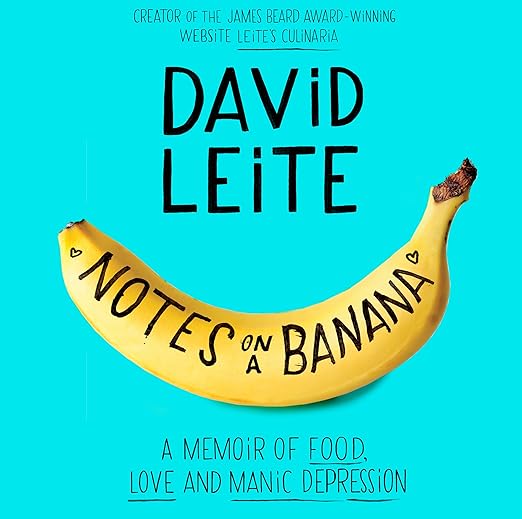
The Short Version
- Read by: Author-performed, which on a memoir this confessional closes the gap between the writing and the listener entirely.
- At its heart: Azorean immigrant childhood, bipolar disorder, a Catholic upbringing and a gay son, food as refuge
- Vibe: Funny, then devastating, often inside the same chapter
- Short version: A memoir that earns every one of its seven name-checked comparisons by refusing to be only one kind of book.
A stove named Thor sits somewhere near the center of this memoir, and the man who named it reads the audiobook himself, which on a book about a voice finding itself is more than a production convenience. David Leite grew up in a Portuguese Catholic household in Fall River, Massachusetts in the 1960s, called Banana by his mother, obsessed with proper hair care and with the swinging kitchen doors he had seen on television, and spent three decades without a name for why his moods moved the way they did.
Food as Coping Mechanism Long Before It Was a Career
Recognition is what the May 19, 2017 response describes, and it is the truest thing anybody on the listing has said about this book. That reader, Portuguese themselves, laughed at the early family scenes and cried at the later ones where his parents were working hard to understand him, and singles out the passages about how he physically felt as eye-opening and written in ordinary language. Both halves of that reaction matter, because the comedy and the clinical detail are not separate registers here.
Food is the through-line rather than the subject, which is the distinction that saves this from the crowded shelf it sits on. Julia Child, a Viking range, the French obsession inherited from a Portuguese and French-Canadian godmother: these arrive as coping mechanisms long before they arrive as a career, and the eventual award-winning website reads as the outcome of a survival strategy rather than an ambition. Very few food memoirs earn their kitchens quite this honestly.
A Cult in Downtown Manhattan to Stop Being Gay
Aesthetic Realism is where the book turns genuinely startling. Leite's attempt to stop being gay took him into what the description names outright as a cult in downtown Manhattan, and that stretch of the story is the reason this belongs on a different shelf from the celebrity chef memoirs. Nothing about it is played for shock. It is simply what a young man raised devoutly Catholic in the 1960s did with a self he had been taught to consider a fault.
Measured Against Sedaris, Bourdain, and Five Others
Longtime readers of his site get the most immediate reward, and the April 19, 2017 response says exactly why: for somebody who has followed the writing for years and known the partner only as The One, the book finally opens the private life at full size. That same response mentions owning his Portuguese cookbook, which is the profile of the audience this was written for first. The material works without that history, though it lands differently with it.
Comedy and grief take turns at close range, and the oscillation is the book's real technical achievement. A joke about hair care sits minutes away from an undiagnosed depressive episode, and neither undercuts the other. Writers attempt that constantly and usually produce whiplash. What keeps this steady is that the humor comes from the same place as the pain, which is to say from a child paying very close attention to a household he did not fit inside.
Comparisons in the description are ambitious and mostly earned. An Unquiet Mind gets invoked for the bipolar material, Ruth Reichl and Anthony Bourdain and Gabrielle Hamilton for the food, Augusten Burroughs and David Sedaris and Jenny Lawson for the comic voice. That is seven names to live up to. The book matches none of them exactly, which is rather the point, since the combination is what makes it unusual rather than any single ingredient.
Track Nineteen Breaking Into Static Before the End
One three-star response reports a genuine defect, and for a buyer it is the most important thing on this listing. That entry describes the nineteenth track of the final disc breaking into noise and static for several minutes, right before the epilogue, leaving the listener with no idea how the story ends. It was posted about a physical edition, so it may well not touch the download, but on a memoir whose ending carries the emotional payoff, check the last chapter early rather than late.
Nearly twelve hours of continuous first-person confession is a long stretch, and the book does not pace itself for anybody taking it in one go. The childhood section is dense with family, the middle carries the diagnosis, and the closing movement covers a twenty-three-year relationship. Taken in evening-sized pieces it is very good company. Taken end to end, the accumulation of self-examination gets heavy well before the epilogue arrives.
Alignment between the written responses and the overall score is unusually tight, which almost never happens. The five written grades average exactly what the full pool of 164 does, so for once the visible sample is representative rather than flattering. Worth mentioning because the same listing files a memoir about mental illness and sexual identity under home and garden, which suggests the shelving was done by an algorithm having a bad afternoon.
Leite's Rare Memoir Works Better With Food
Anybody who grew up feeling structurally wrong inside an otherwise loving family should hear this, and an April 2018 response makes the case better than a critic can, describing the relief of feeling normal on discovering that somebody else had been through the same things. That is the specific service this book performs. It also belongs with listeners working through a diagnosis of their own, or living alongside somebody who is.
Grief-averse listeners should be warned that the funny parts are a delivery system. The cult chapters, the undiagnosed years, and the parents trying to understand a son they had no vocabulary for are all handled with warmth, but they are handled at length. Anyone shopping for a light culinary memoir with recipes and restaurant anecdotes has picked up something considerably more demanding by mistake.
Leite has written the rare memoir that would work without the food and is better with it, and the choice to perform it himself removes the last layer of distance between the story and whoever is listening. Sample the closing chapter before you settle in, given what one listener reported about the ending, and then give the book the run of evenings it deserves rather than a single long sitting.
Frequently Asked Questions
Does David Leite narrate the Notes on a Banana audiobook himself?
He does, and it matters more than usual. This is a memoir about a boy taught that his own instincts were a fault, so hearing the story in the voice that eventually claimed it removes a layer of mediation. Hired readers do many things well; they cannot do that particular thing.
How much of the audiobook is actually about cooking?
Less than the title and the author's reputation suggest. Food runs through the whole book as refuge and eventually as a career, but the spine is family, faith, sexual identity, and a late diagnosis. Expect kitchens to appear as emotional shelter rather than as recipes or restaurant reporting.
What is the emotional range of this audiobook?
Wide, and it swings fast. The five-star response from April 25, 2017 describes laughing out loud at several points and being moved to tears by the ending, which matches the structure: comic childhood set pieces early, and the cost of those years accounted for in full toward the close.







