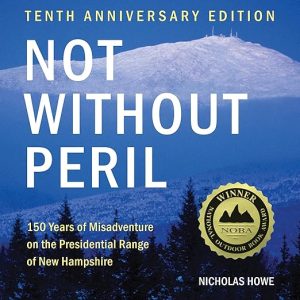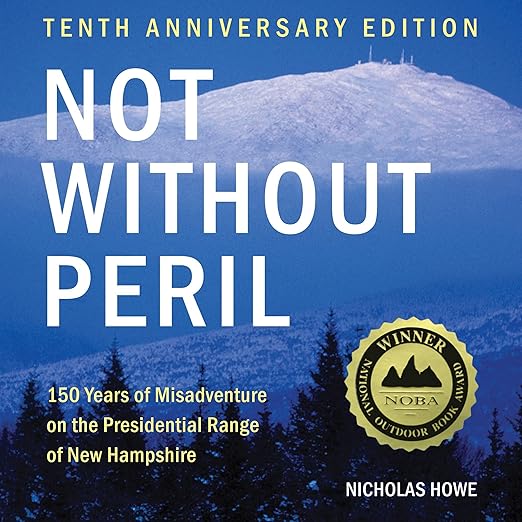
I started Not Without Peril on a Saturday morning while reorganizing my bookshelves, which felt like exactly the wrong context about thirty minutes in. This is not background listening. It is the kind of audiobook that keeps pulling focus back to itself because the material is too specific and too serious to process peripherally. By the time I reached the second or third case study, I had stopped moving boxes and was sitting on the floor with the book playing into earbuds, giving it the attention it demands. I stayed there for the better part of two hours before the day's obligations intervened.
Mount Washington is 6,288 feet tall. That height is unremarkable by global standards, many popular hiking destinations in the American West exceed it comfortably. What distinguishes Mount Washington is its weather, specifically its wind. For decades the summit held the world record for the highest wind speed ever recorded at a surface weather station: 231 miles per hour, measured in 1934. The mountain is subject to rapid, violent weather changes that catch people who have underestimated it, and Nicholas Howe has spent this book documenting what that underestimation looks like across nearly 150 years of recorded misadventure.
Our Take on Not Without Peril (Tenth Anniversary Edition)
The structure of Not Without Peril is chapter-length case studies of individual incidents or small groups of incidents, arranged roughly chronologically from the 19th century through to the period of first publication. The approach means that the book accumulates its argument inductively: not through a thesis about what kills people on Mount Washington but through the patient documentation of what actually killed specific people, and why.
One reviewer's observation that White Mountain deaths are usually due to underestimation while Everest deaths are often due to circumstances beyond climbers' control is one of the most useful frames for understanding what Howe is doing here. The mountain's relative accessibility, it is, after all, drivable, with a road to the summit, creates a false impression of manageability that genuinely experienced high-altitude climbers rarely carry into more objectively dangerous environments. The gentlefolk of the 19th century ascending in hoop skirts and wool suits are not as different from some of the 21st-century casualties as they might appear.
Why Listen to Not Without Peril (Tenth Anniversary Edition)
The edition reviewed here is the tenth anniversary version, which includes a new afterword from Howe describing an evening he spent at the Mount Washington Observatory while 160-mile-per-hour winds raged outside. The afterword is worth noting for listeners deciding between editions. It provides a first-person account of the mountain's conditions that complements the case-study structure of the main text, grounding the historical and reported accounts in one writer's direct physical experience of what Mount Washington's weather actually feels like from inside a building that is built to withstand it.
The Boston Globe recognized the first edition as one of the 100 Essential New England Books, and the Banff Mountain Book Festival gave it acclaim for its gripping accounts of exploration and tragedy. These are not the usual endorsement categories for a regional outdoor nonfiction book, and the recognition reflects the quality of Howe's writing, which never slides into disaster-tourism sensationalism or dry accident-report prose.
What to Watch For in Not Without Peril (Tenth Anniversary Edition)
The narration requires a careful calibration that Douglas James mostly achieves. These are deaths, sometimes deaths from obvious mistakes, sometimes from extraordinarily bad luck, sometimes from a combination, and the narrator must hold them with appropriate weight without making every chapter feel like a funeral. James's delivery has a measured quality that suits the documentary register, and he navigates the tonal difference between the 19th-century accounts, which have a certain Victorian distance, and the more recent cases, which are closer in time and feel more uncomfortably recognizable.
At eleven hours and twenty-seven minutes, this is a long listen for a nonfiction account of a single mountain's accident history, but the chapter structure means it can be taken in sections without losing the thread. Multiple reviewers describe it as a book that keeps them awake rather than putting them to sleep, which is testimony to how effectively Howe builds tension within the constraint of known outcomes.
Recommended For
Not Without Peril is essential listening for anyone who hikes or plans to hike in the White Mountains of New Hampshire. It is also valuable for hikers in other mountain environments, particularly those accustomed to well-marked trails in areas with more predictable weather, who may not have developed appropriate calibration for rapidly changing alpine conditions. Readers interested in accident analysis, outdoor risk management, or regional New England history will find it absorbing regardless of personal hiking experience. The content involves detailed accounts of deaths, including some that are protracted and painful, so listeners sensitive to that kind of material should approach it knowing what they are committing to.
At a Glance
- Performance: Douglas James brings a documentary gravitas to the case studies, neither sensationalizing the deaths nor draining the urgency from accounts where it belongs.
- What it covers: Human error versus mountain conditions, the gap between perceived and actual risk, the democratization of mountain access
- Feel: Somber and absorbing, with the specific tension of knowing each chapter will end badly for someone
- Our call: A sustained examination of why people die on Mount Washington that respects both the mountain and its victims enough to avoid easy explanations.