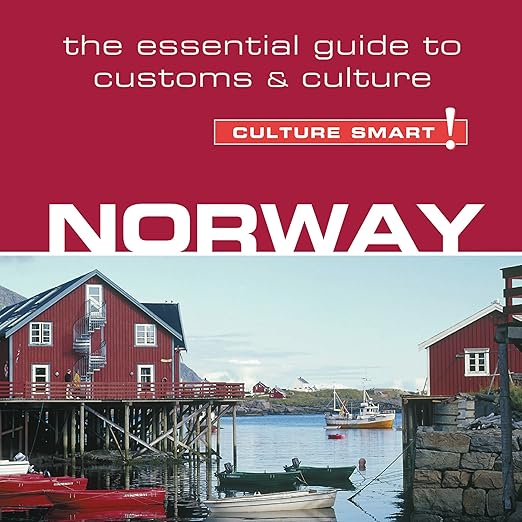
The Short Version
- Performance: Peter Noble reads clearly and at a pace suited to the practical reference nature of the content, without affectation.
- What it covers: Norwegian social customs, janteloven and egalitarianism, business and personal etiquette
- Feel: Compact and informative, reassuringly practical
- Our call: A reliable orientation guide for travelers to Norway, best treated as preparation rather than a substitute for deeper cultural reading.
I have a fondness for the Culture Smart series as a category. They exist in the honest space between tourist guide and serious cultural study, aiming for practical usefulness rather than scholarly depth, and when they are well-executed they give you exactly what they promise: the knowledge to avoid embarrassing yourself, to understand why people around you are behaving as they do, and to build rapport rather than accidentally signaling disrespect. The Norway volume, written by Linda March and narrated by Peter Noble, sits comfortably in that functional tradition.
At three and a half hours, it is a lean listen. I finished it in two commuting sessions and found that the format worked better for this kind of material than I expected. Culture Smart books are often used as reference texts, dipped into for specific sections, and there is something to be said for absorbing the whole argument in audio form before a trip rather than reading it piecemeal. You come away with a more integrated sense of Norwegian character than you might from browsing chapters.
How Norway - Culture Smart! Holds Up
March structures the guide around the questions a visitor actually needs answered: how Norwegians use space, why directness in professional settings reads differently here than in other European countries, what the janteloven concept means for social interaction, why Norwegians are often described as reserved but reveal genuine warmth in the right contexts, and what practical expectations you should have for business meetings, social invitations, and everyday encounters. One reviewer noted that after reading the book they understood why their Norwegian professor behaved in particular ways, choosing hotels with open space, swimming in cold water, going on long hikes after professional meetings. That kind of specific recognition is what these guides do well.
The historical section covers the essentials without overstaying. You get enough context about Norway's relationship with Denmark, Sweden, and Germany, its relatively recent full independence, and its petroleum economy to understand why the country carries both genuine pride and a certain caution about how it presents itself internationally. The egalitarianism that pervades Norwegian social life, a seriousness about flat hierarchy that can feel unfamiliar to visitors from more status-conscious cultures, is traced to sources rather than simply described as a cultural quirk.
Why Listen to Norway - Culture Smart!
Peter Noble narrates with the pleasant competence of a professional reader who understands that this kind of content needs to be clear and paced for retention rather than emotionally inflected. There is no performance here, which is exactly right. You are listening for information, and Noble delivers it without getting in the way. The Norwegian words and place names are handled confidently, which matters when you are preparing to actually use some of this knowledge in conversation with Norwegian hosts.
Reviewers who have used the Culture Smart series for multiple countries consistently mention the format as one of their reliable travel preparation tools, and this volume lives up to that reputation. For anyone about to spend time in Norway for work or extended tourism, the section on business culture is particularly applicable. Norwegian directness in professional settings, the discomfort with performative hierarchy, and the preference for consensus over top-down decision-making are all specific enough to be immediately useful.
What to Watch For in Norway - Culture Smart!
The brevity is an asset for travelers who need quick preparation and a genuine limitation for anyone who wants cultural depth. March covers the necessary terrain without much room for nuance, and on some topics, particularly the regional variation within Norway, the guide is necessarily reductive. Norway is a large, geographically diverse country with meaningful differences between its cities, its coastal communities, and its inland and northern areas, and a three-and-a-half-hour guide cannot do justice to that variety.
The publication date of 2016 is worth noting. Norway has continued to evolve, and some of the cultural observations about digital life, immigration, and the changing demographics of Norwegian cities will reflect the country as it was a decade ago. The core values and social customs tend to evolve slowly, so the fundamental orientation is likely still sound, but travelers should supplement with current sources for context on specific contemporary issues.
The Right Listener for Norway - Culture Smart!
This audiobook serves travelers preparing for a first visit to Norway, whether for business or personal reasons, and professionals about to engage with Norwegian counterparts who want to understand the cultural context behind communication styles and professional norms. It works well as a preliminary listen before more substantial reading about Norwegian history, literature, or geography. Those seeking deep cultural analysis, academic treatment of Norwegian society, or detailed regional specificity will need to look beyond this series. For practical orientation before arrival, it does its job reliably and efficiently.
Good to Know
Is the Norway - Culture Smart! audiobook useful for business travelers specifically, or is it primarily aimed at tourists?
It covers both effectively. The guide dedicates specific attention to Norwegian professional culture, including the discomfort with performative hierarchy, consensus-based decision-making, and direct communication styles in business settings. Reviewers have found this section particularly applicable for professional contexts.
Can you listen to this audiobook as a reference, or does it work better as a continuous listen?
The audio format works best as a complete preparatory listen rather than a reference tool, since navigating to specific sections is harder in audio than in print. The three-and-a-half-hour runtime makes a complete listen before travel practical, and you emerge with a more integrated sense of Norwegian culture than you might from browsing chapters of the print version.