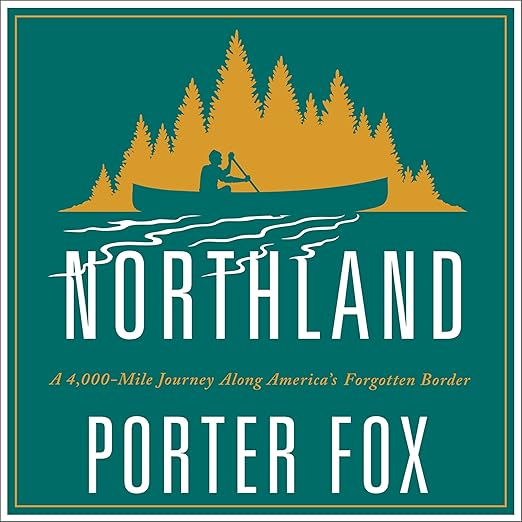
Porter Fox spent two years traveling nearly four thousand miles along the U.S.-Canada border by canoe, freighter, and car, and the resulting audiobook earns its subtitle as equal parts history and travelogue rather than leaning fully into either. Northland covers ground literally and figuratively, Samuel de Champlain's original explorations, the boom-and-bust cycles of the iron, wheat, and timber industries, a Great Lakes freighter crossing, and the fur trade routes through the Boundary Waters, while also profiling contemporary border guards, Indigenous activists, and militia leaders Fox met along the way. At nine hours and nine minutes, narrator Jonathan Yen has real room to let both registers, historical narrative and present-tense reportage, breathe without rushing either one.
The Review
What makes Northland distinct from a standard travel memoir is how much weight Fox gives to the region's human history before he ever gets in a canoe. Chief Red Cloud of the Lakota Sioux, railroad tycoon James J. Hill, and Meriwether Lewis all appear as recurring reference points across the book, anchoring Fox's present-day observations about the Standing Rock Sioux Reservation and Montana's Medicine Line country in a much longer historical arc. Reviewer Jeff Titelius calls it 'a modern-day pioneer's journal,' and that description captures the book's real ambition: this is not simply a list of scenic stops but an attempt to understand how the northern border came to mean what it means today.
Fox does not stay neutral, and reviewer Mr. Stuff flags this directly, finding the book 'a little preachy at times' on questions of climate change and environmental protest, while also noting the irony of environmentalists who 'protest against damaging the planet, yet leave trash behind.' That tension is worth naming upfront: Northland has a clear point of view about water wars, border security, and climate change wracking the region, and listeners expecting pure travelogue without editorial perspective should know the book leans opinionated in its second half.
The industrial history Fox traces, the rise and fall of iron, wheat, and timber economies along the border, functions as more than backdrop; it explains why so many of the towns and communities he visits exist at all, and why some are now hollowed out while others adapted. That economic throughline gives Northland a structural backbone beneath the travel narrative, connecting Samuel de Champlain's earliest explorations to twenty-first-century water disputes as stages in one continuous story of a region defined by what could be extracted from it and by who controlled the boundary running through it.
James J. Hill, the railroad tycoon whose Great Northern Railway shaped so much of the region's early economic development, gets treated by Fox as a case study in how private capital and public land intersected to physically build the modern northern border's infrastructure, roads, rail lines, and towns that still define the region's map today. That kind of specific historical figure study, rather than broad generalization, is characteristic of how Northland balances big-picture themes with grounded, named detail throughout its runtime.
Why Listen to Northland
Jonathan Yen has handled ethnographic and military history material before, including a well-regarded turn narrating T.R. Fehrenbach's Comanches, and that same steady, respectful register serves Northland's passages on Lakota history and border tribal communities well. Travel narration lives or dies on whether a narrator can shift between landscape description and historical exposition without either one going flat, and a narrator experienced with dense, multi-thread nonfiction is a reasonable match for a book juggling this many historical threads at once.
Connor Fine's review calls Northland 'one of my favourite non fiction books' and specifically praises how fast the book reads despite its scope, crediting both the informational content and the adventure-narrative momentum. At over nine hours covering explorers, industries, and contemporary border politics across a four-thousand-mile stretch, that pacing claim matters: a nonfiction audiobook this structurally ambitious could easily feel like a list of disconnected facts, and the reviewer consensus suggests Fox's actual travel narrative keeps pulling the history forward rather than letting it stall.
The Great Lakes freighter crossing Fox describes gets specific, sensory attention in the source material, the scale of these vessels, the isolation of the crew, the industrial rhythm of moving raw materials across fresh water seas larger than some countries, and that kind of detail-rich reportage benefits from a narrator willing to slow down rather than summarize. Long-form nonfiction narrators who can distinguish between a passage meant to move quickly and one meant to let a specific image land are the ones who serve travel writing like this best.
The Caveats
This is not a light beach-read travelogue, and listeners going in expecting only scenic description of Glacier National Park and freighter crossings should recalibrate: significant stretches address heavy contemporary issues, water rights disputes, border militarization, the long aftermath of Indigenous displacement, alongside the more purely adventurous canoe-and-freighter sections. Fox weaves history, politics, and personal travel narrative together rather than keeping them in separate chapters, which rewards a listener willing to follow a more associative structure than a strict itinerary would offer.
Mr. Stuff's three-star framing, 'part history class, part a traveler's journey,' is a fair description of the tonal mix a prospective listener should expect. Anyone who found Fox's opinions on environmental protest heavy-handed in the print reviews should know that perspective carries through into the audio edition unchanged; this is source material with a point of view, not a neutral survey of the northern border's geography and history.
Readers who enjoyed border-focused nonfiction that blends personal travel with historical and political reporting will recognize the structural approach here, alternating between Fox's own canoe-and-car journey and deep dives into topics like fur trading routes or Indigenous displacement. The book asks for patience with that alternating structure rather than delivering either a pure adventure narrative or a pure history in isolation, and listeners most engaged by one mode over the other should expect some chapters to hold their attention more than others.
The Right Listener for Northland
Northland suits listeners who enjoy travel writing anchored in real historical research, in the tradition of a book that treats a journey as an excuse to dig into everything the landscape has witnessed rather than just describing what it looks like now. Anyone interested in Indigenous history, the U.S.-Canada border specifically, or contemporary water and climate politics in the northern borderlands will find substantial material here well beyond the canoe-trip framing device.
Skip it if you want a purely scenic, low-conflict travel listen; Fox's willingness to editorialize about environmental hypocrisy and border politics means this is not background listening for a relaxing drive. Listeners specifically allergic to any political framing in their nonfiction should sample a chapter first, since the book's tone shifts noticeably once the narrative moves past the purely historical material into contemporary advocacy.
The Short Version
- Narration: Jonathan Yen brings the same steady, respectful register he has used for dense ethnographic history to Fox's border narrative.
- Themes: U.S.-Canada border history, Indigenous history, climate and water politics
- Mood: Adventurous but opinionated, part travelogue and part argument
- Verdict: A rich, well-researched border travelogue for listeners who want history and politics alongside scenery, not a neutral scenic tour.
Does the Northland audiobook cover the entire U.S.-Canada border?
Yes, Porter Fox traveled the nearly four-thousand-mile border by canoe, freighter, and car, and the audiobook follows that route from the Great Lakes through Glacier National Park and the Boundary Waters.
Is this audiobook more history or more travel memoir?
It genuinely blends both, weaving explorer history, industrial history, and Indigenous history into Fox's present-day travel narrative rather than keeping the two strands separate.
Does Northland take a political stance on border and climate issues?
Yes, reviewers note the book leans opinionated on climate change, water rights, and border security, particularly in its second half, rather than staying strictly neutral on those questions.
How long is the Northland audiobook?
It runs nine hours and nine minutes, giving narrator Jonathan Yen room to handle both the historical narrative sections and the present-tense travel reportage without rushing either.