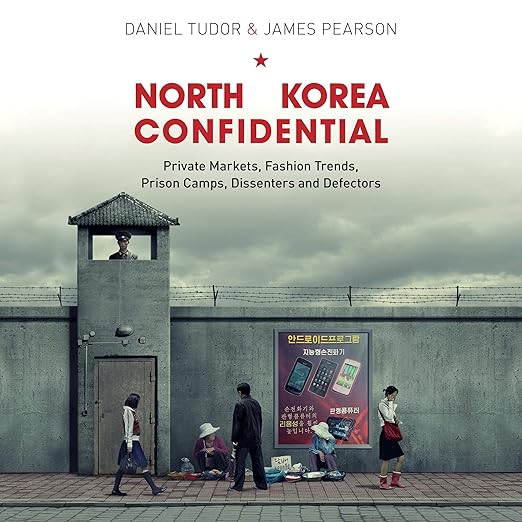
Quick Take
- Narration: Derek Perkins delivers the material with measured, appropriate authority for serious geopolitical nonfiction; his restraint is exactly right for this subject.
- Themes: Underground capitalism under totalitarianism, information penetration via USB and K-pop, the sociology of the songbun caste system
- Mood: Sobering and revelatory, occasionally claustrophobic in the best documentary sense
- Verdict: One of the more grounded portraits of everyday North Korean life in audio; the 2015 research base is a real limitation but not a disqualifying one.
I came to North Korea Confidential on the recommendation of someone who had spent time working in East Asia and found most Western journalism about the country frustrating for its habit of reducing everything to the Kim family and nuclear warheads. Tudor and Pearson’s book was their antidote, and I understand why. I finished it during two evening sessions, and I spent the second one regularly pausing to look things up, which is a reliable sign that the material is doing its job rather than simply confirming what you already know.
Daniel Tudor and his co-author James Pearson draw on an unusual network of sources: defectors from multiple time periods and regions, diplomats, NGO workers, cross-border traders from China, and a range of Korean and Chinese texts that rarely make it into English-language accounts of the country. The resulting portrait is organized around seven themes rather than a straight chronological narrative, which means the audiobook has the feeling of a series of connected dispatches rather than a unified argument with a single conclusion. Derek Perkins’s narration suits this structure well; he reads with the even, unhurried tone of someone presenting evidence rather than performing conclusions he has already reached.
The Famine as the Turning Point
The most historically significant insight Tudor develops is the role the 1990s famine played in transforming North Korean society from the ground up. The collapse of the state distribution system forced ordinary people to find other means of survival, and the informal markets that emerged were not simply economic innovations; they were the beginning of a social reorganization that has been quietly challenging the regime’s control ever since. The songbun caste system that one reviewer identified as a key to understanding Korean society comes into sharper focus here: who survived the famine, and how, was not random. The system’s internal logic, with its inherited loyalties and hereditary classifications determining access to food and resources, shapes daily reality in ways that outsiders rarely grasp from political reporting alone.
This is not a comfortable story to tell because it requires holding two things simultaneously: the horror of mass death and the strange, unintended resilience that emerged from it. Tudor does not flinch from the horror, but he is equally serious about documenting what changed in the famine’s aftermath. The North Korea he describes is not the hermetically sealed monolith of Western stereotype. It is a society with an underground economy, a functioning black market for information, and a population that has learned to navigate and partially evade the surveillance apparatus it nominally lives under.
USB Sticks and the Limits of Information Control
One of the most striking sections of the book addresses how South Korean dramas, K-pop, and foreign films are entering the country through USB sticks and micro SD cards smuggled across the Chinese border. This is not a marginal phenomenon: it represents a systematic erosion of the regime’s information monopoly, and Tudor is careful to distinguish between what ordinary citizens actually consume privately and what they perform publicly for the benefit of state surveillance. The gap between those two things is one of the more fascinating aspects of daily life he documents, and it suggests a population that is considerably more sophisticated about information management than its government would prefer or publicly acknowledge.
The most substantive criticism of the book, which a thoughtful reviewer articulated clearly, is that the sourcing skews toward a relatively narrow social stratum: people connected enough to have interacted with the diplomatic and NGO world Tudor accessed. The lives of the most isolated rural poor are necessarily less visible here. The 2015 research base also means some observations have been overtaken by subsequent developments. Tudor is more transparent about these limitations than most authors writing on this subject, which helps calibrate expectations appropriately.
What Derek Perkins’s Narration Contributes
Narration choices matter particularly in geopolitical nonfiction because the subject matter is inherently charged, and a narrator who editorializes through tone can subtly distort the listener’s relationship to the evidence being presented. Perkins avoids this completely. His delivery is measured, authoritative, and consistently neutral, which allows the material to make its own case without additional emphasis. The seven-chapter structure benefits from his willingness to reset the register at each new theme rather than carrying accumulated editorial weight from one section to the next.
At four hours and forty-five minutes, the runtime is efficient without feeling rushed. The book’s thematic organization means individual chapters can be revisited for reference without losing the thread of the larger argument, which makes this a useful audiobook for listeners who may want to return to specific sections on North Korean economics or information infrastructure rather than experiencing it purely as a linear listen.
Right Listener, Wrong Listener
Listen if: You want to understand North Korean society beyond the nuclear standoff headlines, you are already somewhat familiar with the Korean peninsula’s history and want to go deeper, or you are interested in how ordinary people adapt to and partially subvert authoritarian systems in ways that rarely make formal histories.
Skip if: You want an up-to-the-minute account reflecting developments from the last several years, you need a narrative rather than a thematic social portrait, or you find geopolitical nonfiction without a strong story spine difficult to follow over audio.
Frequently Asked Questions
How dated is North Korea Confidential given that it was researched around 2015?
The core social dynamics Tudor documents, including informal markets, information penetration via USB, and the songbun caste system, remain relevant. Specific details about technology access and political developments will have shifted, so treat it as a foundation rather than a current account.
Does Derek Perkins’s narration add anything to the material, or is it purely neutral delivery?
Perkins reads with measured authority and does not inject opinion or editorial overlay. For geopolitical nonfiction this charged, that restraint is the right call; the material makes its own case without performance emphasis.
Is this book primarily about the Kim regime and nuclear politics, or about ordinary North Korean life?
Deliberately more about ordinary life. Tudor explicitly frames the book as a portrait of the man and woman on the street. The Kim family appears but is not the central focus, which distinguishes this from most Western coverage of the country.
Is North Korea Confidential available as a free audiobook?
It is listed at $0.00 for eligible Audible members. If you have not started an Audible membership yet, you can access this free audiobook through a new member trial. Check the current listing for availability in your region.