Quick Take
- Narration: Johnathan McClain is, as always with Noobtown, the reason this series works as well as it does in audio, his Jim is pitch-perfect self-deprecating exhaustion, and the post-Demon-Door disorientation of this volume suits his range.
- Themes: Identity after catastrophic loss, the value of what you’ve built vs. the cost of returning to it, LitRPG reset mechanics as emotional metaphor
- Mood: Warmer and more reflective than earlier entries, though the dad jokes and chaos-demon energy are fully present
- Verdict: The most emotionally resonant entry in the Noobtown series, Rimmel uses the game-plus reset structure to actually interrogate what Jim wants, not just what Jim does.
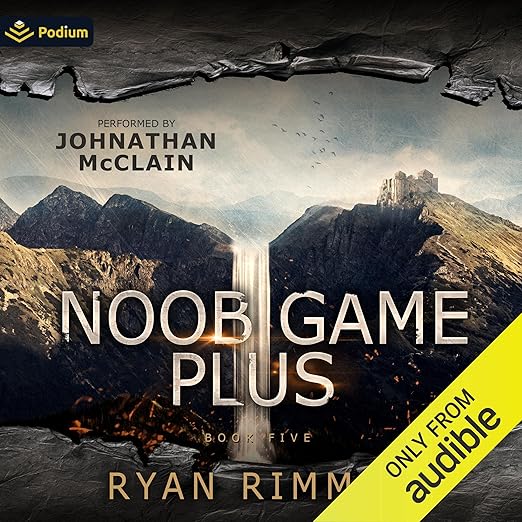
I came into Noob Game Plus having listened to the four previous Noobtown books in quick succession over a couple of weeks, the kind of binge that makes a series feel like a continuous space you inhabit rather than a sequence of books you consume. So when this volume begins with Jim on the other side of the Demon Door, stripped of Shart and Badgelor, back where he started, I felt the disorientation alongside him in a way I probably wouldn’t have if I’d spaced out my listening. That’s not an accident. Ryan Rimmel has been building toward this structural choice across the whole arc, and the New Game Plus framing, the video game concept of restarting with accumulated experience but without accumulated companions, turns out to be emotionally resonant in a way that earns the series’ best reviews.
The central question this volume asks is also the right one for book five: after Jarra’s death, is Windfall even what Jim wants anymore? That’s not a comedic question. It’s a question about grief and purpose and whether the thing you built can survive being built partly out of someone who is no longer there. Rimmel wraps it in dad jokes and a magic system and the ongoing chaos of shoulder-demon Shart, but the substance of the emotional arc is serious, and it’s handled with more directness here than in any previous volume.
The World Beyond Windfall
One of the consistent limitations of the Noobtown series through book four was that Windfall’s internal politics and geography were richly developed while the broader world felt like backdrop. The Demon Door reset forces Rimmel to actually take Jim outside the city and show what else exists. One reviewer specifically praised this expansion, we learn a bit about the rest of the world, not too much, but enough, and that’s the right calibration. The series’ charm is rooted in the particular textures of Windfall and the specific population Jim has accumulated there. The outside-world material works best as contrast, not replacement.
The fast choices Jim has to make in the early post-Door chapters give the book a more compressed urgency than the city-management plotting of earlier volumes. Jim stripped of his support structures is a different kind of character than Jim embedded in them, and Rimmel uses that contrast to show what Windfall and its inhabitants have actually done to him, how much he has changed from the man who stumbled through the door in book one, without quite realizing it.
When the Comedy Earns Gravity
A reviewer called Noob Game Plus the best in the series and noted they would give it ten stars if they could. That’s the kind of hyperbolic enthusiasm series fans generate, but in this case it’s tracking something real. The jokes in this volume are as good as they’ve been, the dad jokes land, Shart’s absence is itself a running gag about absence, the magic system produces its usual ridiculous internal logic, but the comedy here is doing structural work that earlier books didn’t ask of it. When Jim is funny about his situation in Noob Game Plus, it is often funny in the way that people who are grieving become funny: as a mechanism for surviving the unbearable.
The groundwork laid for the next book, Nautical Noobs, is evident in retrospect but doesn’t distract from the present narrative. Rimmel has grown as a plotter, and the architecture here shows it. The callbacks to previous books work as emotional resonance rather than fan service.
McClain’s Most Demanding Noobtown Performance
The Jim in this volume is more internally complicated than any previous version, and Johnathan McClain’s performance rises to the complexity. The early chapters, with Jim alone and disoriented and working through whether Windfall is worth returning to, require a quieter register than the series usually operates in. McClain handles the stillness well, he doesn’t play Jim’s grief as obvious sadness, but as the particular deflation of someone who has been hit harder than they’re willing to admit and is keeping themselves moving through forward momentum alone.
Shart’s voice is absent for much of the early book, and the silence where he usually is functions as its own comic-melancholic comment on what Jim has lost. When Shart does return, McClain’s delivery of their dynamic has an earned quality it hasn’t had before. These two characters have been through five books together, and the performance reflects that accumulated history.
Who Should Listen / Who Should Skip
Noob Game Plus is for listeners who have read books one through four of Noobtown and found them satisfying enough to keep going. Starting here is not possible, the emotional weight of this volume depends entirely on Jarra’s arc, the city-building history, and the established relationships that Rimmel has been developing for four volumes. For existing series listeners, this is the point where the series justifies everything that came before it. For LitRPG comedy fans who haven’t started Noobtown, this is where you’re heading, start at book one.
Frequently Asked Questions
Does the New Game Plus reset concept mean the earlier books are essentially irrelevant, or does prior context still matter?
Prior context matters enormously. The New Game Plus framing means Jim is back to a starting location, but not back to a starting character state, his grief, his relationships, and his accumulated experience are all present. The emotional resonance of this volume depends completely on what happened in the first four books.
Reviewers call this the best in the series, is it a good standalone entry for new LitRPG listeners?
It is not a good standalone. The emotional weight that makes this the series’ strongest entry is inseparable from four books of accumulated history. New LitRPG listeners should start at the beginning of Noobtown for the premise to make sense and the payoffs here to land.
How does Johnathan McClain’s narration change in this volume compared to earlier Noobtown books?
This volume requires a quieter, more internally complicated register than previous entries, and McClain handles it well. The early chapters, with Jim alone and disoriented, are performed with a stillness that the series hasn’t needed before. His handling of Shart’s absence and eventual return is particularly effective.
Is the emotional weight around Jarra’s death handled sensitively, or does the comedy overwhelm the grief?
Rimmel handles Jarra’s absence with more directness than the earlier comedy-focused entries might lead you to expect. The comedy runs alongside the grief rather than replacing it, and there are passages where the humor is clearly functioning as a coping mechanism for Jim rather than a genre default. It is the emotional center of the volume.