Quick Take
- Narration: Marshall Rosenberg narrating his own framework is the definitive version, his storytelling style, humor, and spontaneous quality convey the practice far better than any professional narrator could.
- Themes: Compassionate communication, needs-based conflict resolution, empathy as a learnable skill
- Mood: Warm and gently challenging, like sitting in on a workshop with someone who has spent forty years figuring this out
- Verdict: At two and a half hours this is more orientation than comprehensive study, but Rosenberg’s own voice makes it essential listening for anyone entering NVC for the first time.
I have a specific memory of the first time I heard Marshall Rosenberg’s voice. I was in the middle of a difficult period with someone I cared about, the kind of period where every conversation seemed to make things worse despite everyone’s good intentions. A friend who had been through NVC training handed me these recordings and said: listen to the first session. Just one. I put it on while cooking dinner and forgot to cook dinner. That was years ago, and the framework has stayed with me in ways that more elaborately produced self-help content has not.
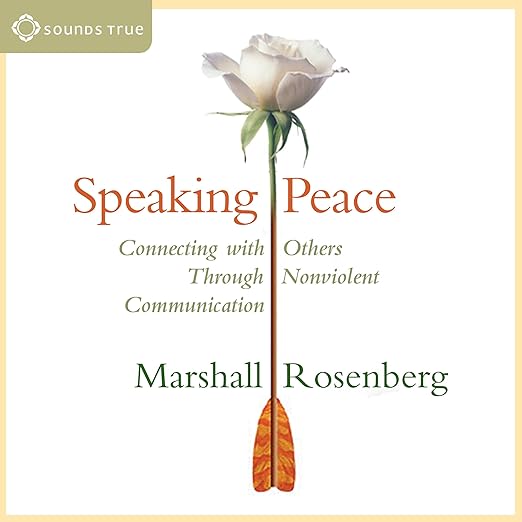
This audiobook is the Sounds True release titled Nonviolent Communication on Audible, though the original program was released as Speaking Peace. It is a recorded seminar rather than a studio narration of a book. Rosenberg presents his four-part model directly, with live examples, spontaneous asides, and occasional singing, because Rosenberg was also a musician who believed songs could carry feeling that analytical explanation could not. If you have only encountered NVC through the printed book, hearing the man himself practice what he teaches is a meaningfully different experience.
Our Take on Nonviolent Communication
The four-part model Rosenberg built across four decades of practice, working with families, schools, prisons, governments, and conflict zones, centers on the distinction between observations and evaluations, the precise naming of feelings, the identification of underlying needs, and the making of requests rather than demands. These distinctions seem simple until you try to apply them in real time, and Rosenberg is brilliant at demonstrating in live examples exactly why the simple formulation is hard to execute and why the difficulty matters.
Reviewer Lanna S. Seuret’s testimony is among the most detailed in the reviews: she came to the recording having already done significant therapeutic work, and what she found was a framework that gave her new language for something she had been practicing incompletely. That is a common response. NVC does not replace therapeutic work but it provides a specific, practitioner-ready framework that complements it.
Why Listen to Nonviolent Communication
Rosenberg narrating his own work is not a stylistic choice so much as a functional necessity. The practice he describes is fundamentally about presence, about bringing your full attention to what is alive in the other person and in yourself. A trained narrator reading the same words could reproduce the content but could not model the practice the way Rosenberg does in the act of speaking. Reviewer john brady captured it simply: it is “fun to hear the master himself.” Reviewer Ba noted preferring to listen at night rather than watch news, which says something about the particular quality of calm this recording generates.
At two hours and thirty-four minutes, the runtime is more a workshop session than a comprehensive NVC curriculum. Rosenberg wrote a full book with exercises and extended case studies, and listeners who want depth will want to engage that material as well. But the audio format gives you something the book cannot: the feel of the practice as something alive rather than something described.
What to Watch For in Nonviolent Communication
One honest note from the reviews: at least one listener found the songs within the recording less effective than the spoken content. That is fair. Rosenberg’s musical interludes are brief and not to everyone’s taste, and they are the one element of the recording that has no parallel in the written book. Listeners who find the songs jarring should know they are episodic rather than sustained.
The recording’s seminar format also means it is less systematically organized than the book. Rosenberg follows threads as they arise rather than working through chapters in sequence. For listeners who want a structured introduction to the four-part model, reading the companion book alongside or after this recording gives the conceptual architecture that the live format does not always provide.
Who Should Listen to Nonviolent Communication
Anyone approaching NVC for the first time should hear Rosenberg before reading about him. The recordings are where the framework comes alive. This is particularly true for listeners who work in contexts where communication breakdowns carry high costs: parents, teachers, therapists, managers, mediators, and anyone navigating a difficult sustained relationship. The two-and-a-half-hour format makes it accessible as an introduction rather than a commitment. Listeners who are already deep in NVC practice will find the content familiar but may still value it as a refresher in the founder’s own voice. Those expecting a traditional self-help audiobook with chapter summaries and action steps will need to adjust their expectations: this is a workshop, not a manual, and it asks you to sit with ideas rather than immediately execute them.
Frequently Asked Questions
Is this audiobook a recording of Marshall Rosenberg teaching, or a studio narration of his book?
It is a recorded seminar, originally released as Speaking Peace by Sounds True. Rosenberg presents the NVC framework directly with live examples, spontaneous commentary, and occasional songs. It is not a reading of the Nonviolent Communication book, though it covers the same core framework.
Should I listen to this audiobook before or after reading the Nonviolent Communication book?
Listening first is valuable because hearing Rosenberg’s voice gives the framework a quality of aliveness that the page cannot replicate. Reading the book afterward provides systematic organization and written exercises that the audio seminar format does not cover in full. Both together are more useful than either alone.
What are the four components of Rosenberg’s NVC framework covered in this audiobook?
The four components are observations (describing what you see without evaluation), feelings (identifying your emotional response), needs (naming the underlying values or requirements generating the feeling), and requests (asking for specific actions to meet those needs, without demanding or threatening).
Does the audiobook address conflict situations beyond personal relationships, such as workplace or community conflicts?
Yes. Rosenberg’s work spans families, schools, businesses, prisons, and governmental negotiations, and the recording draws examples from multiple contexts. The framework is presented as applicable across any situation where two or more people need to understand each other.