Quick Take
- Narration: John FitzGibbon reads Goldman’s military-political history with the authority the material warrants, measured and clear through dense strategic analysis.
- Themes: Forgotten battles that changed history, Soviet-Japanese geopolitics, the dominoes of 1939
- Mood: Dense and rewarding, the intellectual satisfaction of a thesis argued with real evidence
- Verdict: Essential listening for anyone serious about World War II causation, Goldman’s argument that Nomonhan shaped Pearl Harbor and the Eastern Front is convincing and genuinely changes how you read the war.
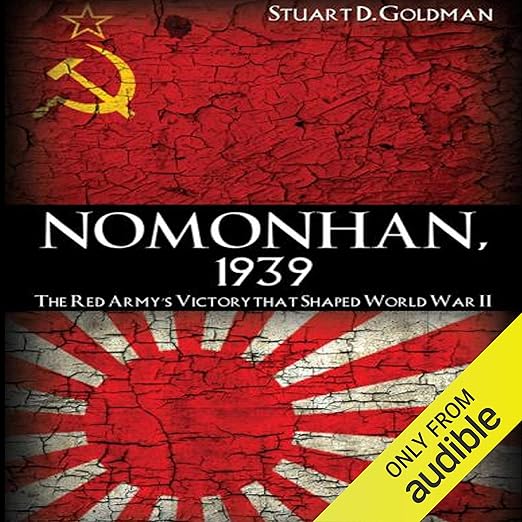
I spent three weeks one autumn reading about 1939, that narrow, catastrophic window between the German-Soviet Non-Aggression Pact and the invasion of Poland when the architecture of the Second World War was assembled in weeks. I thought I had a solid grasp of that moment. Then a historian friend mentioned Nomonhan, and I had to admit I knew almost nothing about it. Stuart D. Goldman’s Nomonhan, 1939 is the book that fixed that gap, and it has changed how I understand the war as a whole.
The Nomonhan incident, or the Battle of Khalkhin Gol, as Soviet sources name it, was an undeclared war fought along the Manchurian-Mongolian frontier in the summer of 1939. Japan provoked a border conflict; the Soviets responded with a devastating offensive that destroyed the Japanese forces under General Georgy Zhukov’s command. Goldman’s argument is that this outcome, combined with the simultaneous signing of the German-Soviet Pact, was not coincidental. Stalin used both moves together: diplomatically isolating Japan while militarily crushing it, freeing the Soviet Union from the threat of a two-front war and enabling his strategy of watching Germany fight Britain and France while the Soviets waited.
Our Take on Nomonhan, 1939
Goldman draws on Japanese, Soviet, and Western sources to construct an argument that genuinely earns the word convincing. The thesis, that Nomonhan directly influenced Japan’s decision to strike south toward the Dutch East Indies and Pearl Harbor rather than north against the Soviet Far East, is not new, but Goldman assembles the evidentiary chain with unusual care. The figure of Tsuji Masanobu, the Japanese officer who both provoked the Nomonhan conflict and later urged his superiors not to repeat the experience against the Soviets in 1941, is particularly well-drawn: a man whose catastrophic miscalculation in 1939 paradoxically saved Japan from an even worse mistake two years later.
The linkage to Zhukov’s later career is where the book becomes genuinely revelatory. Zhukov earned his strategic reputation at Nomonhan. The reinforcements he was able to rush to Moscow in 1941, the troops that stopped the Wehrmacht at the city’s gates, came from the Soviet Far East, held in reserve because Japan had decided not to attack. That decision, Goldman argues, rested on memories of Nomonhan. The battles are connected across time in a way that conventional WWII histories, which treat the Pacific and European theaters as parallel rather than interacting, tend to obscure.
Why Listen to Nomonhan, 1939
John FitzGibbon narrates with appropriate gravity. Military-political history of this kind requires a narrator who can handle density without either rushing through the strategic analysis or losing pace entirely. FitzGibbon manages both: the battle descriptions have movement, and the diplomatic sections have weight. At just over ten hours, the audiobook is well-paced for a scholarly argument of this scope.
Reviewer oldgrump, who had read over a hundred books on the Pacific war and Asia between 1931 and 1945, described Nomonhan, 1939 as one that stood out from the field. That is a recommendation worth taking seriously from a reader with that kind of depth in the subject.
What to Watch For in Nomonhan, 1939
Reviewer Scott Whitmore recommends some basic understanding of pre-WWII events as useful background. I would agree: listeners coming to this without some familiarity with the German-Soviet Pact, Japan’s imperial expansion in Manchuria, and the general shape of 1939 European diplomacy will find the argument harder to follow. Goldman writes accessibly, but the material is inherently complex, and the book does not slow down to provide elementary context.
Reviewer Tinchley21 notes this is less comprehensive than Alvin Coox’s definitive two-volume study of Nomonhan. That is accurate, Goldman’s book is an analytical argument, not an exhaustive operational history. Listeners who want every battalion accounted for should know that up front. Listeners who want to understand why this battle mattered will find Goldman’s approach exactly right.
Who Should Listen to Nomonhan, 1939
Essential for World War II history readers who want to understand the war’s causation rather than just its events. Also rewarding for listeners interested in Soviet military history, Japanese imperial decision-making, or the intersection of military outcomes and diplomatic maneuver. Less accessible for listeners without prior WWII context who would benefit from a broader survey before engaging with Goldman’s specific argument.
Frequently Asked Questions
Do I need to know World War II history to follow Goldman’s argument in Nomonhan, 1939?
Some background helps. Goldman writes accessibly, but the argument requires familiarity with the German-Soviet Non-Aggression Pact, Japan’s Manchurian expansion, and the general shape of pre-war European diplomacy. A basic WWII survey read first makes the thesis much easier to follow.
How does Nomonhan, 1939 relate to other books on the Soviet-Japanese conflict, like Alvin Coox’s exhaustive study?
Goldman’s book is an analytical argument about strategic consequences rather than a comprehensive operational history. Coox’s study is far more detailed on the battles themselves. Goldman is the right book for understanding why Nomonhan mattered; Coox is the right book for understanding exactly how it was fought.
Is John FitzGibbon’s narration suited to the density of the military-political analysis?
Yes. FitzGibbon reads with measured authority and handles the transitions between battle narrative and diplomatic analysis without losing the thread of either. The pacing is appropriate for a scholarly argument that rewards attention rather than background listening.
Does the book’s argument hold up, is there scholarly consensus that Nomonhan influenced Japan’s decision not to attack the Soviet Union in 1941?
Goldman’s core thesis is well-regarded and supported by multi-archival research. The connection between Nomonhan’s outcome, Tsuji Masanobu’s subsequent advice to his superiors, and Japan’s southward strategic orientation is documented rather than speculative, though historians continue to debate the relative weight of various factors.