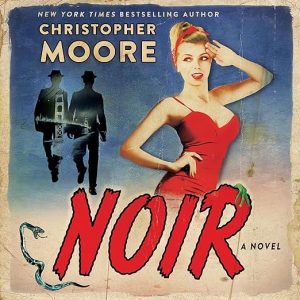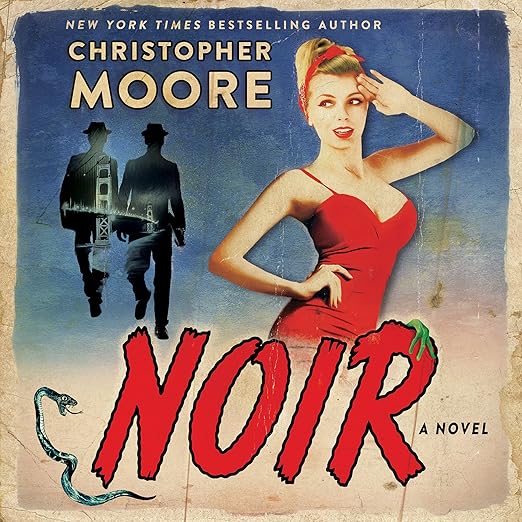
Christopher Moore's Noir arrives at the audiobook stage with a clear premise and the full weight of Moore's comic sensibility applied to it: what if someone wrote a genuine Raymond Chandler pastiche - hardboiled patter, femme fatale, fog-wrapped San Francisco, an Air Force general with suspicious business - and then introduced a black mamba named Petey and something that might be extraterrestrial activity? The answer is a book that works best when read aloud by a narrator who refuses to wink at the audience. Johnny Heller does not wink.
That restraint is the most important technical decision in this audiobook production. Moore's humor consistently operates through the tension between the heightened, stylized seriousness of the noir genre and the increasingly unhinged content that gets delivered in that style. A narrator who played the comedy would kill it. Heller plays the bartender Sammy "Two Toes" Tiffin as a man doing his best in circumstances that most noir protagonists wouldn't recognize, and the commitment to that position across nine hours is what makes the absurdity land consistently rather than in bursts.
Our Take on Noir
The setup is San Francisco, Summer 1947. Sammy tends bar at a scruffy gin joint. A woman named Stilton - like the cheese - walks in, and Sammy falls for her immediately. An Air Force general named Remy shows up with urgent business. Up the Pacific coast in Washington State, a flying object has been spotted. In New Mexico, a crash in a place called Roswell. Meanwhile, Petey the black mamba has opinions.
Moore is doing several things simultaneously here. He is writing a genuine noir narrative with a competent plot architecture that honors the genre it is satirizing. He is also writing comedy that emerges from character rather than from the plot machinery. Sammy is not a fool; he is a man of limited resources navigating a situation that is beyond those resources, and he navigates it with the particular dignity that Moore's protagonists consistently display. The book has been compared to Raymond Chandler meeting Damon Runyon with a Bugs Bunny chaser, and that description is accurate in a way that makes it sound messier than it actually is.
Why Listen to Noir
Heller handles the Chinese sidekick character and the full ensemble cast with appropriate differentiation - each voice is distinct enough that a listener can track a scene with multiple characters without confusion, but not so distinct that the performances feel like impersonation rather than narration. This is harder than it sounds for material that is specifically playing with genre conventions, where the danger is that the vocal characterization tips into caricature and undermines the satirical intelligence Moore has built into the prose.
Moore fans who have followed him through Lamb, the Shakespeare trilogy (Fool, Serpent of Venice, Shakespeare for Squirrels), and his other comic novels will recognize the specific quality of his comedy here: an earnestness in the face of absurdity that refuses to signal to the reader how funny the situation is. The book trusts you to find the comedy without being cued to laugh. Heller trusts the same thing, which makes him the right voice for this particular author.
What to Watch For in Noir
The Roswell angle deserves mention because it functions differently than the rest of the book's absurdity. Moore uses the Roswell crash and the flying object sightings not as pure comedy but as a way to import genuine Cold War paranoia into the noir setting - the general with his tight lips and urgent business, the Air Force interest in what is happening on the Pacific coast, the sense that the government is managing something the civilians aren't supposed to know about. This is historically accurate as a description of the late 1940s mood, and Moore uses it to give the comedy some actual stakes.
The romantic plot - Sammy's love for Stilton, her mysterious disappearance, his investigation to find her - is played more earnestly than everything around it. Stilton is described as a woman with sharp angles and dangerous curves, but Moore's treatment of her avoids reducing her to the genre convention she initially appears to be. Listeners who find noir femme fatales tiresome should know that Moore is aware of that tiredness and is working around it, which may or may not be sufficient depending on your tolerance for the genre framing.
The cast of characters beyond Sammy and Stilton - the Chinese sidekick, the Air Force general, Petey the black mamba, the wisecracking waif - gives the book a quality of controlled chaos that Moore's other ensemble-heavy works share. The San Francisco setting is used with a specificity that gives the world physical weight: the gin joint, the fog, the hills, the particular social landscape of 1947 when the city was still processing the aftermath of the war and its demographics were in visible transition. Moore is doing period work here as well as genre work, and Heller's narration treats both with the same seriousness that the comedy requires.
Who Should Listen to Noir
This audiobook is for listeners who enjoy comic fiction that knows its genre well enough to play with it from the inside, and who appreciate humor that is deadpan rather than signposted. Prior Moore readers will recognize the register and likely enjoy it. Chandler readers who are curious about affectionate genre satire will find this more fun than most pastiches. Skip if you want hardboiled noir without the comedy - Moore is not trying to scare you or put you on edge, and Heller's performance, excellent as it is, is serving comedy rather than suspense. But for the listener who wants nine hours of stylized absurdity executed with real craft, this audiobook delivers exactly that.