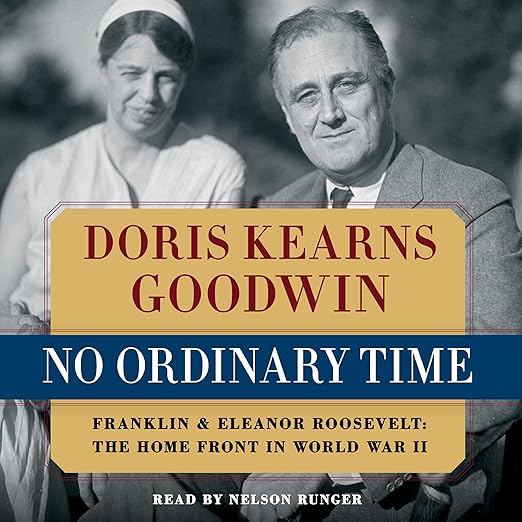
Two reviewers give this book a subtitle. They give it two different subtitles. M. Levitt's response is headed "No Ordinary Time: Franklin and Eleanor Roosevelt and the Home Front in World War II" and adds that the title says it all. Wilhelmina writes it out as "No Ordinary Time: Franklin and Eleanor Roosevelt: The American Home front during World War II". The title on this audiobook carries neither, stopping dead after three words, with thirty-nine hours of Nelson Runger sitting underneath.
Nelson Runger reads all thirty-nine hours and fourteen minutes, and that credit is the only thing here describing the recording itself. No abridgement note appears in any field, which on a book this size is the question a buyer most needs settled. A Pulitzer-winning history of a presidency and a marriage, spanning the Great Depression and a world war, can arrive complete or arrive trimmed, and a clock reading of thirty-nine hours does not by itself decide which.
Wilhelmina's four stars are also the oldest response gathered here, dated July 2010, roughly ten months before the May 2011 date on this recording. That is the response carrying the second version of the subtitle, and it describes the project accurately: an attempt to depict Franklin and Eleanor Roosevelt "not just as political powerhouses of the mid twentieth century, but as actual human beings with genuine emotions".
Thirty-nine hours is the commitment, and the description spells out what fills it. Goodwin braids a striking number of story lines together: the marriage and remarkable partnership of Eleanor and Franklin, Eleanor's life as First Lady, and the impact of that White House on America and on a world at war. Four books plaited into one, in other words, and the runtime is proportional to the ambition instead of to any padding. Simon & Schuster Audio issued the recording in May 2011, while the responses attached to it run from July 2010 to February 2026, a spread of more than fifteen years. The book has been finding new readers the entire time.
Left in Awe of Eleanor, One Reviewer Writes
Goodwin's method is what the reviewers actually praise, and suncloud describes it best: a narrative style that lets dry technical information flow easily by drawing the reader into the day-to-day lives of two of the most important and impactful people of the twentieth century. That is the whole argument for hearing a history this long. The facts arrive inside a domestic story, which is precisely the shape audio handles well.
Franklin and Eleanor are the engine, and M. Levitt sets out the stage the book opens on: Hitler and the Nazi war machine moving through one European country after the next, Great Britain standing alone, a conservative Congress at home, an isolationist country with no standing army, no navy or air force and no stomach for what was going on in Europe. What Goodwin does with that setup across thirty-nine hours is the book. The same response reaches back past this war to a deep distrust of how the country had been dragged into the previous one, which is the political weather the Roosevelts had to work against before anything else could happen.
Eleanor is the figure readers keep returning to. Cate's entire review is one sentence about being left in awe of Eleanor Roosevelt, and suncloud pairs her name with the president's at every turn. The description promises Eleanor's life as First Lady as one of the braided story lines, and the responses suggest it is the strand that lands hardest. For a listener who knows the presidency but not the partnership, that is the draw.
Brilliant Spelled Two Different Ways, Same Review
Count the graded responses and you reach five, all of them sitting under a counter that admits two. The badge reads 4.7, and two whole-star grades cannot produce that figure under any convention going. So the number printed at the top is measuring something other than the column sitting below it, and the grades you can actually read amount to four fives and a single four. Trust those. The average is stale or wrong, and the record offers no way to tell which.
Political history of this era gets written and rewritten constantly, and the responses here place this one usefully. Wilhelmina's account is that Goodwin works to bridge the gap between the personal happenings of the Roosevelt family and the historical events of the Second World War. That framing is worth carrying in before you start, because thirty-nine hours of domestic detail will frustrate somebody who came for military history and delight somebody who came for a marriage.
Norman Bissett, filing from the United Kingdom, supplies the other piece of context: this is the third of Goodwin's political biographies that review reports having read, after ones on Lincoln and Lyndon B Johnson, and all are called equally brilliant. The praise is for a body of work and not for this recording. Worth adding that the same response spells brilliant with an accent the first time and without one afterwards, which is the sort of small corruption this record collects. That review also produces the tightest summary of the craft anybody here manages: a vast body of information ordered expertly, joined to brilliant analysis, scrupulous research and sheer readability. Readability is the operative word on a listen of this length.
Nobody Has Written a Word About Nelson Runger
Runger's thirty-nine hours suit one listener in particular: somebody who wants the Roosevelt years at full length, in order, with the domestic material left in. Readers of long-form American history, listeners who finished one Goodwin book and want the next, and anybody who has watched a documentary about the period and wished for everything it had to cut will get exactly what they came for here. suncloud's takeaway is worth repeating for anybody still deciding: learning about America's role during the war through FDR's and Eleanor's daily activities. That is what thirty-nine hours buys you, which makes it a very different book from a campaign history.
Patient listeners only, though. Thirty-nine hours is weeks of listening for most people, and this listing still has not told you whether the text is complete. If that matters to you, and for something this long it should, ask before you buy. Goodwin gets the last word here because nobody has yet written one about Nelson Runger.
Key Details
- Performance: Nelson Runger carries thirty-nine hours and fourteen minutes alone, on a record that never states whether the text is complete.
- What it covers: a presidency and a marriage at once, the Home Front, Eleanor Roosevelt's public life, a country argued out of isolation
- Feel: Immersive, domestic and enormous
- Our call: The best kind of long history, on a record that has mislaid its own subtitle.
Am I getting the full text of No Ordinary Time on audio?
The listing never says. No abridgement note appears in any field, and thirty-nine hours and fourteen minutes is long enough to be either complete or trimmed depending on the edition it follows. On a Pulitzer-winning history that single question decides what you are buying, so ask the seller before spending.
Why do reviewers give this audiobook two different subtitles?
Because the title itself carries none, leaving each reviewer to supply one from memory or from a different edition. One writes it with the Home Front in World War II; another renders it as the American Home front during World War II. Both are describing the same book, and this record commits to neither.
Does thirty-nine hours of audiobook earn its length?
For the right listener, yes. Reviewers describe a narrative style that carries dry material easily, and the book plaits a marriage, a First Lady's public life and a wartime White House into one continuous story. Come for military history alone, though, and the domestic detail will test you well before hour twenty.
Should I trust the 4.7 badge on this listing?
Not on its own. The counter claims two votes while five graded responses sit directly underneath, and two whole-star votes cannot land on 4.7 in any case. The individual grades make a better guide: four readers awarded five stars and one awarded four. The badge is measuring something else.