Quick Take
- Narration: Virtual Voice AI narration; the material is strong enough to engage despite the synthetic delivery, but listeners sensitive to AI narration should know what they are getting.
- Themes: Secular meaning-making, post-religious identity, rationalism and transcendence
- Mood: Thoughtful and searching, with the quality of a genuinely good conversation with someone who has done the reading
- Verdict: A careful, evidence-grounded exploration of how to live meaningfully without religious framework, and one of the more nuanced books in an increasingly crowded secular spirituality space.
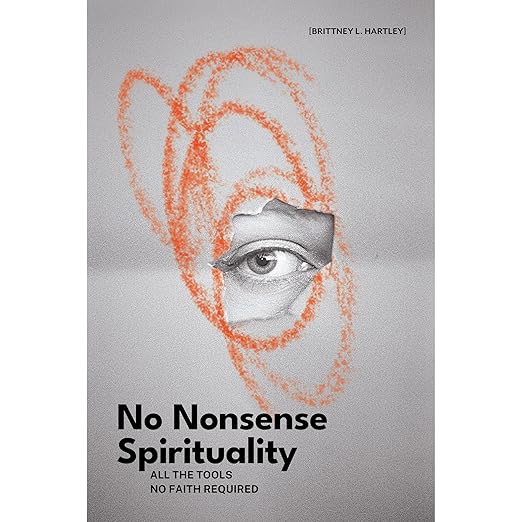
The secular spirituality shelf has grown considerably in the last decade, and the quality varies enormously. For every carefully argued contribution there are several books that either uncritically adopt the language and rituals of religion without honestly accounting for why those things existed, or overcorrect into a barren materialism that offers nothing to live by. Britt Hartley’s No Nonsense Spirituality sits at the more considered end of that spectrum. It reads like someone who has actually thought about both the losses and the gains involved in leaving a religious framework behind, rather than someone simply celebrating the exit.
Hartley is a philosopher and atheist spiritual director, which is a genuinely unusual combination of qualifications. She has built an audience through social media content on secular meaning-making, and this book represents her most comprehensive statement of the approach she has been developing. The framing is explicit from the beginning: no faith in the unbelievable is required. What she is offering instead is an account of how ritual, morality, awe, transcendence, wisdom, community, intuition, connection, and meaning can be approached through a secular lens without either dismissing those concepts as irrelevant or inflating them beyond what the evidence can support.
The Chasm Between Atheism and Emptiness
The most useful diagnostic Hartley offers early in the book is an account of the specific loss that many people experience when they leave religious communities or frameworks. This is not the loss of specific beliefs, she argues, but the loss of a structured relationship to the large questions: death, meaning, community, moral orientation, and the sense that these questions matter and that there are others thinking about them alongside you. Her work as an atheist spiritual director gives her direct experience of what that chasm feels like from the inside, and she does not minimize it or rush past it toward the reassuring solution.
One reviewer who described having followed Hartley’s social media content before reading the book noted that the book extends and deepens what short-form video could only gesture toward. That is an accurate description of the relationship between her online presence and this text. The book has the intellectual architecture that the format of short videos cannot sustain, and Hartley uses the space well. Another reviewer invoked Marcus Aurelius, Viktor Frankl, Hitchens, Harris, Brene Brown, and Yuval Harari as reference points for the kind of synthesis she is attempting, which gestures at both the ambition and the genuine breadth of her engagement with source material.
What the Book Draws From
Hartley ranges across philosophy, religion, psychology, and science in ways that are genuinely wide rather than cherry-picked for confirmation. The book is more successful as a survey of resources for secular meaning-making than as an original philosophical contribution, but that is not a fatal weakness. For readers who have not done extensive reading in adjacent areas, it functions as a very good map of rich and underexplored territory. The citations are clear and the references and resources for further exploration are helpfully organized, which reflects the thoroughness reviewers consistently praise.
One reviewer offered a reasonable calibration: the book works better for someone actively deconstructing from religion or newly spiritually adrift than for someone who left religion long ago and is now seeking practical tools for building a secular practice. That is a fair description of the book’s actual target reader, and it is worth knowing before you commit eight hours to it. Hartley herself effectively acknowledges the gap by noting that a more applied companion volume is needed.
The Virtual Voice Question
No Nonsense Spirituality is narrated by Virtual Voice, Amazon’s AI narration system, and that is worth flagging directly. The audio quality is functional. But there is a quality of genuine engagement and emotional responsiveness in human narration that AI narration does not yet replicate, and for a book substantially about the nature of human experience, meaning, and spiritual depth, the gap between the content and the voice delivering it is occasionally noticeable. Listeners who have become attuned to AI narration will notice it. Listeners who primarily engage with ideas rather than performance will likely find it adequate for the purpose.
One thing that distinguishes Hartley from comparable secular humanist writers is her professional background working directly with people in spiritual crisis rather than simply theorizing about the problem from the outside. The book carries the texture of real conversations with people navigating post-religious identity, and that texture gives the more abstract philosophical sections a grounding that purely academic treatments of the same territory often lack.
A Meaningful Contribution to a Crowded Space
Hartley’s No Nonsense Spirituality is recommended for listeners navigating the space between religion and pure materialism, particularly those who have recently left a religious framework and are looking for a thoughtful secular alternative. Also valuable for anyone who has found the New Atheist tradition intellectually satisfying but emotionally thin. Available as a free audiobook through Audible membership. If you are already settled in a secular practice and primarily seeking practical ritual guidance, the book will feel more preparatory than conclusive, but it is a worthwhile foundation for that next step.
Frequently Asked Questions
Is No Nonsense Spirituality appropriate for listeners who have never been religious, or is it primarily for those deconstructing from a religious background?
Hartley’s primary audience is people navigating the space between religion and pure materialism, many of whom are coming from a religious background. Listeners who have never been religious may find less personally resonant content, though the philosophical and psychological material is broadly interesting.
How does the Virtual Voice AI narration affect the listening experience?
It is functional but lacks the emotional responsiveness of human narration. Listeners who have strong preferences for human narrators should know going in. The content is substantive enough to engage despite the delivery, but the mismatch between the emotionally rich subject matter and the synthetic voice is periodically noticeable.
Does Hartley’s atheist spiritual director background give the book a clinical or academic tone, or is it accessible?
Accessible. Multiple reviewers note that Hartley writes with personal warmth and shares her own story alongside the academic and evidence-based material. The book feels like a thoughtful guide rather than a scholarly argument, which is one of its real strengths.
Does the book offer specific practices for building a secular spiritual life, or is it primarily theoretical?
More theoretical in this volume. One reviewer noted that readers looking for concrete daily practices will want more than the book provides, and Hartley herself acknowledges this gap. The journal questions in the companion PDF offer some practical engagement, but listeners seeking a detailed practice guide may find this book preparatory rather than conclusive.