Before You Press Play
- Read by: Suzanne Toren brings authority and warmth to Wendy Moore's WWI history, tracking the emotional arc of Flora Murray and Louisa Garrett Anderson's work without letting the period prose feel static.
- At its heart: Women's suffrage and professional medicine, wartime gender barriers, institutional resistance to change
- Vibe: Quietly outraged and deeply admiring, with the pacing of a narrative history that earns its emotional payoff
- Short version: Moore's account of the Endell Street Military Hospital is the kind of history that genuinely changes what you thought you knew about World War I and about the cost of medical progress.
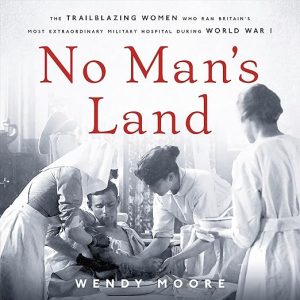
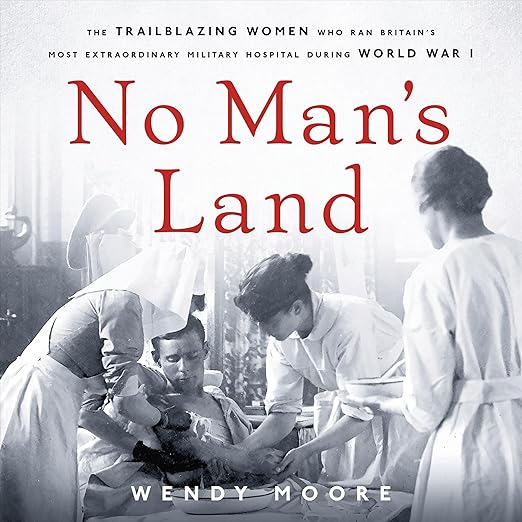
Most accounts of World War I's medical history center on the catastrophic inadequacy of treatment available to the wounded on the Western Front. Wendy Moore's No Man's Land audiobook approaches the same period from a different angle: two female doctors who offered their services to the British Army in 1914, were refused, went to Paris anyway, and ran a hospital so effectively that the Army eventually asked them to come back to London. The Endell Street Military Hospital - the Suffragettes' Hospital - treated thousands of casualties from France's battlefields and pioneered several surgical techniques. It was staffed entirely by women. And it was erased from the standard historical record almost immediately after the war ended.
Flora Murray and Louisa Garrett Anderson are the book's central figures, and Moore assembles their story with the care of a biographer who has spent serious time in primary sources. Murray and Anderson were both suffragettes and medical doctors - a combination that made them suspect in a medical establishment that restricted female physicians to treating women and children and a suffragette movement that had made the government its enemy. Their decision to go to Paris with their Women's Hospital Corps in the first month of the war, before the British government would work with them, is the founding act of the narrative: they created their own opportunity and made themselves too useful to ignore.
Two Suffragette Doctors Built Their Own Hospital
The 12 hours and 13 minutes of the audiobook is well used. Moore's sourcing is extensive - letters, diaries, hospital records, contemporary journalism - and the narrative is built on documentary evidence rather than speculation. The reviewer Tetsu's note that "the author describes the women's suffrage movement prior to the First World War" captures the context Moore provides: the book is not only the story of Murray and Anderson's hospital work but of the political landscape that made that work simultaneously necessary and controversial. Understanding what the suffragette movement had done to its relationship with the government - years of militant action, including arson and hunger strikes in prison - makes the story of two prominent suffragettes offering their medical expertise to that same government more complex and more interesting than the bare facts suggest.
Moore is particularly good at the institutional machinery around Murray and Anderson. The Army's initial refusal, the workaround via Paris, the subsequent request to return to London, the conditions under which Endell Street was established, and the ongoing bureaucratic pressure the hospital operated under are all documented with specificity. This is not hagiography - Moore shows the tensions within Endell Street, the professional relationships that frayed under wartime pressure, and the costs the work extracted from both women. But the portrait that emerges of Murray and Anderson as administrators, physicians, and advocates is powerful precisely because it is grounded in the difficulty of what they were actually doing rather than in a simplified narrative of triumph against odds.
Toren's Measured Authority Suits Documentary History
Suzanne Toren's narration is well matched to the material. She brings a measured authority to Moore's prose that suits a history written with documentary precision rather than novelistic drama. The pacing is deliberate - this is not a fast-moving narrative, and Toren does not artificially accelerate it. The 12-hour runtime means listeners encounter extended sections on the suffragette political context, the medical practices at Endell Street, and the post-war erasure of the hospital from official memory. Toren holds attention through all of it by treating the material as substantive rather than as background to a simpler heroic narrative.
The Wall Street Journal's description of the book as "absorbing and powerful" and Craig Meyer's review noting that "the female physicians were not allowed, at the time in England, to treat male patients" both point to the book's central irony: that the war created conditions under which restrictions that had no medical justification were finally suspended, not because attitudes changed but because the need for surgeons was greater than the institutional prejudice against female ones. Moore's account of what Murray and Anderson accomplished under those conditions - and what happened to the record of that accomplishment after the Armistice - is the kind of history that surfaces a injustice that has been papered over by the larger narrative of the war.
Repetitive at First, Necessary in Hindsight
The one consistent limitation noted by reviewers is the opening third's pacing. JK's review flags that the first section "reads very repetitive" before the narrative picks up as more historical figures enter the scene. The suffragette context, which Moore establishes at length before moving to Paris and Endell Street, is necessary but dense. Listeners who find the early sections slower than they expected should be assured that the narrative accelerates significantly once the hospital work is underway, and that the contextual foundation established in the opening pays off in the complexity of what follows.
The book covers a specific slice of WWI history - women's medical service, institutional gender politics, the relationship between the suffragette movement and the British state - rather than a broad account of the war itself. Listeners approaching this as a general WWI history will find the scope narrower than they anticipated; listeners specifically interested in women's history, medical history, or the suffragette movement within its wartime context will find the coverage more than sufficient at 12-plus hours. The 4.6 rating from 268 reviews reflects broad satisfaction among an audience that came to the book for the right reasons.
Vera Brittain Readers Will Feel at Home
This audiobook is suited for listeners drawn to women's history within the context of World War I, and for anyone interested in how professional medicine was transformed by wartime necessity rather than by institutional willingness. Readers of books like Vera Brittain's Testament of Youth or Anne Sebba's biography of Wallis Simpson's wartime work will recognize Moore's approach: meticulous sourcing, a central female figure who has been undervalued by the historical record, and a social context rendered with enough depth to make the individual story comprehensible. Those wanting a broad account of the Western Front or a general WWI narrative will need to look elsewhere. Suzanne Toren's narration makes the 12-hour investment feel proportional to the material's weight.
Before You Listen
Does this audiobook require background knowledge of World War I to follow the history of the Endell Street hospital?
Moore provides sufficient context that listeners without detailed WWI knowledge can follow the narrative. She explains the political situation, the state of military medicine, and the suffragette movement's pre-war activities in the opening sections. Listeners with existing WWI knowledge will find those sections move through familiar territory quickly before reaching the less commonly documented story of Murray and Anderson's hospital.
Is the audiobook appropriate for listeners primarily interested in medical history rather than women's history?
The medical content is substantial. Moore documents the surgical techniques developed at Endell Street, the hospital's organizational structure, the treatment protocols for specific types of battlefield injuries, and the ways in which female physicians approached patient care differently from the male-dominated military medical establishment. The history of women in medicine and the history of wartime surgery are genuinely intertwined throughout, so listeners from either interest will find relevant material.