Quick Take
- Narration: Ruairi Carter delivers the journalistic voice with conviction and clarity, sustaining the book’s urgent investigative tone across eight hours.
- Themes: Immigration, cultural integration, national security, European identity
- Mood: Polemical, alarming in intent, written from a firmly conservative political standpoint
- Verdict: A partisan investigative account that argues a consistent ideological thesis; essential listening for readers who share Kassam’s framework, genuinely one-sided for those who do not.
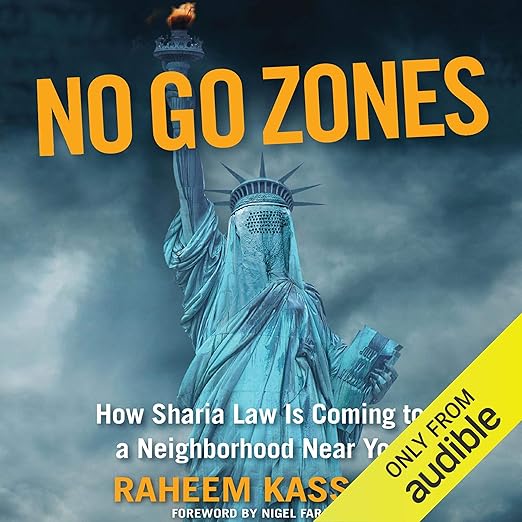
I want to be upfront about what kind of book this is before I write about whether it does that kind of book well. No Go Zones is a work of conservative political journalism published by a Breitbart editor. It argues, with reporting from multiple Western cities, that zones of Islamic cultural dominance have formed in European and American cities, that law enforcement increasingly avoids them, and that Western governments are systematically failing to acknowledge the problem. This is not a neutral premise, and Raheem Kassam does not pretend it is. His thesis is stated in the opening pages and never wavers. What matters for this review is how rigorously he supports it and how the audiobook experience renders that argument. This free audiobook through Audible membership runs eight hours and twenty minutes.
Kassam is a West London-born writer of Indian-Pakistani heritage who edited Breitbart London. He visits San Bernardino in California, Hamtramck in Michigan, Malmö in Sweden, and specific neighborhoods in London, reporting on what he witnesses and cross-referencing it with demographic data, crime statistics, and interviews. His writing is confident, his humor dark, and his political framework consistently present. Ruairi Carter narrates with the appropriate urgency of investigative journalism.
The Reporting: What Kassam Actually Shows You
The book’s strongest passages are the firsthand accounts. Kassam walking into specific streets, describing what he observes, noting what is present and what is conspicuously absent. One reviewer praised the way Kassam takes you on a journey through these zones as a fellow traveler, with his ever-present humor and constant questioning. That travel writing quality gives the more contested statistical claims a grounding in observed detail that purely data-driven arguments lack.
The chapter structure organized by location works well in audio. Each city gets its own examination, and the movement between San Bernardino, Hamtramck, Malmö, and London creates a cumulative argument that individual episodes cannot make alone. The welfare state analysis, focused on how European social systems may create conditions that sustain cultural separatism, is the most analytically sophisticated section and the most useful for listeners who want to engage with the policy dimension rather than the cultural alarm specifically. Reviewer Len Steiner noted that the book broke down the chapters into locations in Sweden, the United Kingdom, and the United States in a way he found particularly clear, which reflects how deliberately Kassam structured his geographic argument.
Where the Ideological Frame Shapes the Reporting
The book’s consistent weakness is also its most defining characteristic: Kassam’s framework does not invite or accommodate counter-evidence. The selection of locations, the framing of each visit, the weight given to particular anecdotes over others, all of it flows in one direction. One reviewer, who found the book compelling, nonetheless noted the difficulty of imagining how we can resist the threat Kassam describes without ourselves becoming less free and less tolerant. That is an honest reader response, and it gets at the book’s central tension.
Kassam distinguishes Islamic neighborhoods from what he calls the equivalent of Little Italy or Chinatown, arguing the cultural and political threat is categorically different. He does not fully develop this distinction in the analytical terms that would satisfy skeptical readers, and the comparison does significant work in his argument without receiving proportionate examination. Listeners who accept the distinction intuitively will find the subsequent chapters persuasive. Listeners who want that comparison examined rather than asserted will find the book consistently frustrating, because Kassam is not writing for them and makes no attempt to be.
Ruairi Carter and the Tone of Controlled Alarm
Carter’s narration sustains the book’s temperature effectively. This is a text written in a mode of controlled alarm, and Carter never tips into shrillness while maintaining the sense that what is being described matters urgently. For a book that relies heavily on the cumulative impact of its reporting, the narration’s emotional consistency is a genuine asset. Carter’s voice carries the authority of someone conveying firsthand information rather than performing outrage, which is the correct register for Kassam’s journalistic style. Listeners who engage with the argument will find the audio experience reinforcing. Listeners who are skeptical will find it equally focused and unyielding.
The book was published in 2017, and some of the specific political contexts it references have evolved since then. The underlying argument about integration, law enforcement, and the politics of acknowledgment remains actively debated and will feel current to listeners following those conversations in any of the countries Kassam visits.
Who This Book Is and Is Not Designed For
Listen to this if you are interested in conservative perspectives on European immigration and cultural integration and want a first-person reported account rather than an abstract policy analysis. Also worth hearing for listeners who want to understand the argument that figures on this side of the debate are making, whether or not they are sympathetic to it. Skip it if you expect journalism to seriously engage opposing evidence and alternative framings. This is advocacy reporting that believes deeply in its conclusion from the first page. It will confirm readers already persuaded and is unlikely to persuade readers who are not, which is not a failing of this particular genre but is something to know going in.
Frequently Asked Questions
Is No Go Zones presented as objective reporting, or does Kassam acknowledge his political perspective?
Kassam does not claim neutrality. He is explicit about his Breitbart background and his conservative framework. The book is best understood as advocacy journalism with a clear thesis rather than balanced investigative reporting, and it works within that genre on its own terms.
Does Kassam’s Indian-Pakistani heritage shape his argument in the book, and how does he address that?
He references his background as a credential of sorts, arguing it gives him particular access to communities and frameworks that a purely Western outsider might lack. Some reviewers found this positioning persuasive; others found it used selectively to pre-empt certain critiques.
Are the locations Kassam visits actually legally designated no-go zones, or is that a rhetorical framing?
This is the book’s central contested claim. Kassam acknowledges the term is disputed but argues the functional reality in certain areas matches the label regardless of official designation. The book opens by noting that the politically correct deny their existence, which signals how Kassam intends to handle this definitional tension throughout.
How does Ruairi Carter’s narration affect the listening experience compared to reading the text?
Carter maintains a consistent tone of urgent, controlled conviction that suits Kassam’s journalistic style. The audio format reinforces the travel-writing quality of the location chapters, since Carter’s steady pace through each city creates a sense of accompanying Kassam on his visits. Listeners who found the text compelling describe the audio as heightening that engagement.