At a Glance
- Read by: Art Benjamin's self-narration is a significant strength; his mathematician's voice carries the material with enthusiasm and pedagogical clarity that makes even unfamiliar techniques feel approachable.
- At its heart: Mental arithmetic as a trainable skill, the gap between numeric anxiety and numeric competence, practical math in daily life
- Vibe: Energizing and accessible, with the feel of a particularly good professor rather than a textbook
- Short version: For listeners serious about building mental math ability rather than just reading about it, Dr. Benjamin's audiobook format turns out to be unusually well suited to the subject matter.
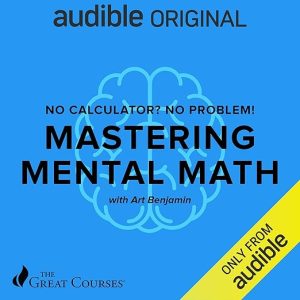
Dr. Art Benjamin has spent decades arguing that mathematics is a performing art, something you can watch someone do live with the same visceral pleasure as watching a musician improvise. No Calculator? No Problem! is the audiobook adaptation of his mental math curriculum, and the audio format turns out to serve this material in a way that is genuinely better than print for a certain kind of learner. One reviewer puts it bluntly: the best way to learn math is not through visualizing but through hearing. Benjamin built his reputation partly on his Mathemagics stage shows, where he performs rapid calculation in front of live audiences, and that performance sensibility comes through in how he narrates his own course.
The subject matter is mental arithmetic in its practical forms: fast addition, subtraction, multiplication, and division; estimation techniques for when an exact answer is unnecessary; memory systems for numbers like credit card PINs and conference call passcodes; multiplication tables extended through 20; left-to-right number thinking that does not require visualization. These are tools that disappear from most people's lives as soon as calculators become available, and Benjamin's central argument is that recovering them does something for your relationship with numbers that the calculator cannot replicate. That argument is not nostalgic. It is grounded in how mental arithmetic changes your sense of numerical proportion, your capacity to catch errors, and your confidence in applied situations from cooking to banking to gaming.
Mental Math Is an Inherently Auditory Skill
The audio format suits this course for a reason that is not obvious until you try it: mental math is inherently an auditory practice. Benjamin's signature approach involves hearing the numbers rather than seeing them, which means the audiobook becomes the natural medium rather than a compromise. The techniques he teaches, including over-subtraction, the cashier's method, and left-to-right multiplication, are designed to work in a mind that processes language sequentially. Following them through headphones while the course is delivered verbally creates a learning environment that mimics how the skills will actually be used in the world: in the grocery store, at a restaurant, in a meeting.
Benjamin's narration is confident without being hurried. His pace reflects someone who has taught these techniques many times and knows exactly where students tend to stumble. The real-world application examples throughout the course, shopping totals, tip calculations, sports statistics, gaming odds, cooking proportions, reflect a careful curriculum design that keeps the abstract techniques anchored to situations listeners have already encountered. That anchoring is what separates a math course that produces actual retention from one that produces a pleasant sense of having been educated.
Guess-Timation Tackles the Fear of Exactness
The distinction this audiobook makes between exact calculation and estimation is particularly valuable. Most math anxiety is rooted in the belief that every numerical situation requires an exact right answer. Benjamin's unit on guess-timation, covering problems that do not require precision, addresses that belief directly and practically. Learning when to round, when to estimate, and when exactness actually matters is a meta-skill that applies far beyond the specific techniques covered in the course. At five hours and forty-six minutes, the runtime is substantial enough to cover real ground without requiring the kind of sustained formal study that often derails self-directed learning.
The course structure moves from foundational operations into more advanced applications, making it usable both for someone starting from basic arithmetic anxiety and for someone who can already do quick addition but wants to develop multiplication and memory skills. The listener who approaches this as a course to be worked through actively, pausing to practice techniques as they are introduced, will get substantially more from it than one who treats it as passive listening. Benjamin designs the material for active engagement, and the audiobook format rewards that approach.
Visual Learners Need Pen and Paper Too
This is an educational course delivered as audio, which means certain types of learning exercises that work naturally on the page require more active mental participation when listened to. Listeners who absorb procedural information better with visual aids may find some of the multiplication and division techniques harder to internalize without working examples written down alongside the audio. Taking notes while listening, or pausing after each technique to practice on paper, significantly improves retention compared to passive listening alone. This is not a weakness of the course but a characteristic of the subject matter in audio format, and Benjamin addresses it by providing enough repetition and varied application to support learners who need multiple exposures to a concept.
The course is focused specifically on mental arithmetic and estimation rather than broader mathematical reasoning or algebra. Listeners hoping for coverage of statistics, geometry, or analytical problem-solving will need to look elsewhere. Within its defined scope, however, No Calculator? No Problem! is exceptionally thorough.
Fans of Benjamin's Live Shows Get Their Answer
This audiobook is an excellent match for adults who feel genuinely uncomfortable with numbers in everyday situations and want a structured, practical way to rebuild their relationship with arithmetic. It is also well suited to students preparing for standardized tests that limit or prohibit calculators, and to professionals who would benefit from faster numerical fluency in meetings and presentations. The commuter listener who wants to use travel time productively will find the course format practical, though active practice exercises should be reserved for stationary contexts. Anyone who has seen Art Benjamin perform live and wondered how he does it will find this course the most direct answer available in audio format.
Is this audiobook effective for someone who has significant math anxiety, or does it assume basic comfort with numbers?
The course is designed to meet listeners wherever they are, including those with significant anxiety around arithmetic. Benjamin builds from foundational techniques, and his framing consistently positions mental math as a learnable skill rather than an innate talent.
Can I actually learn mental math from an audiobook, or do I need a print workbook alongside it?
Many listeners report real skill development from the audio course alone, particularly because Benjamin's techniques are designed for auditory processing. Taking notes and practicing techniques after each section will improve retention, but the audio format is genuinely appropriate for this subject matter.
Does Art Benjamin's self-narration make the audiobook more or less engaging than a professional narrator would?
More engaging for most listeners. Benjamin has performed these techniques live and taught them extensively, and that experience gives his narration an authority and enthusiasm that reflects genuine expertise rather than read-through familiarity.