In Brief
- Performance: Holter Graham is credited on a memoir written without sight, where description works through hearing, texture and balance instead of anything visual, and the recording goes unmentioned in every review on the listing.
- What it covers: Life after a defining achievement, disability and adaptive sport, adopted family, whitewater as a reckoning.
- Feel: Inspirational and genuinely tiring, by one reviewer's own account.
- Our call: A serious memoir with craft prizes behind it, and a long haul that earns its length.
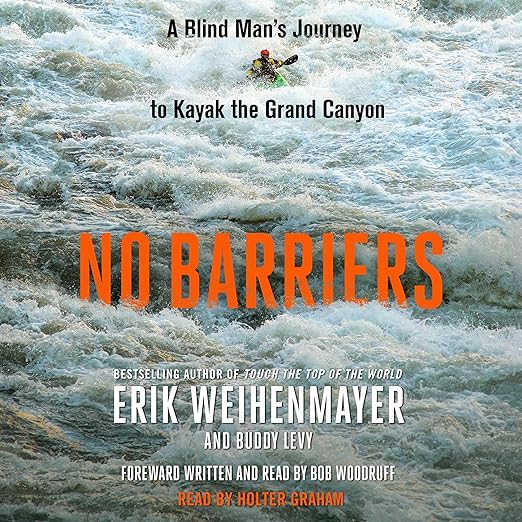
What do you do after Everest? Erik Weihenmayer's expedition leader answered that on the descent, with a line this audiobook keeps returning to across the next nineteen and a half hours: "Don't make Everest the greatest thing you ever do." Weihenmayer remains the only blind climber to have stood on that summit, and the book is his response to the instruction. Holter Graham is the credited narrator, and it takes a reviewer to restore the subtitle the listing omits: A Blind Man's Journey to Kayak the Grand Canyon.
His Anthology of Breaking Barriers
The shape of this book is unusual and worth understanding before you buy it. This is not one expedition told end to end. Weihenmayer moves from leading blind Tibetan teenagers on expeditions, to helping injured soldiers climb their way back from war, to adopting a son from Nepal, and finally to the solo kayak descent of the Grand Canyon that the subtitle promises. One reviewer calls the result "his anthology of breaking barriers", which is a more accurate description than anything in the marketing copy manages.
Interleaved through all of it are other people's stories. The description says Weihenmayer meets "adventurers, scientists, artists, and activists" who came through trauma and loss of their own, and that these encounters show him ways forward that surpass logic. That structural choice is the book's biggest gamble. It converts a memoir into something closer to an inquiry, and whether it reads as generosity or as dilution depends almost entirely on how much you came for Erik himself.
The kayak descent is the spine and the payoff. The copy calls it "the most terrifying reach of his life", and one review describes the experience of following it as "both captivating and dizzying," which is the correct pairing for whitewater written from inside a blind man's sensory world. Weihenmayer cannot see the rapid coming. Everything he knows about the river arrives through sound, water pressure and balance, and the book is at its strongest whenever it stays inside that specific problem instead of stepping back to draw a lesson from it.
Graham Reads Mountains, Rivers, and Rooms
The strongest case for this particular edition is one the book itself makes. Weihenmayer is blind, the listing carries a People with Disabilities tag, and audio is the format in which his account reaches readers who share his condition without requiring an intermediary. That is not a sentimental observation but a practical one, and it applies to a substantial number of potential listeners for whom a print edition is not an option at all.
Holter Graham holds the credit, and the material makes an unusual demand of a reader: sensory translation. Weihenmayer describes mountains, rivers and rooms without sight, so the prose runs on sound, texture, air and balance rather than on anything visual. A reading has to give those passages their full weight without converting them into a performance of profundity. The book also swings between technical outdoor writing and grief, sometimes inside a single page. None of the three reviews here says a word about the recording, so how those transitions land is a matter for the sample.
The awards recognition on this listing is specific enough to be informative too. The description cites a 2018 Colorado Book Awards finalist placement in creative nonfiction, plus an honorable mention from the 2017 National Outdoor Book Awards in their outdoor literature category. Those are craft prizes rather than inspiration prizes, and the distinction matters for a book of this type. Brad Meltzer's quoted blurb points the same way, calling it "A beautiful book about family and finding a way to achieve more than you ever thought possible." Family comes first in that sentence, and that is not an accident.
One Reviewer Docks a Star Over Language
Sustained inspiration at this length is a heavier commitment than it sounds. One review title says it outright: "Amazingly inspirational and emotionally exhausting!" Read that as a warning and a recommendation at once. The book moves through trauma, injury, war and loss on its way to each of its summits, and anyone putting on a mountaineering memoir expecting adventure will find something considerably more demanding waiting for them.
One reviewer docks a star purely over language, calling the story incredibly inspiring and then explaining: "I would have given it 5 stars except for all the curse words in it." That is one person's standard, and it is also the only content guidance anybody on this listing provides. If profanity in a memoir is a problem for you, or you are weighing this for a classroom, a family listen or a younger reader, take that four-star assessment at face value.
A Reviewer Supplies the Missing Subtitle
The interleaved stories cut both ways. Every time the narrative leaves Erik for a scientist, an artist or a soldier, momentum on the main thread pauses. In an audiobook this long those detours are harder to skim past than they would be on the page, where an eye can jump ahead to the next chapter carrying Erik's name. Anyone who came strictly for the Grand Canyon descent should know it arrives late and shares the runtime with a great deal of other material.
Note also that the listing does not carry the subtitle. A reviewer supplies it, and that review is the only place on this page where you learn the kayaking is the destination. Buyers scanning the title alone could easily assume this is a general motivational book rather than the account of one specific and extremely dangerous river descent.
The Runtime Reads as a Relationship
The adaptive sport and disability communities are the primary audience, and not in a token way. Weihenmayer leads blind teenagers up mountains, works with soldiers whose bodies changed in war, and writes about navigating a world designed for sighted people. The book has standing to discuss all of that, and the People with Disabilities tag on this listing is accurate rather than decorative.
Outdoor and expedition readers are the second group, with a caveat about proportion. The mountaineering and whitewater content is real and technically grounded, and the National Outdoor Book Awards recognition supports that judgment. But this is fundamentally a memoir about what to do with a life after the defining achievement, and the rivers and mountains are the vehicle rather than the destination. If you want route detail and summit logistics, the ratio will frustrate you.
Two cautions to finish on. Anyone sensitive to strong language already has a four-star review on this listing telling them exactly what to expect, and it is the most useful piece of buyer guidance on the page. And anyone wanting a short dose of encouragement should look at the runtime again: nineteen hours and thirty-four minutes is a relationship rather than a boost, and the book spends a great deal of that time in the hard parts before it earns a single one of its summits.
A Few Questions About No Barriers
Is this audiobook mostly about Everest?
No. The summit is already behind him when the book opens, and the story starts with an instruction delivered on the way down. What follows covers expeditions with blind Tibetan teenagers, work alongside wounded soldiers, an adoption, and finally a solo run through Grand Canyon whitewater.
Does it contain strong language?
Enough that one reviewer removed a star over it. That review praises the story warmly and then explains that a fifth star would have followed without the swearing. It is the only content guidance anywhere on the page, so weigh it accordingly if you are buying for a classroom or a shared listen.
How long is the audiobook, and does it follow one thread?
Nineteen hours and thirty-four minutes, and no it does not. The book keeps stepping away from Weihenmayer to profile other people who came through hardship of their own, which one reviewer describes as an anthology structure. Anyone who came only for the river should expect it to arrive late.