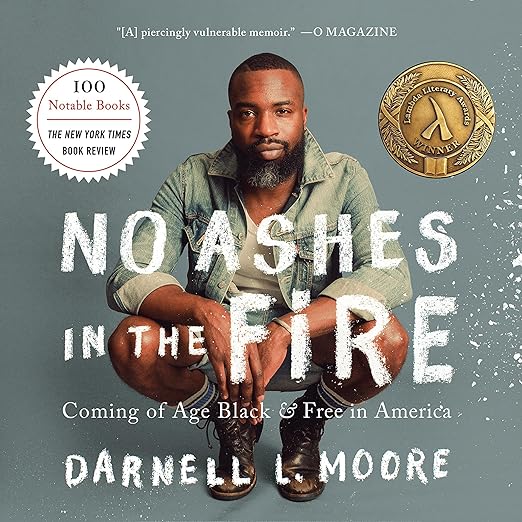
At fourteen, Darnell Moore was ambushed by three boys from his own neighborhood who assumed he was gay, doused in gasoline, and nearly burned alive on his way home from school. This audiobook, narrated in Moore's own voice, opens with that attack rather than easing into it, then spends its remaining hours tracing how that terrified teenager grew into an award-winning journalist and a leading Black Lives Matter organizer.
Reading His Own Account as an Act of Witnessing
Moore doesn't structure this as a straightforward victim-to-survivor arc. The synopsis frames it as a story of transcendence over what it calls the myriad forces of repression, with the personal survival story braided into a portrait of Camden, New Jersey, a hometown treated with real affection despite its hardships rather than reduced to a grim backdrop. That refusal to flatten either himself or his city into a single note is part of what gives the memoir its weight.
Reviewer Michelle, describing herself as a longtime follower of Moore's journalism, calls memoir writing 'a daring, daunting task' and says plainly that 'Moore is well braced for the challenge.' Self-narration matters enormously for a book like this. Moore reading his own account functions less like a performance and more like an act of witnessing, his own voice inseparable from the material's authority in a way a hired narrator, however skilled, couldn't fully replicate.
A Title About the Fire That Failed to Claim Him
The title itself carries real weight once you've heard the opening chapter. No Ashes in the Fire evokes survival that leaves no trace of defeat behind, and that image runs through how Moore frames his own life afterward, less as someone who escaped destruction and more as someone the fire simply failed to claim. It's a small detail, but it signals a writer thinking carefully about language and structure, not simply recounting events in chronological order.
The specificity of Camden, New Jersey, in this account matters beyond scene-setting. Moore treats the city's own struggles, economic hardship, disinvestment, and violence, as inseparable from his personal story rather than incidental backdrop, drawing a direct line between structural neglect of a place and the dangers that found him as a teenager there. That connection between environment and personal harm gives the memoir a sociological dimension alongside its intimate one.
Required Reading for Everyone in the Country
Stephanie's review offers a specific and telling context: most of the books on her shelves are by Black heterosexual women, and this was her first time reading a memoir by a queer Black man. She describes finding it 'incredibly moving,' which speaks to the book's power to open perspective for listeners outside its most immediate audience, not just affirm the experience of those who already share it.
Reviewer D J goes further, calling it required reading for everyone in the country, a claim that ties directly to Moore's activism. This isn't purely personal history. Moore's Black Lives Matter organizing work gives the memoir stakes beyond one man's survival story, turning it into something closer to an argument for seeing structural harm clearly rather than looking away from it.
Moore Refuses to Pick Journalist Over Activist
Moore's specific description of himself as both a journalist and an activist, rather than choosing one identity over the other, shapes how the book balances reporting instinct with personal stake, refusing to pretend at the kind of neutral distance a purely journalistic account might otherwise claim for itself.
Moore's career as an award-winning journalist shows up in the craft of the storytelling itself, not just in his credentials. The synopsis frames the book's ultimate argument as bigger than one life story, a case that liberation becomes possible when people commit to building futures where those pushed to society's margins can genuinely thrive, not just survive. That widens the book's scope well beyond memoir into something closer to a call to collective action, grounded in one specific, harrowing personal history.
Listeners who've read Moore's journalism previously, whether at Mic or elsewhere, will find this memoir adds a layer of origin story to work they may already know, tracing the personal history that shaped his later reporting and organizing rather than existing as a wholly separate, unconnected project.
Building Toward Hope Rather Than Cataloguing Harm
This is not an easy listen, and it shouldn't be mistaken for one. The opening attack is rendered in direct, unflinching detail, and the synopsis makes clear it wasn't the last time Moore would face real danger. Listeners sensitive to depictions of hate-motivated violence should know that going in, though the account reads as someone processing lived experience rather than sensationalizing it for effect.
At six hours, this is a relatively compact memoir, which suits its intensity. A longer, more drawn-out treatment of this material might have been its own kind of difficult to sit through. It's also worth knowing the book is explicitly building toward hope and liberation as an endpoint, not just cataloguing harm, so the darkness at the center doesn't define the entire listen.
This isn't a book where the worst moment happens in the opening minutes and then resolves into safety. Further danger follows across Moore's later life, which raises the emotional stakes but also means the intensity doesn't fully release until much later in the runtime. Listeners expecting the memoir to downshift into safety after its opening chapters should recalibrate that expectation directly before pressing play.
The runtime itself is worth weighing against the subject matter honestly. Six hours is short enough to finish in a single weekend, which some listeners may prefer for material this intense, getting through the hardest parts without the story lingering across weeks of intermittent listening. Others may find that same compactness means less time to emotionally process each chapter before the next one begins, so pacing preference here is a genuinely personal call rather than a fixed recommendation either way.
A Hometown That Functions as a Real Character
Readers of contemporary LGBTQ-plus memoir, anyone following Moore's journalism or his Black Lives Matter organizing specifically, and listeners drawn to place-specific memoir, where a hometown functions as a real character rather than scenery, will all find substantial reward here.
Readers who appreciate memoir that resists a tidy resolution, one that keeps circling back to unfinished questions about safety and belonging rather than closing them off neatly, will find Moore's approach rewards a more attentive kind of listening than a straightforward survival narrative might ask for.
The unflinching opening violence will be genuinely hard for some listeners to sit with, and anyone not in a place to take in a hate-crime survival story at its center should wait for a moment when they are, rather than push through before they're ready.
At a Glance
- Voice: Darnell Moore narrates his own story with the steadiness of someone bearing witness rather than performing, which suits testimony this personal.
- Big ideas: surviving a hate crime, Black queer identity, activism and liberation
- Atmosphere: Harrowing but ultimately hopeful
- Worth it?: A powerful, difficult listen that earns its emotional weight, best approached when you're ready for its opening violence.
Before You Listen
Why does Darnell Moore narrate this audiobook himself instead of using a professional narrator?
His own voice functions as an act of witnessing rather than performance, giving the memoir an authority a hired narrator couldn't fully replicate for material this personal.
How long is the No Ashes in the Fire audiobook?
It runs six hours, a relatively compact runtime that suits the intensity of the material without dragging the difficult content out longer than necessary.