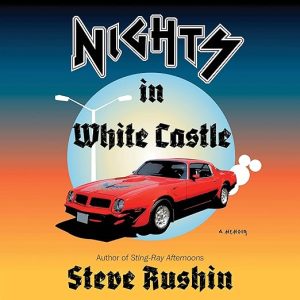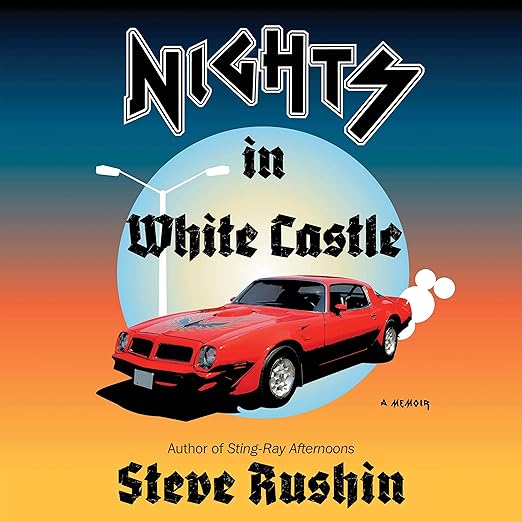
A thirteen-year-old kid staging his own author photo in Bloomington, Minnesota, hoping it will someday grace a book jacket: that’s where Steve Rushin opens this audiobook memoir, and the joke lands harder once you know he actually got there. Nights in White Castle picks up where Sting-Ray Afternoons left off and follows Rushin from that staged photo through a menial summer job at Bennigan’s, a stint in Milwaukee, and into seedy early-1980s New York City, ending at a desk in the legendary Time & Life Building.
At eight hours and forty-five minutes, narrator Greg Baglia carries listeners through what the synopsis itself calls an extraordinarily funny and tender account of the specific, disorienting years between adolescence and an actual career, the ones most memoirs skip past in a paragraph.
Baglia Carries a Story Evoking Blake's Bildungsroman
This is a sequel in the loosest, most functional sense: it doesn’t require the earlier book to make sense, but it clearly rewards readers who’ve already spent time with young Rushin. The structural arc, small-town Minnesota kid to New York media professional, is really a story about how far a specific kind of ambition and self-deprecating humor can carry someone, and Rushin never lets the destination make the earlier, more embarrassing years feel like mere setup.
The book’s real subject is the gap between who you think you’re becoming at thirteen and who you actually turn out to be at the Time & Life Building a decade later, and Rushin treats that gap as comedy first and only lets the tenderness surface underneath it.
The synopsis frames this explicitly as a journey from innocence to experience, deliberately evoking the coming-of-age tradition running from Blake’s poetry through a century of bildungsroman memoir, and Rushin earns that framing by refusing to let any single stage of the journey, the staged author photo, the Bennigan’s job, the Milwaukee dorm room, the New York City newsroom, feel like a punchline at young Rushin’s expense alone. Each stage gets to be both genuinely funny and genuinely formative, which is a harder balance than straightforward comic memoir usually attempts. That’s the throughline connecting this book to its predecessor: both track a specific kind of American boy learning, awkwardly and in real time, who he’s actually going to become. THOMAS SMITH’s review captures this generational specificity well, describing the shock of realizing a beloved writer’s career had somehow run parallel to his own life for years without him noticing. That’s a rarer accomplishment in memoir than it sounds, since most writers settle for one register or the other rather than sustaining both simultaneously.
A 1989 Manuscript Rushin Never Answered
One reviewer’s reaction gets at exactly the audience this book rewards: a self-described “sports-loving Minnesota native” who admits being “embarrassed” that Rushin’s career at Sports Illustrated had somehow eluded them until a friend compared their own writing to his, at which point they went and bought his earlier memoir. Regional and professional overlap with Rushin clearly deepens the experience, though it isn’t required to enjoy it.
The single best piece of evidence for how devoted Rushin’s readers become comes from a reviewer who has followed him “since he began to write for Sports Illustrated” and once, in 1989, mailed him “a long hand-typed manuscript of my own semi-humorous experience trying to sneak into the old Boston Garden (he never replied).” That’s the kind of specific, decades-long fan relationship a genuinely good humor writer builds, and it says something that this reviewer is still showing up for his memoirs more than three decades later.
The geographic arc, suburban Minnesota to a Milwaukee dorm room to a grittier, pre-gentrification Manhattan, tracks a real transition in American media careers that barely exists anymore: a kid without connections working his way into a major publishing address through persistence and talent rather than an unpaid internship funded by family money. That specific, now-vanished pathway gives the book real documentary value about how career mobility used to work in publishing, layered underneath the comedy. Listeners interested in media history, not just memoir as entertainment, will find something genuinely informative buried inside the laughs. J.K. Campbell’s own decades-long correspondence, real and unanswered, with Rushin is itself a small piece of that same media-history texture: fans reaching out to a working writer through the mail, long before social media made that kind of direct address instantaneous and expected.
Sports Illustrated Fame Aside, This Isn't a Sports Book
Because this continues directly from Sting-Ray Afternoons, first-time Rushin listeners will get more context and payoff by starting there, even though this volume is written to stand on its own chronologically from age thirteen forward.
The cultural specificity is real and worth naming: Bennigan’s, Milwaukee college life, and the particular texture of early-Reagan-era Manhattan are all very specific touchstones, and one reviewer notes being “about 5 years younger than Rushin but certainly” having lived through the same era. Listeners of a similar generation, or with genuine curiosity about that specific American moment, will feel these references land differently than a reader with no reference point for them at all.
Despite Rushin’s fame coming from sports journalism, this specific memoir isn’t a sports book; the synopsis and every attached review describe a general coming-of-age story that happens to end at a media career, with Sports Illustrated functioning as a later-life detail rather than the book’s actual subject. Listeners with zero interest in sports can approach this without hesitation, since the book’s real terrain is adolescence, ambition, and early adulthood rather than box scores or press boxes. That’s worth clarifying upfront, since the Sports Illustrated connection in reviewer bios might otherwise suggest a narrower audience than the book actually has. Norcalsurf’s review, from someone roughly five years younger than Rushin, suggests the generational window for full recognition is real but not narrow, spanning at least a decade of readers who came of age around the same cultural moment.
The Humor Travels Well Past Rushin's Fanbase
Existing Rushin fans, sports journalism readers, and anyone who enjoys funny, self-deprecating coming-of-age memoirs are the clearest audience, especially listeners roughly Rushin’s own generation who came of age in a similar cultural moment.
Readers of American coming-of-age memoir generally, not just sports-adjacent audiences, are a real fit here, alongside anyone who enjoys a specific, deeply personal account of the unglamorous jobs and awkward transitions most successful people’s official biographies skip entirely. The humor travels well beyond Rushin’s existing fanbase, even if that fanbase gets an extra layer of recognition the rest of the audience won’t.
A reader with zero interest in Rushin’s earlier memoir, or no patience for early-1980s cultural specifics, will miss some of the payoff, even though the book does real work to stand on its own for newcomers.