Before You Press Play
- Read by: Elizabeth Callens manages dense horror retrospective material with clear authority, bringing particular energy to the exclusive interview sections.
- At its heart: franchise analysis, horror film history, Freddy Krueger iconography
- Vibe: Seriously fan-scholarly, with a genuine critical argument beneath the retrospective structure
- Short version: The most rigorous audiobook treatment of the Nightmare on Elm Street franchise, built for dedicated fans who want production history and genuine critical engagement with the sequels.
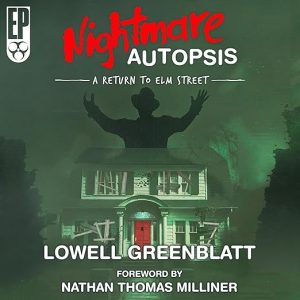
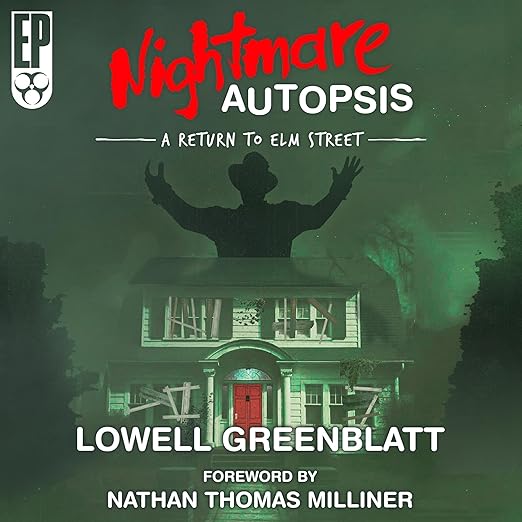
Does a franchise built on a razor-gloved dream demon who kills teenagers in their sleep deserve the kind of rigorous retrospective treatment usually reserved for canonical cinema? Lowell Greenblatt answers that question implicitly in every chapter of Nightmare Autopsis, and his answer is an unambiguous yes. This audiobook, narrated by Elizabeth Callens across 12 hours and 55 minutes, is a full-franchise examination of the Nightmare on Elm Street series, featuring original story analyses, production history, and exclusive new interviews with cast and crew from every entry in the original run. The title itself signals intent: an autopsis, in the historical sense, is a seeing for oneself, a firsthand examination, and Greenblatt has done the sustained work that framing requires.
The book features reflections from three directors, extensive looks at unused sequel scripts, notes on deleted and alternate scenes, deep dives on each film's story origins, and what the author describes as long-overdue appreciations for the sequels, which have historically been dismissed in critical accounts of the franchise that privilege the original 1984 Wes Craven film above everything that followed. Greenblatt's argument about the sequels is the book's most intellectually interesting contribution, and Callens's narration of those sections carries a genuine advocacy energy that reflects the author's own investment in making the case.
Callens Differentiates Voice and Tone Throughout
Callens's narration is one of this audiobook's decisive assets. She brings a clear, authoritative voice to what is genuinely dense material, managing the transitions between interview excerpts, production history, and analytical commentary without losing the listener in the layering. Horror retrospective books can become dry catalogs of production minutiae, and Callens's pacing prevents that. She reads the interview reflections with particular liveliness, and the sections drawing on exclusive new accounts from cast and crew benefit enormously from her ability to differentiate voice and tone within the prose.
The book's approach to the sequels is its most intellectually interesting contribution. Most Elm Street scholarship, such as it is, treats the original film as the franchise's only serious artistic achievement and dismisses the sequels as diminishing returns. Greenblatt pushes back against that framing with genuine critical attention, and his analysis of the unused sequel scripts and the alternate creative paths the franchise could have taken is the kind of material that even knowledgeable fans are unlikely to have encountered before. A reviewer familiar with similar horror retrospectives like Taking Shape and Slash of the Titans noted that Nightmare Autopsis operates at the same level of dedicated fan-scholarship, which is the relevant comparison for assessing its seriousness and depth.
A Photo Gallery Lost in the Audio Edition
The audiobook format works particularly well here because the interview material, Greenblatt's exclusive conversations with directors, cast members, and genre luminaries, benefits from the spoken register. These are oral histories in spirit, and hearing them rendered in audio rather than reading them as printed text preserves something of their original conversational texture. At nearly thirteen hours, the runtime reflects genuine depth: the franchise spans multiple films, and Greenblatt gives each entry substantive treatment rather than allocating attention in proportion to critical reputation. The late entries in the series, which most critics have treated as franchise decay, receive analysis that treats them as objects of genuine interest rather than cautionary tales.
The foreword by Nathan Thomas Milliner, delivered at the audiobook's opening, establishes the retrospective's scholarly credentials within the horror fan community. It is a brief but purposeful framing that signals to the listener what kind of book they are entering. The franchise-spanning photo gallery referenced in the print edition is not accessible in audio form, which is the one format limitation worth acknowledging for listeners who would want the visual companion alongside the historical analysis.
Freddy Krueger's Iconography, Traced Film by Film
The sections on Freddy Krueger's evolving iconography, tracing how the character's visual design and tonal register shifted across the film series, are among the audiobook's most analytically interesting passages. Callens reads these with engaged precision, and they represent the kind of cultural analysis that lifts the book beyond pure fan service into something more genuinely critical. The discussion of how each film influenced the next is structured as a cumulative argument rather than a series of independent chapter summaries, which means it rewards sequential listening rather than dipping in and out. The logic builds across the franchise's run, and the payoff of that structure is a coherent argument about why the Elm Street series matters beyond its body count.
Note that the audiobook excludes coverage of the 2010 remake and the two-season Freddy's Nightmares television series. One reviewer flagged this exclusion while still rating the book highly, noting that the coverage within scope is generous enough to justify the editorial choice. The franchise's original theatrical run is treated with enough thoroughness that the exclusions do not leave significant gaps for the listener who has followed that run.
The Most Complete Account Currently Available
This audiobook is built for the dedicated Nightmare on Elm Street fan who wants serious, researched engagement with the franchise rather than a surface-level celebration. Listeners who have seen every entry in the original run and want to understand the production history, the creative decisions, and the critical context that shaped the franchise will find it genuinely substantive. General horror fans who have not spent significant time with the Elm Street series should probably approach the films first. The book assumes familiarity with the material it analyzes, and its argument about the sequels' undervalued status will land differently for listeners who have actually watched them. Those who have will find this audiobook the most complete account of the franchise's creative history currently available.
Does Elizabeth Callens's narration serve the horror retrospective format of this audiobook?
Very effectively. Callens manages the transitions between production history, interview excerpts, and cultural analysis without the audiobook becoming a dry catalog. Her reading of the exclusive interview material is particularly strong.
Does this audiobook cover the 2010 Nightmare on Elm Street remake?
No. One reviewer noted that the remake and the Freddy's Nightmares television series are both excluded. The audiobook focuses on the original film series run, which still represents nearly 400 pages of original content with a generous selection of production detail and exclusive interviews.