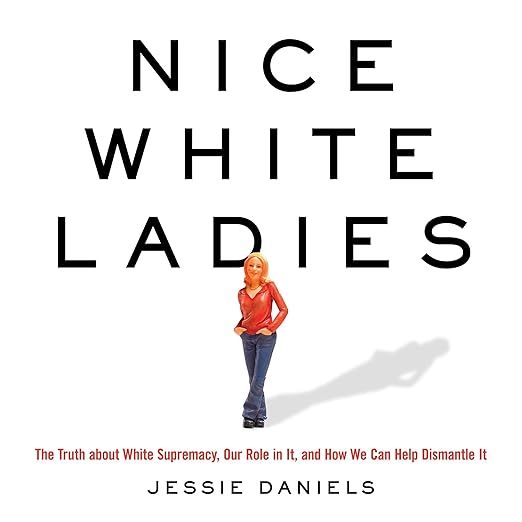
Quick Take
- Narration: Jessie Daniels reads her own work with the authority of someone who has spent decades in this material, keeping the academic rigor and personal candor in productive tension.
- Themes: white women’s role in systemic racism, the politics of niceness, segregation through everyday choice
- Mood: Incisive and unflinching, with a constructive intent that keeps it from becoming purely accusatory
- Verdict: A serious, well-researched argument that asks white women to examine their own complicity, with the courage to implicate the author alongside everyone else.
I finished Nice White Ladies over two evenings, and I spent a fair portion of that time genuinely uncomfortable in the specific productive way that serious social criticism is supposed to make you uncomfortable. Jessie Daniels is a sociologist who grew up as the granddaughter of a Klansman, taught in universities, spent years researching white supremacy online, and brings all of that accumulated biographical and intellectual weight to an argument that is both careful and unflinching.
The title’s provocation is intentional. Daniels is not interested in the easy target of the viral Karen video, though she acknowledges it as part of the cultural landscape. She is interested in the more durable, less visible complicity that lives in the ordinary choices of well-meaning white women: which schools they choose for their children and why, what the cumulative effect of those choices is on school segregation, how a wellness industry premised on self-care has insulated a demographic from confronting its own privilege, and how even progressive feminism has repeatedly displaced women of color from its center.
Our Take on Nice White Ladies
The structure of the book moves between memoir, academic analysis, and reportage, and Daniels is skilled at keeping all three modes in conversation with each other. The memoir sections carry particular authority because she is not positioned as an observer of the phenomenon she is critiquing. She is, by her own account, part of it, and the willingness to implicate herself gives the critique a moral seriousness that it would lack if she maintained a distance between herself and her subject.
The analytical framework draws on a wide base of scholarship, but Daniels translates it for a general educated audience without losing precision. The argument about school choice and resegregation is particularly well-evidenced: white mothers making individual decisions that feel entirely reasonable within the frame of parenting for their child’s benefit are collectively recreating the segregated educational landscape that civil rights law was meant to dismantle. The mechanism, not individual malice but systemic structural logic operating through individually reasonable choices, is exactly what makes this kind of analysis necessary and exactly what makes it hard to internalize.
Why Listen to Nice White Ladies
Daniels narrating her own work is the right production choice for this particular book. Her academic background gives the prose a precision that a neutral narrator might render dry, but her personal investment keeps it from becoming clinical. When she describes her grandmother’s influence, or the specific discomfort of recognizing her own behavior in the patterns she is analyzing, you hear that discomfort in her voice in a way that serves the argument. It is not performance. It is a scholar sitting with her own findings.
Reviewers across a range of backgrounds have described the book as perspective-shifting, which is the appropriate term. One reviewer, describing themselves as biracial and someone who considered themselves aware of racial dynamics from multiple angles, noted being presented with new perspectives they had not considered. That is meaningful evidence that the book’s analysis extends beyond confirming what readers already believe.
What to Watch For in Nice White Ladies
The book is oriented toward a US context, and the specifics of American school choice policy, residential segregation patterns, and the particular history of white feminism in the United States are load-bearing to the argument. International listeners will find the framework intellectually transferable, but the detailed evidence is drawn from American institutions and dynamics.
The book also moves at an analytical pace that is not everyone’s preferred register. This is not narrative nonfiction in the conventional sense. It is more closely aligned with accessible academic writing, the kind of book that requires you to sit with ideas rather than simply absorb a story. Listeners who came to it expecting something more journalistic or memoir-forward may find the argumentative mode less immediately engaging than they hoped.
Who Should Listen to Nice White Ladies
This audiobook will reward white women who are genuinely trying to understand their relationship to systemic racism and are willing to hear an argument that locates part of the problem in well-intentioned behavior. It will also serve educators, social workers, and policy thinkers who want a rigorous analysis of how inequality is reproduced through everyday choices rather than explicit prejudice. Listeners who come wanting affirmation rather than examination, or who approach the premise defensively, will likely disengage. For everyone else, this is eleven hours of honest, evidenced, constructive social criticism from someone with the biography and the scholarship to make the argument stick.
Frequently Asked Questions
Is Nice White Ladies only relevant to white women, or does the analysis speak to a broader audience?
While the book is explicitly addressed to white women, the analysis of how systemic racism operates through ordinary individual choices is relevant to anyone trying to understand racial inequality in the United States. Reviewers from biracial and non-white backgrounds have described finding new perspectives in the book that extended their own understanding.
How does Daniels handle the tension between critiquing white women as a group and acknowledging individual variation?
She focuses on structural patterns and systemic mechanisms rather than individual guilt. The Karen figure is explicitly named as the wrong frame. Her interest is in cumulative effects of ordinary choices, not in assigning blame to individuals acting within the constraints of a system they did not design but do participate in.
Is the book primarily academic in tone, or does it read accessibly for general audiences?
It occupies a middle space. The scholarship is genuine and the analysis is rigorous, but Daniels writes for educated general readers rather than for an academic journal. The memoir sections and reportage provide texture and entry points that make the analytical argument more accessible, though listeners accustomed to narrative nonfiction may find the argumentative mode more demanding than expected.
Does Daniels offer a constructive path forward, or is the book primarily a critique?
The synopsis describes a second section that charts a better path forward. Daniels looks at white women who have taken active roles in fighting neo-Nazis online, challenging all-white spaces, and organizing within communities. The book is not structured as a simple condemnation without alternative, though the critical analysis takes up more space than the prescriptive material.