At a Glance
- Narrator: Nick Adams reads his own work with the ease of a storyteller who has told these tales at rally stops many times before, unhurried and comfortable in his own voice.
- Subjects: Finding renewal in familiar roads, the particular pleasures of modest machines, the texture of Canadian wilderness riding
- Tone: Relaxed and road-weary in the best sense, with the warmth of good campfire conversation
- Bottom line: A satisfying collection of motorcycle essays that works best as road company for riders who know the specific pleasure of going somewhere they have already been.
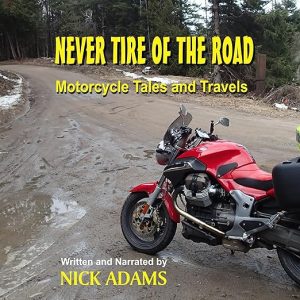
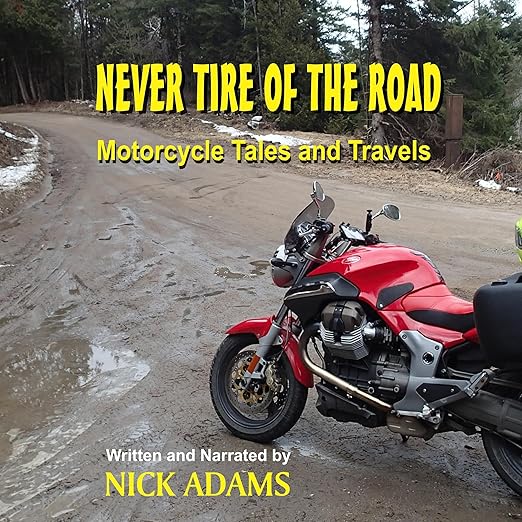
Nick Adams rides a $750 plastic ugly duckling through northern Ontario forest roads in one chapter of Never Tire of the Road, and that specific detail tells you almost everything you need to know about the audiobook's sensibility. Adams is not writing about aspirational machines or bucket-list routes. He is writing about the specific psychological texture of riding the same roads again, facing the ennui that creeps in when familiarity tips into staleness, and finding that a slight change in perspective or attitude restores what you thought you had exhausted. For listeners who have been riding long enough to know that feeling intimately, this audiobook is the written equivalent of a good riding partner in the seat beside you: someone who has also been around long enough to know that the journey is not always revelatory, and that this is fine.
The Review
The book is explicitly a grab-bag of motorcycle tales, and Adams does not try to disguise that structure with false narrative continuity or a unifying thesis beyond the title sentiment. He rides northern Ontario forest roads on that cheap plastic bike, explores Nova Scotia by what he calls a road couch, adventures by ancient Guzzi through ADV territory, and dips into urban Ontario to visit a couple of enormous hounds. These are not dramatic journeys in the conventional travel-writing sense. They are the kind of rides that most serious motorcyclists actually take, the ones that do not produce Instagram moments or summit photographs but that constitute the actual substance of a life spent on two wheels across decades. Adams finds something genuine in those ordinary excursions, and his prose is relaxed enough to carry it without overselling. The book's thesis, that avoiding road ennui is a matter of attitude and perspective rather than itinerary, sounds simple and perhaps obvious. But Adams earns it through accumulation rather than declaration, building the case ride by ride rather than stating it upfront and then illustrating it with examples. That structure rewards patient listening over the four-and-a-half-hour runtime.
Why Listen to Never Tire of the Road
Self-narration works particularly well here because Adams's writing has the rhythms of spoken storytelling more than formal prose. His delivery on the audiobook matches what reviewers describe when they say his writing brings enthusiasm and genuine interest even to seemingly mundane descriptions. One reviewer noted that even the ordinary passages are riveting to a fellow rider, which points to the right frame for this material: this is writing for riders by a rider, and the insider register is part of what gives it its texture. Non-riders can certainly follow the content, but they will miss some of the specific recognitions that make the book satisfying. At four hours and thirty-two minutes, the runtime is modest enough to serve as actual road company, something you might put on during a long stretch of familiar highway when you want the mental equivalent of a riding companion who knows when to talk and when to leave you to the road. The Nova Scotia segment in particular carries the specific pleasure of somewhere Adams clearly loves, rendered without tourist promotion or forced wonder. He has been there enough times to describe it the way you describe a road you know.
The Caveats
Readers outside the motorcycling world will find less traction here than enthusiasts. Adams is not making a case for motorcycling as a lifestyle or explaining its appeal to the uninitiated. He assumes the reader already knows why you would pull on all that gear and head out on a cold morning, and builds from there. Non-riders can certainly enjoy the writing on its own terms, but the specific pleasures the book offers, the recognition of certain road feelings, certain machine personalities, certain atmospheric conditions that change a familiar stretch entirely, require some lived experience with the activity to resonate fully. The Canadian geography is also specific and not always well-known to readers outside Ontario and the Maritimes. This is not a problem so much as a feature: Adams is writing from his own territory, which is where the best travel writing always comes from. The modest production values of the self-narrated recording are in keeping with the book's personality; this is not a polished studio performance, and the slight roughness suits the material.
Should You Listen to Never Tire of the Road?
Motorcyclists who are between rides, grounded by weather or circumstance, are the ideal audience. Adams's reviewers make this explicit: one noted that his stories get them through the stretches when they cannot get out on their own bikes, that they serve as a substitute for being on the road. This is road-trip literature functioning as replacement riding, which is a specific and underserved genre. Writers who ride and riders who read will find Adams a companion worth returning to; he has produced multiple books in this mode, and the consistency reviewers describe across his catalog suggests this volume is representative of his quality rather than exceptional. New riders curious about the touring life will get something from it, but the book speaks most directly to the experience of having been out there many times already and loving it anyway, which is the feeling the title names. Skip it if you are looking for dramatic adventure writing or unfamiliar territory as the primary appeal.