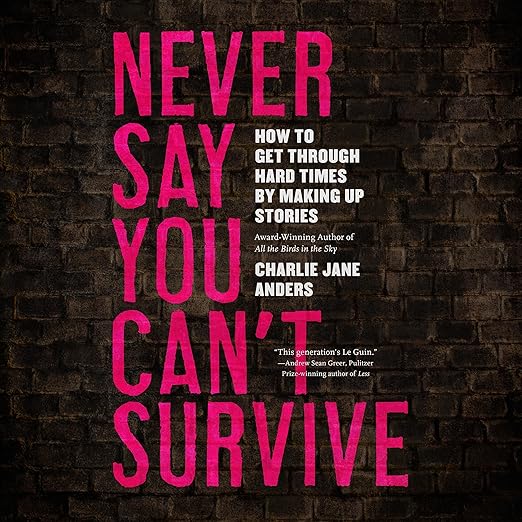
Charlie Jane Anders wrote Never Say You Can't Survive during a period of acute political crisis, and this audiobook - narrated by Anders herself across seven hours and twenty-two minutes - does not allow the listener to forget that context even when it is operating as a practical craft guide. That insistence is the book's central argument: that creative work and political reality are not separable concerns, and that understanding storytelling technique matters more, not less, when the world is genuinely frightening. Anders is the author of All the Birds in the Sky and The City in the Middle of the Night, both significant works of speculative fiction, and she brings the authority of a working novelist to advice that could easily sound abstract when delivered by someone who has not recently sat with the specific difficulties of getting a long narrative to cohere. A Macmillan Audio production, this is a book that was partly serialized chapter by chapter before its final form, and that origin is visible in the structure - each section is self-contained enough to be revisited without the full context, which turns out to be an asset in audio.
Memoir Sections That Double as the Argument
The book is organized into sections covering storytelling fundamentals, specific writing techniques, and the writing life - the practical and emotional conditions under which writers do or fail to do their work. AudioFile Magazine called it "part memoir, part pep talk," which is accurate but undersells the craft content. The technique sections are specific enough to be genuinely useful. Anders addresses character motivation, narrative structure, the mechanics of tension, and the relationship between a writer's identity and their fictional choices with the precision of someone who has thought about these problems in the context of actual manuscripts rather than in the abstract. One reviewer who followed the book chapter by chapter during its original serialized publication described it as "the rare mixture of solid writing advice and lived experience," and that combination is where the book earns its distinction from standard writing guides. The memoir sections are not filler bridging craft chapters; they are the argument. Anders is showing, not just telling, that personal experience processed through a committed creative practice produces work that matters and sustains the person making it. A reviewer who identified as a painter found the fiction-specific advice required translation to their medium, which is an honest observation worth noting for non-fiction and non-literary readers approaching this with different creative contexts in mind.
Anders's Casual Presence Only Works Read Aloud
The self-narrator format is not incidental here; it is the point. AudioFile Magazine specifically cited Anders's "colloquial and casual presence" as a strength, and that presence is far more available in the audio format than on the page. Reading this book in print, the informal register reads as a stylistic choice. Hearing Anders deliver it, the informality is clearly a temperamental quality - this is genuinely how she thinks and speaks about writing, and the voice tracks, starts over, finds the right word in real time in a way that makes the craft advice feel less like received wisdom and more like active problem-solving happening in front of you. For writers who feel alienated by the authority pose of much writing-about-writing, that quality is significant. The seven-hour runtime is distributed unevenly across the book's sections, with the craft chapters receiving the most sustained attention. The writing life sections - on managing creative anxiety, maintaining practice during difficult external circumstances, finding and sustaining community - are shorter but function as pressure releases across the longer analytical passages. Fans of Anders's fiction who read All the Birds in the Sky or The City in the Middle of the Night will find this production a useful companion to understanding how those books came to exist.
Speculative Fiction Chapters Are Where This Sharpens
The sections where Anders addresses her own genre - speculative fiction, science fiction, fantasy - are the sharpest, as might be expected from someone who has spent her career working in those forms. Her observations about worldbuilding, the specific challenges of the secondary world, and the relationship between political allegory and narrative transparency in genre fiction are precise and practically useful in ways that her more general craft observations occasionally are not. The book's political grounding - the insistence that writing is an act of resistance during difficult times - is more convincing in the audio version than it might appear in print because Anders's voice carries the authentic weight of someone who needed to believe this argument during a difficult period and tested it against her own practice. That personal pressure is the difference between the book's central claim being inspiring and being true. The chapter organization translates well to audio; each section is self-contained enough that listeners can return to specific craft topics without losing continuity. One reviewer described a previous iO9 connection to Anders that predates this book, which points to a writer whose critical voice has been consistent across formats and years - this audiobook is the distillation of that consistency into a single, sustained argument about why making things matters.
Fiction Writers Who Need Permission to Create
Fiction writers - particularly those working in speculative, science fiction, and fantasy traditions - who want a craft guide that takes their political and emotional circumstances seriously will find this an unusually honest companion. Writers who have struggled with the question of whether creative work is defensible during periods of real-world crisis will find Anders's answer specific and actionable rather than merely reassuring. Listeners who are fans of Anders's fiction will encounter the writer behind the novels in a way that illuminates the work without reducing it to autobiography. Non-fiction writers and visual artists may find the advice requires translation to their forms, as one reviewer noted; the book is primarily structured around narrative fiction. The self-narrator format makes this far preferable as an audiobook than as a print reading for most listeners; the colloquial register simply works better spoken than read, and that difference matters across seven hours.
Before You Listen
Does Charlie Jane Anders narrate the audiobook herself, and how does that shape the experience?
Yes, and it significantly shapes the listening experience. AudioFile Magazine cited her 'colloquial and casual presence' as a defining quality. The informal, thinking-aloud tone works more naturally in audio than on the page, making the craft sections feel like active problem-solving rather than received wisdom.
Is the audiobook organized to allow listening to specific sections rather than straight through?
Yes. The book is structured in distinct sections covering storytelling, technique, and the writing life, with self-contained chapters that allow listeners to return to specific topics. Multiple reviewers note it works well as a reference text you can dip into rather than requiring linear listening.
How political is Never Say You Can't Survive, and does it overshadow the craft content?
The political context is present throughout but serves as framing rather than subject matter. The book argues that writing is an act of resistance during difficult times, and that framing is woven into the craft advice rather than replacing it. Listeners who share the book's political sympathies will find it energizing; those who do not may find the framing more intrusive.