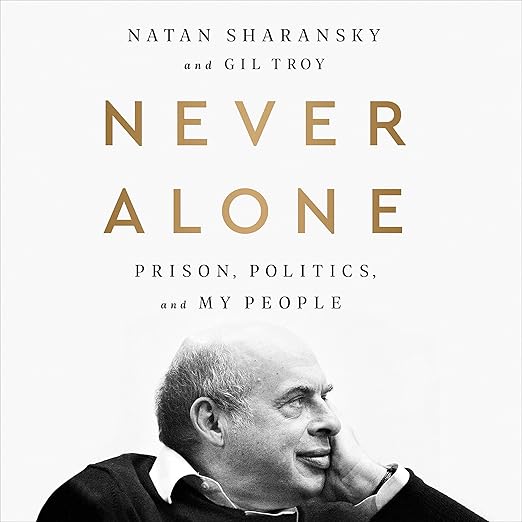
Quick Take
- Narration: Sharansky reads his own story with quiet authority and a distinct accent that adds unmistakable authenticity to nine years of Soviet imprisonment and decades of public life.
- Themes: Political imprisonment and resilience, Jewish identity and belonging, liberal democracy under authoritarian pressure
- Mood: Reflective and morally serious, yet warmed by wit and conviction
- Verdict: A rare memoir that earns every claim it makes about freedom and identity, best appreciated by listeners who want historical substance alongside personal testimony.
I came to Never Alone already knowing the broad strokes of Natan Sharansky’s story. The Soviet dissident, the KGB arrest in 1977, the nine years in the Gulag including stretches in brutal solitary confinement, the eventual release and emigration to Israel. What I did not expect was how the audiobook would reframe all of that history as prologue. Sharansky reads his own words, and within the first hour it becomes clear that this is not a book principally about suffering. It is a book about what a person builds from suffering, and how belonging to a people, an idea, and a cause can sustain someone across decades of pressure.
I listened to the first half across two long evenings, the kind where the windows go dark and you keep pushing back bedtime by another chapter. Sharansky’s voice carries an unhurried gravity that suits the material perfectly. He is not performing anguish. He is simply telling you what happened, and trusting you to understand its weight.
Our Take on Never Alone
The book earns its unusual structure. Organized around Sharansky’s three-times-nine framework, nine years in the Gulag, nine in Israeli politics, nine heading the Jewish Agency, it uses that symmetry not as a gimmick but as genuine moral architecture. Each phase forces a different kind of courage. Prison demanded inner fortitude; Israeli politics demanded public honesty in environments where convenient silence would have been professionally safer; the Jewish Agency demanded bridge-building across a diaspora fractured by geography, denomination, and generational memory. One reviewer describes the book as a chronicle of Sharansky’s 27 years of remarkable public life. That framing is accurate but undersells it. The real subject is how a set of values forged under maximum pressure held up across radically different arenas, and whether they needed to bend to survive.
Why Listen to Never Alone
The narration is a genuine asset here. Authors reading their own memoirs can go either way. Some deliver flat line readings that make you wish for a professional. Sharansky does something better. His cadence reflects a man who has told certain stories many times but has not stopped thinking about them. When he describes the chess games he played from memory in solitary confinement, or the moment Thatcher and Reagan’s public pressure actually changed his treatment inside the Soviet system, his pace slows instinctively. He knows which moments carry the most weight, and he gives them room. The slight Russian-Hebrew inflection in his English never becomes an obstacle. Within twenty minutes, it simply becomes his voice, and any other voice would feel wrong for this material.
What to Watch For in Never Alone
Listeners who know Sharansky primarily from Fear No Evil, his account of the Gulag years, should know that Never Alone deliberately compresses that period to spend more time on what came after. Reviewer Peter Pollak notes this is Sharansky’s fourth book, and that the prison years, while present, serve more as moral context than central narrative. If you come expecting a second deep dive into the Soviet prison system, you will need to recalibrate. What you get instead is a more surprising book: a sustained argument that the qualities cultivated in solitary confinement, clarity, refusal to separate personal and political honesty, loyalty to identity over strategic flexibility, are not just survival tools but governing principles applicable to very different situations. The sections on the Israeli-Palestinian peace process and the tensions between Israeli and diaspora Jewish communities are frank to the point of being uncomfortable, which is exactly what makes them worth listening to. Sharansky has no interest in telling any constituency what it wants to hear.
Who Should Listen to Never Alone
This one is for listeners who want political memoir with genuine intellectual content, not just a compelling life story. If you care about the history of Soviet dissidence, the internal politics of Israel, or the broader question of how liberal democracy fares under pressure from both external authoritarianism and internal tribalism, Never Alone gives you 22 hours of thinking from someone who lived those questions at close range. Skip it if you are hoping for a traditional chronological memoir. The structure is thematic and discursive, and some sections require patience with political detail. But if you stay with it, the final chapters on Jewish unity and the future of democratic identity carry an earned weight that is difficult to find in more conventionally structured books.
Frequently Asked Questions
Does Sharansky’s narration of his own memoir work, given he is not a professional audiobook narrator?
Yes, more than you might expect. His measured pacing and slight accent carry a lived authenticity that a professional actor could not reproduce. The main trade-off is some unevenness in energy across the longer political chapters, but it never becomes a listening obstacle.
Is Never Alone a sequel to Fear No Evil, and do you need to read that first?
It builds on that earlier memoir but works as a standalone. Sharansky summarizes the key elements of his imprisonment without assuming prior knowledge, though readers familiar with Fear No Evil will find added resonance in the brief references back to those years.
How much of the book covers the Israeli-Palestinian conflict and Middle East politics?
A substantial portion, particularly in the middle third covering Sharansky’s years in Israeli government. He discusses Oslo-era negotiations, his friction with Yasser Arafat’s leadership, and his theory of democracy as a prerequisite for lasting peace. These sections are specific and opinionated, not background summaries.
At 22 hours, is Never Alone worth the time investment for a general history listener, or is it aimed mainly at readers already interested in Jewish history?
It will land most strongly with listeners who have some existing interest in Soviet history, Israeli politics, or the broader post-Cold War democratic moment. General history listeners will find it rewarding but should expect more political theory woven through the narrative than a standard biography would offer.