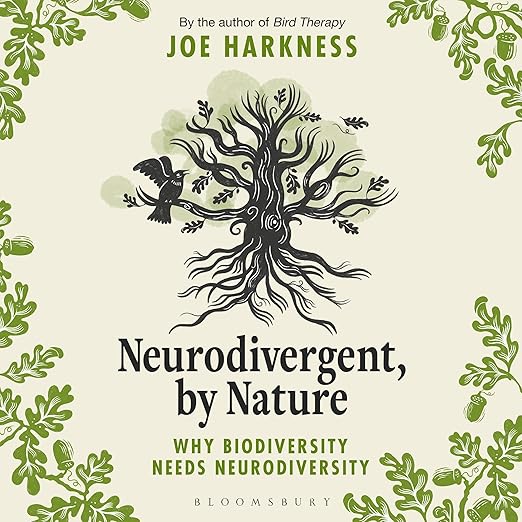
Joe Harkness starts Neurodivergent, by Nature from a position of personal uncertainty, and that quality of not-quite-knowing pervades the audiobook in the best way. After receiving an ADHD diagnosis in his thirties, Harkness began asking a question that sounds simple but opens into considerable complexity: was his deep bond with the natural world intrinsic to his neurodivergence, or something he had arrived at through the particular choices of his life? Rather than answer the question himself, he went looking for others who might help him think it through. What he found was a community of neurodivergent people whose relationship with nature ranged from restorative to vocational to identity-defining. The audiobook, written and narrated by Harkness himself and published by Bloomsbury, runs 7 hours and 40 minutes and is as much a listening experience as it is a reading one.
Self-narrated memoirs are not automatically an asset. When an author reads their own work, the intimacy can feel genuine or it can feel raw in the wrong way, unprocessed, as though the recording booth caught something the page had not. With Harkness, the intimacy works because the book's central uncertainty is not resolved so much as examined. He is not telling you how it turned out; he is thinking aloud about why it mattered. His voice carries the tentativeness of that position, and it makes the book feel more trustworthy than if it had been narrated by a professional with no stake in the material.
An Argument Built From Accumulated Evidence
The structure of the book is important to understand before you begin. This is not a linear memoir of Joe Harkness's own life, though his story threads through it. It is an ensemble piece, a collection of personal accounts from neurodivergent individuals who share a connection to the natural world, many of whom have built nature-related careers around that connection. Some readers come to the book hoping for the deeper theoretical account of why neurodivergence and nature intersect, and a few reviews register mild disappointment on that front. One reviewer with ADHD writes that they were hoping for more analytical depth into the connection itself, rather than a series of personal stories.
That is a fair characterization and also, I think, a misread of what the book is trying to do. Harkness is not arguing a thesis; he is gathering testimony. The texture of the book is accumulated rather than deductive. You understand the connection between neurodivergence and nature through the accumulation of these accounts, through the recurring patterns of hyperfocus finding an object worthy of it, of sensory overwhelm finding relief, of the social pressures of neurotypical environments dropping away in open landscape. The argument emerges through evidence rather than assertion, which is both the book's strength and the source of the occasional sense that it hasn't quite gone as far as it could.
A Faint Structural Irony in the Listening Format
Audio is an especially appropriate format for this particular book. Reading about the sensory aspects of outdoor experience in silence is one thing; hearing Harkness describe the sounds and the stillness of natural spaces while you are walking or commuting is another, more layered experience. The book becomes a kind of companion to its own subject matter. Several of the stories he shares involve people who found relief from cognitive overload through immersion in natural soundscapes, which gives the listening format a faint structural irony that works in the book's favor.
Harkness also draws on his professional experience here, and the passages that address what workplaces and schools gain when they genuinely support neurodiversity rather than merely tolerate it are among the book's most useful sections. For parents, teachers, or anyone managing teams with neurodivergent members, these sections offer practical reframing alongside the personal narrative. The book does not separate the personal from the systemic; it insists they are the same conversation, and that insistence is one of its most durable qualities.
Years of Masking Before a Late Diagnosis
Pay attention to the recurring theme of diagnosis timing. A significant proportion of the people Harkness speaks with received their diagnoses in adulthood, often after years of masking in environments that did not accommodate their processing styles. The book does not dramatize this; it allows the pattern to accumulate quietly. By the time you have heard several accounts of the relief that came with a late diagnosis, the argument about why earlier identification matters has been made more persuasively than any policy paper could make it.
The chapters that address nature-related careers are particularly interesting for listeners who work in education or conservation. Harkness is careful not to romanticize neurodivergence as straightforwardly advantageous, but he is clear-eyed about the ways that the specific cognitive styles associated with ADHD, autism, and related conditions can produce exactly the kinds of deep focus, pattern recognition, and sustained passion that environmental work requires. The correlation is not coincidental, and the book makes that case without overstating it.
The Voice and Text Feel Genuinely Inseparable
This audiobook will resonate most directly with people who are neurodivergent themselves and who have wondered about their own pull toward natural environments. It is also genuinely useful for parents, educators, and anyone in a professional context who wants to understand neurodivergent experience through personal testimony rather than clinical description. Those looking for a rigorous theoretical treatment of attachment theory, sensory processing, and ecological psychology will need to go elsewhere; Harkness is a memoirist and community builder, not an academic. But as a piece of thoughtful personal inquiry, this audiobook is hard to fault, and the author-narrator combination makes it one of those self-read memoirs where the voice and the text feel genuinely inseparable.
Is this audiobook relevant if I don't have a formal neurodivergent diagnosis?
Yes. Harkness writes about the experience of connection to nature in ways that don't require a diagnosis to resonate. The book includes people who identified as neurodivergent before formal diagnosis and those who came to self-understanding through the community he describes. It also addresses the broader question of why some people find natural environments restorative, which applies well beyond any diagnostic category.
Does the audiobook benefit from being read by the author rather than a professional narrator?
Substantially yes. The book's exploratory quality, its willingness to not have all the answers, comes through in Harkness's voice in a way that a polished professional narrator would likely smooth over. His hesitations and the genuine warmth he has for the people whose stories he is sharing give the listening experience a texture that suits the material.
How does this audiobook handle the tension between personal story and broader argument?
It leans heavily into personal testimony rather than formal argument. The theoretical framework of attachment theory and sensory processing is present but light-touch. Most of the time, Harkness is sharing stories and trusting listeners to draw the connective tissue themselves. Readers who prefer explicit argument may find the structure diffuse; those who prefer accumulated testimony will find it generous.
Is this audiobook suitable for someone newly diagnosed with ADHD trying to understand themselves?
It is a thoughtful companion rather than a comprehensive guide. Harkness does not offer diagnostic advice or therapeutic frameworks. What he offers is a community of people who have navigated similar questions, and the sense that the deep connection to nature many neurodivergent people feel is neither incidental nor pathological. For the emotional dimension of a new diagnosis, that kind of affirmation can be genuinely useful.