
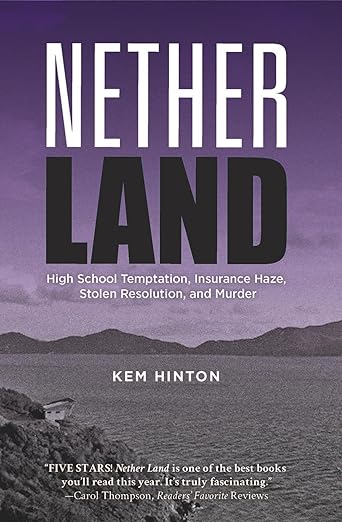
Photographs cannot be read aloud, and the listing for this audiobook says the printed book is filled with anecdotes and photos. Kem Hinton spent a decade chasing the death of Ed Netherland, a former high school classmate murdered at a secluded location in the Virgin Islands, and the result apparently carries images alongside the prose. Scott Ellis is credited with five hours and seven minutes of it. Whatever those photographs were doing on the page, the recording has to manage without them, which means every face, every document and every Tennessee street has to arrive as a sentence or not arrive at all.
Promoting the Investigation to the Role of Plot
Hinton had ten years to shape this, and the shape is the best thing about it. He knew Netherland in high school and in college. The description places a mysterious occurrence at the funeral as the event that set a decade-long investigation running, and what follows reads as a list that keeps escalating: toxic waste endeavors, controversial life insurance techniques, enticing investment schemes, an enormous fortune, and then great loss. Any one of them, the copy says, may have contributed to the death in paradise. That hedge is the honest position. It is also the structural problem a true crime memoir without a solution has to solve, and Hinton solves it by promoting the investigation itself to the role of plot.
Structure is where that solution lives. An August 2025 report filed at four stars, from someone who attended high school with both the author and the murdered man, says the comparison of the two childhoods and backgrounds was the draw rather than the crime. That is a useful piece of evidence about what the book actually is. Nether Land gives real room to Tennessee in the last quarter of the twentieth century, to the ordinary business of growing up in a small Southern town, and it runs that material as a control against which Netherland's later life registers as a departure. The funeral opens the book, which is a conventional move doing unconventional work here: it puts the ending first and turns everything after it into reconstruction. The murder supplies the frame. The parallel childhoods supply the argument. Anyone arriving for a procedural will spend the opening stretch wondering when the case starts.
An Architect's Structural Questions About a Fortune
Awards on a listing are usually furniture, but the run attached to this one is specific. Nether Land won the International Impact Book Award for Memoir in 2025 and was a finalist for both the American Book Fest Best Book Award and the American Writing Awards in the same year. The press quotes stacked underneath are more useful than most. Readers' Favorite Reviews leads with 'Deeply reflective, vividly detailed'; the artist and author Paul Harmon offers 'Eureka, a historian who writes like a poet'; and BookLife Reviews supplies the sharpest sentence anywhere on the page, describing 'a split-screen narrative of two men from the same town with the same background going on to lead vastly different lives,' which is a better account of the method than the synopsis manages on its own.
Tennessee business and political history is what an August 2025 five-star report recommends the book for, and that recommendation is worth taking literally. This is not a whodunit with a detective in it. Hinton trained as an architect, and the investigation carries the training: the questions are structural ones about how a waste-disposal venture, an insurance product and an investment vehicle fit together into a fortune, and then about which joint gave way. Five hours and seven minutes leaves a compact runtime for that much financial machinery, and the compression works in the book's favor. Nothing here has room to sprawl into the padding that longer true crime accounts use to disguise the absence of an ending.
Every Response Skips Scott Ellis Entirely
Chapter numbers turn up in the written column in a way that should give an audio buyer pause. A September 2025 report filed at four stars breaks the book into three parts, the author's childhood, Ed's insurance and waste businesses, and his death in the islands, then advises anyone drawn to one part more than the others to start at chapter 9 or 17. On a page that is a two-second maneuver. In a five-hour recording it means dragging a progress bar and guessing, because chapter markers in an audio player rarely announce what a table of contents announces. The same report is blunt about the ending as well: no concrete answers, because none exist.
Absent from the whole column is any assessment of the recording. Not one of the five written responses mentions Scott Ellis, the pacing, or the difference between hearing this and reading it; every one of them is about the story and its subject. The metadata does not help either, since the page carries a 248-page count and a print ISBN next to a five-hour runtime, the sort of bleed that happens when an audio edition is stapled onto a print record. Buyers who want to know how the reading sounds before committing will have to sample it, because the listing offers nothing on the subject at all.
None of the Photographs Reach This Recording
Anyone who likes true crime told by a person who was actually present, rather than reconstructed from court documents by a stranger, will find value here. The Tennessee angle is genuine and specific: a January 2026 five-star note calls this 'a well-researched, well written true story about lives that began in the same small Southern town and intersected over several decades,' which is exactly the book on offer. Listeners who enjoy memoir as much as crime, who want the person telling the story to have a stake in the outcome, and who can accept an investigation that closes on a set of possibilities rather than a name, are the audience. So are people who grew up in the American South in the seventies and eighties and want the period rendered by someone who lived inside it.
Certainty is the one thing this book cannot supply, and that disqualifies a real slice of the true crime audience. If the appeal of the genre for you is the arrest, the trial and the sentence, five hours here will end with a question mark sitting exactly where the answer should be. The photographs are the other caution. A memoir the publisher describes as filled with anecdotes and photos is saying plainly that part of its evidence is visual, and none of that reaches the recording, so anyone who wants the faces and the documents should buy print alongside or instead. Everyone else gets a compact, well-built account of two Tennessee lives that started in the same place and finished nowhere near each other.







