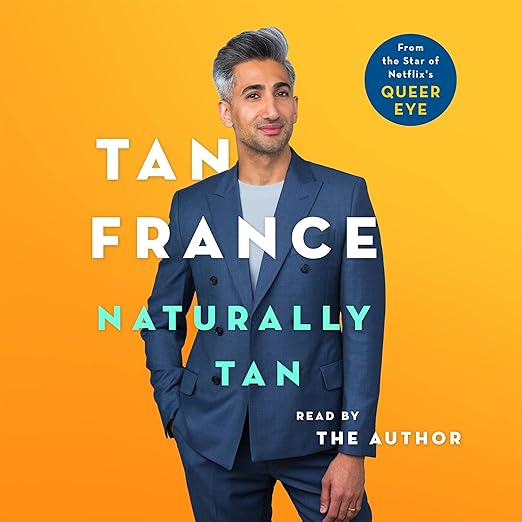
The publisher put a magazine's verdict at the top of this audiobook's description, ahead of any plot summary: audio, it says, is the best way to experience Tan France's memoir, because of the accent, the intimacy and the delivery. That is an unusual thing to lead with. Most descriptions sell the story and leave the format to the format. This one argues for the recording before it tells you a single fact about the life inside it, and since Tan France is also the credited narrator, the argument is at least internally consistent.
How Naturally Tan Holds Up
A seven-hour memoir read by its own subject is a different proposition from a seven-hour memoir read by an actor, and the description knows it. The program, it says, is read by the author, with a special guest appearance. The guest is never named. No second voice appears in the narrator credit, no cast list follows, and the exclamation mark is doing all the work of a promise. You will find out who it is by listening, or you will not find out at all.
That candor is the memoir's real subject. Tan France grew up the youngest child in a South Asian, Muslim family in South Yorkshire, one of very few in a predominantly white community, and was bullied for his culture and his skin color. He knew he was gay early and kept it from his family until he was thirty-four, by which point he was married to Rob, described here as a Mormon cowboy from Salt Lake City. The distance between those two facts is the book.
What the five written responses talk about is that book, not the recording. One buyer describes seeing it on a Hudson News shelf at an airport and buying the digital copy instead. C. Gottlieb, the only four-star vote, calls it a perfect summertime read for the pool or beach and says it reads like chatting it up with the author over tea. Praise for the sentences is not praise for the voice, and the column never quite gets around to the thing the description is selling.
Why Naturally Tan Works as an Audiobook
Nothing about the pitch here is subtle, and I mean that as a description more than a complaint. Seven hours and three minutes of a person telling you what happened to them, in their own accent, is a specific product with a specific buyer. If you have seen the show and want the voice attached to the life, this edition is the only place the two arrive together. Buy the print and you get the material without the delivery the publisher plainly considers the point of the exercise, which is a defensible trade only if you were never in it for the person.
Every strong passage the reviewers point to is a moment of exposure, never a fashion tip. Sharbart, a self-described older white woman, singles out the detail that fame did not spare Tan France extra searches while flying. Bananabreath comes away asking whether you are genuine or a poser, loving and decent or a jerk, which is a strange pair of questions to take from a makeover show and exactly the pair this memoir plants. The book about clothes keeps turning into a book about being looked at.
One thing it circles constantly is the gap between two countries. The description promises candid observations on US and UK cultural differences, social media behavior, celebrity encounters and the behind-the-scenes realities of reality television, and that list is honest about the shape of the thing: it is episodic. Bananabreath calls the stories deeply personal and the read quick and fun. The three-star holdout calls the writing disjointed and strange. Both are describing the same structure and disagreeing only about whether the looseness reads as charm.
Weak Spots in Naturally Tan
Two votes are all the counter admits to, and to land on 4.5 those two have to total nine points out of ten. Nine across two whole-star votes leaves exactly one arrangement: a five and a four. Meanwhile five people have written, and their grades run three, four, five, five, five. So the sharpest entry here, the three-star that finds the writing disjointed and the author never quite deep enough, sits outside the average altogether. The badge is calmer than the column beneath it.
Most of what that dissent objects to is structural. A memoir assembled from set pieces will feel disjointed to anyone expecting a chronology, and this one is assembled from set pieces: childhood in South Yorkshire, the clothing lines for Kingdom & State and Rachel Parcell, Inc., the casting that put him beside Antoni Porowski, Karamo Brown, Bobby Berk and Jonathan Van Ness. The links between those blocks are tonal, not narrative. The chummy intimacy the magazine quote advertises is precisely the glue such a structure needs.
Both the strengths and the limits come from the same choice. Tan France is telling you about being the first openly gay South Asian man on television and about being searched at airports, and he is telling you in the register of a friend across a table. That register carries the light chapters easily. It also lets him decline to go further when a harder question surfaces, which is what the three-star reader noticed and what the four-star vote registers as mild reservation. Expect warmth, not excavation.
The Right Listener for Naturally Tan
By the sound of the column, the natural audience already knows the show. Three of the five written responses bring it up by name before they get anywhere near the prose, and the memoir is built for exactly that listener: someone who wants the life behind a face they have watched for a few seasons. Fashion tips do arrive, in passing, folded into stories about family, faith and marriage. Anyone hoping for a business memoir about building clothing lines will get the outline and very little more, because the commercial chapters are the ones that move fastest.
At seven hours and three minutes this asks very little of you, and the shape of it suits short sessions: a chapter at a time, one story per sitting, no plot to lose track of. Skip it if you want a systematic account of South Asian life in England, or a deep reckoning with religion and sexuality, because the three-star reviewer is right that the book stops short of both. Go in for the voice and the candor, and let the counter say whatever it likes.
A Few Questions About Naturally Tan
Does Tan France reading his own memoir change what the audiobook offers?
It changes the argument for choosing it. The credit lists Tan France as both author and narrator, and the magazine quote the publisher placed at the top of the description rests entirely on his accent and delivery. Print gives you the same stories without the thing that description treats as the selling point.
Can the audiobook work for someone who has never seen the show?
It works, though the reviews suggest television is the usual on-ramp: a clear majority of them name the series before saying anything about the writing. Arrive cold and you still get a coherent memoir about a South Asian, Muslim childhood in South Yorkshire, a coming out at thirty-four, and a career built in fashion.