Quick Take
- Narration: Joe McQuillan reads with a tone that matches the book’s skeptical intelligence, clear, measured, and without the evangelical fervor that would have undermined Levinovitz’s central argument about false certainty.
- Themes: The naturalistic fallacy, secular religion and ideology, the ethics of technology and artifice
- Mood: Intellectually bracing and occasionally unsettling, in the way that good philosophical argument should be
- Verdict: A short, well-argued dismantling of one of the most pervasive and unexamined assumptions in modern life, worth the nearly nine hours even if you think you already agree with its conclusion.
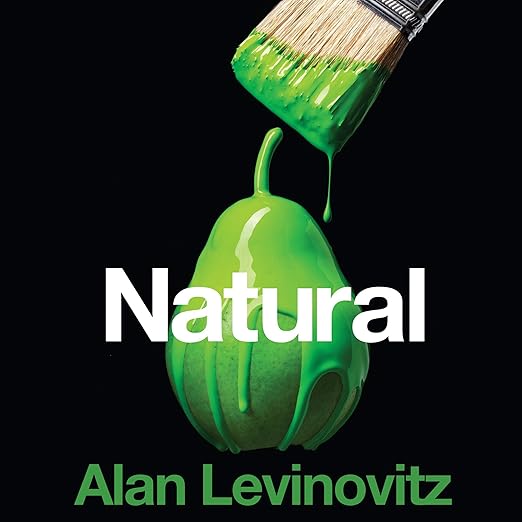
I picked this one up on a whim after a conversation about clean-label food products that left me irritated in a way I could not fully articulate. A colleague had been explaining why she only bought things with ingredients she could pronounce, and I found myself unable to produce a principled response to what seemed like a principled position. Alan Levinovitz’s Natural had been sitting in my queue for months. I moved it to the top.
Levinovitz is a professor of religion, and that background matters more than the book’s marketing might suggest. His central argument is not simply that the appeal to nature is a logical fallacy, which it is, and which philosophers have been pointing out since Hume. His argument is that the appeal to nature functions as a religion: it provides a creation myth, a set of commandments, a concept of sin and purity, and a community of believers whose faith is largely immune to evidence. That framing is what makes Natural interesting where a simpler debunking book would have been merely satisfying.
Our Take on Natural
The range of examples Levinovitz draws on is genuinely impressive. From Gwyneth Paltrow’s Goop to evolutionary biologists naturalizing gender roles, from organic farming advocates to Alex Jones’s supplement empire, he demonstrates that the appeal to nature crosses every ideological boundary. Progressives and conservatives, scientists and pastors, skeptics and true believers: everyone does it. That evenhandedness is important and is the book’s primary structural achievement. He is not writing a partisan takedown; he is identifying a cognitive habit that humans across all belief systems share.
Joe McQuillan narrates with the right register: thoughtful, slightly dry, never preachy. The irony of an anti-preachy book being delivered in a preachy tone would have been devastating, and McQuillan avoids it. He trusts the argument to do its own work, which it does. At just under nine hours, the book is long enough to make its case fully and short enough not to overstay it.
Why Listen to Natural
Because the naturalistic fallacy is everywhere in daily decision-making, and recognizing it is practically useful in ways that most philosophical debunking is not. After listening to this, you will catch yourself mid-argument whenever you are about to say that something is good because it is natural or bad because it is artificial. That catch is worth the investment.
Levinovitz is also genuinely good on the environmental dimension, which is where the book becomes most uncomfortable for readers who consider themselves environmentally serious. His argument is not that nature does not matter or that human technology is neutral. It is that the romanticization of nature as a moral standard actively makes environmental thinking worse by substituting a sentimental image of pristine wilderness for the harder work of figuring out what we actually owe the systems we live within. That distinction has real stakes, and he earns it.
What to Watch For in Natural
The book’s argument is genuinely persuasive, which means listeners who arrive already convinced that the appeal to nature is fallacious may find the middle sections slower than the opening chapters. Levinovitz is thorough in a way that serves the skeptical reader more than the already-converted one. If you reach a point where you feel the case has been made, trust that the later examples are doing work the earlier ones could not do alone; the breadth of application is part of what makes the argument robust rather than merely clever.
There is also a question the book raises more than it fully answers: if appeals to nature are so epistemically unreliable, what should replace them as ethical guides? Levinovitz gestures toward a more explicit reckoning with human responsibility and technological ethics, but the constructive portion is less developed than the critical one. This is a book that is better at dismantling an assumption than at specifying what should fill the resulting space. That limitation is worth knowing before you start.
Who Should Listen to Natural
Anyone who shops at a farmers market while feeling vaguely virtuous about it. Anyone who has used the phrase all-natural as a mark of quality. Anyone who has argued against a vaccine, a food additive, a hormone therapy, or a synthetic material on the grounds that it is not natural. Levinovitz is not targeting any of these people specifically; he is identifying a shared cognitive reflex that shapes all of them. The book is accessible enough for general readers and rigorous enough to reward listeners with philosophical backgrounds. The combination is rarer than it should be.
Frequently Asked Questions
Does Natural argue that environmental protection and concern for ecosystems are misguided?
No. Levinovitz distinguishes between the sentimental appeal to nature as a moral standard and the serious ethical project of understanding what we owe to ecosystems. He argues the naturalistic fallacy actually makes environmental thinking worse, not better.
Is Alan Levinovitz coming at this from a scientific background or a humanities background?
He is a professor of religion, and that shapes the book considerably. His primary contribution is showing how the appeal to nature functions structurally like a religion, which is a more interesting analysis than a straightforward scientific debunking.
Does Joe McQuillan’s narration work for a philosophy-adjacent nonfiction book?
Yes. McQuillan reads with a measured, intelligent tone that suits the material without becoming academic or dry. He does not editorialize, which is the right choice for an argument this deliberately balanced across ideological lines.
Is this book a good listen for someone who already considers themselves skeptical of natural food marketing?
Partly. If you are already convinced the naturalistic fallacy is a fallacy, the opening will confirm that. The book’s value comes from the breadth of examples across very different ideological communities, and from the religion-as-framework analysis, which adds something even to already-skeptical listeners.