Quick Take
- Voice: Lauren Garvin brings energetic, coach-adjacent warmth to nearly eleven hours of certification material, staying clear and brisk through both concepts and practice questions.
- Big ideas: NASM certification prep, exercise science and biomechanics, client behavioral coaching.
- Atmosphere: Focused and encouraging, built for repetition rather than deep immersion.
- Worth it?: A genuinely useful audio companion for NASM-CPT candidates who study best in motion, best paired with written materials for tracking weak domains.
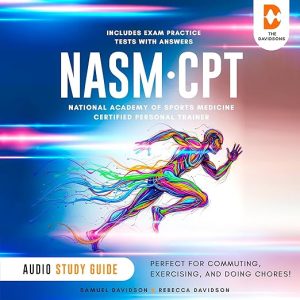
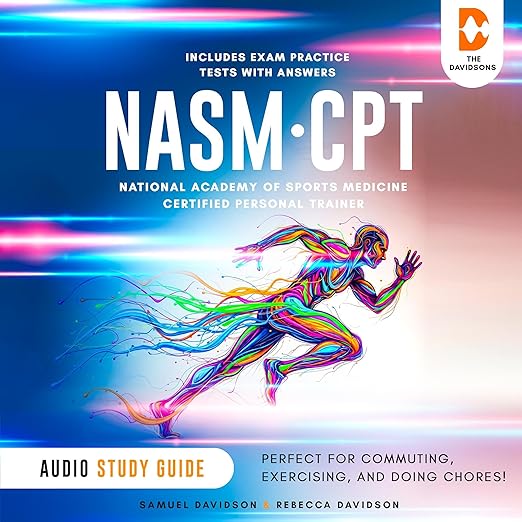
A post-workout protein shake is an unlikely classroom, but that is exactly where this NASM-CPT audiobook study guide wants you studying, going by its own pitch: turn the drive to the gym, the reps themselves, and the drive home into exam preparation instead of dead time. Samuel Davidson's Davidsons Audiobooks imprint has built its entire 'Exam Test Prep' series on that premise, and this entry, aimed at candidates chasing the National Academy of Sports Medicine's Certified Personal Trainer credential, commits to it across nearly eleven hours.
The material moves in the order most NASM candidates actually need it: exercise physiology and biomechanics first, then client psychology and behavioral coaching, then the assessment protocols, movement screens, posture checks, fitness testing, that turn theory into an actual session plan. The NASM Model itself, the Stabilization, Strength, and Power framework that structures the whole certification, gets its own dedicated stretch, and practice questions are woven throughout rather than dumped at the end, mirroring how the actual exam is likely to feel.
Repetition Without Friction Replaces Screens and Flashcards
Test-prep audio has one obvious limitation, and Davidson's team seems to know it: no flipping back to compare two multiple-choice answers side by side, no underlining a paragraph on assessment protocols. What this format earns instead is repetition without friction. A commute becomes a review session, a folding-laundry hour becomes flashcards that cannot be lost, and the audiobook's own no-screens, no-flashcards pitch reads as honest rather than aspirational once you notice how much of NASM's curriculum, the coaching psychology especially, was always better suited to being heard than stared at on a page.
The exam-practice sections earn a specific mention on their own. Rather than a flat list of questions and letter answers, each one gets its reasoning explained aloud, which does real work for retention that a printed answer key cannot replicate on its own. A wrong guess followed immediately by a clear, spoken explanation of why the correct option fits the NASM framework sticks in a way that flipping to an answer key rarely does, especially for a candidate reviewing the same domain for the third or fourth time.
Coaching Skills Taught About a Spoken Skill
The client relations and behavioral coaching chapters are where audio genuinely outperforms the printed manual, and it is worth saying so directly rather than treating every section as equally well served by narration. Motivational interviewing, building client rapport, reading resistance to change, these are spoken skills being taught about a spoken skill, and hearing tone and pacing modeled while tone and pacing are being explained does something a bulleted textbook page cannot. The professional development material, on ethics and scope of practice, carries similar weight read aloud rather than skimmed.
A five-star average across fifty ratings is a small sample, but it lines up with what Davidson's Audiobooks has built a reputation for elsewhere in this same catalog: production engineered specifically around commute-length review rather than a straight audio port of a textbook. Candidates who have used the imprint's other certification guides, in other fitness and wellness domains, will recognize the structure immediately, chapters sequenced to mirror how NASM itself organizes the material, from scientific foundations through program design to a closing practice-exam simulation.
NASM's CPT credential itself carries accreditation from the National Commission for Certifying Agencies, one of the more widely recognized marks of legitimacy in a fitness-certification market crowded with far less rigorous options, which raises the real stakes of actually retaining this material rather than skimming it once. An audiobook built around repetition, hearing the same stabilization-strength-power framework explained across multiple contexts and practice questions, suits a credential this substantive better than a single quick read-through of a manual would.
Most Listeners Are Gym Staff Squeezing In Study
An audio-only practice test has one real constraint worth naming before buying: hearing a question and its explained answer is genuinely useful, but it does not let a candidate easily track which specific NASM domain, program design versus assessment versus client psychology, keeps tripping them up across repeat attempts. Serious candidates will likely still want a written practice exam alongside this one for that diagnostic tracking, even if the bulk of first-pass learning happens comfortably here.
Worth being clear about scope too: this is a single-certification deep dive, not a survey of personal training credentials generally. A listener still deciding between NASM, ACE, or another certifying body will not find that comparison here. The audiobook assumes the choice is already made and the goal is passing NASM's specific exam, built around its specific Stabilization-Strength-Power model, which is a reasonable thing for a study guide to assume but worth knowing before pressing play.
Most people pursuing this specific certification are not full-time students with open afternoons. They are gym staff picking up shifts, career changers studying around an existing job, or trainers already working who need continuing education on top of a full client schedule. That reality is exactly who this format was built for, worth naming directly rather than assuming every listener has the dedicated study blocks a printed manual would assume.
Repeat Listening Reinforces the Reasoning Behind Answers
Anyone prepping for the NASM-CPT exam whose real study windows are a commute, a gym session, or a load of laundry rather than a quiet desk is the clear audience here, and the production is honest about that being the whole design philosophy rather than a workaround. It pairs naturally with NASM's own official materials as a repetition layer, reinforcing the same content in a second modality, which is close to how spaced repetition is supposed to work in the first place.
The practice-question format specifically rewards repeat listening in a way a printed answer key rarely inspires. Hearing the same question explained a second or third time during a later commute, after an earlier attempt got it wrong, reinforces the reasoning behind the correct answer rather than just the answer itself, closer to how NASM's own exam actually tests applied understanding rather than simple recall.
A subtler logic is worth naming in Davidson's design too: studying training science while the body is mid-workout means the material arrives in roughly the same physical context where a future client session will actually happen. That kind of context-matched learning, information encoded in close to the same setting it will later need to be recalled in, is a real, if understated, argument for why this specific pairing of subject and format makes more sense than it might first appear.
A highlighter and a printed diagram of the kinetic chain still do something no audio format can replicate, so candidates who learn best by marking up a page, or who need to isolate exactly which NASM domain is dragging their practice scores down, should treat this as a supplement to written materials rather than the entire plan. Everyone else gearing up for exam day will find nearly eleven hours of close to exactly the material needed, arriving at exactly the moments that would otherwise go to waste.