Quick Take
- Narration: Thomas Yackimec delivers a clean, confident performance that matches the guide’s encouraging tone, the narration suits the fitness education context well, professional without being clinical.
- Themes: Personal training certification, exercise science and anatomy, OPT model application
- Mood: Organized and encouraging, this is accessible fitness education content designed to build genuine competence alongside exam confidence
- Verdict: A well-structured NASM CPT preparation guide for the 2025-2026 exam cycle with strong ratings and clear domain coverage, though listeners should verify whether the practice test audio format meets their study style.
I spent one Saturday morning last year walking through the OPT Model, NASM’s Optimum Performance Training framework, with someone preparing for their CPT exam. What struck me about the conversation was how much the test was actually asking about decision-making rather than just exercise science knowledge. The OPT model isn’t a program template to memorize; it’s a reasoning framework for how to sequence training adaptations based on a client’s assessment results. That distinction, between knowing the stages and knowing how to apply them, is what separates candidates who pass the NASM CPT exam from those who study diligently and still find themselves caught by scenario questions they hadn’t anticipated.
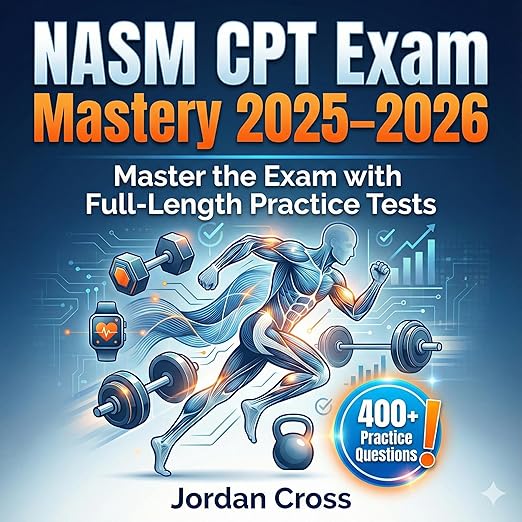
Jordan Cross’s NASM CPT Exam Mastery 2025-2026 appears to understand this distinction. The synopsis specifically highlights learning to create safe and effective programs for real clients and building confidence to handle even the toughest exam questions. That framing points toward application rather than recitation, which is the right orientation for a certification that evaluates professional judgment as much as content knowledge.
Domain Coverage and the OPT Model Deep Dive
The NASM CPT exam covers a substantial range of domains: anatomy and physiology, exercise science, client intake and assessment, program design, exercise technique, coaching and communication, professional and legal responsibilities, and nutrition. Cross’s guide addresses all of these, with the OPT Model receiving the step-by-step treatment that it requires. The OPT Model is genuinely complex when you get into it, five phases across two levels, each with specific training adaptations, rep ranges, rest periods, and client populations, and candidates who enter the exam with only a surface understanding of the model will struggle with the program design scenarios that make up a substantial portion of the test.
Thomas Yackimec narrates at a pace that works for the exercise science content. Anatomical terminology, muscle function descriptions, and movement assessment protocols are delivered clearly enough that active listeners can build mental models of what the content describes without needing to see diagrams. That’s a meaningful distinction from certification content that’s so diagram-dependent it loses coherence in audio format.
Practice Tests and the Limits of Audio Q&A
The guide includes full-length practice tests that mirror the real exam format and difficulty, with detailed explanations for each answer. This is a significant element of the preparation value, and it’s worth thinking about how the audio format handles it. Written practice tests allow you to flag questions, skip and return, review your incorrect answers in batches, and track your performance across domains. Audio Q&A is inherently more linear, you hear a question, hold it in working memory, hear the answer, and then move on without a visual record of your performance pattern.
The guide’s promise to help you pinpoint your weak areas works better on the written page than through audio alone. Most candidates who use this audiobook for practice test preparation will find themselves supplementing with written practice materials to get the domain-level performance tracking the NASM exam requires. The audio explanations remain valuable for understanding why wrong answers are wrong, which is the hardest thing to convey in any exam prep format and the most valuable when it’s done well.
The 4.8 Rating and What It Signals
A 4.8 rating across 12 reviews is a reasonably strong early signal for a 2025-2026 edition guide. The candidate pool for this exam is significant, NASM is one of the two most recognized personal training certifications in the US fitness industry, alongside ACE, and prep guides in this space tend to accumulate reviews from candidates who are motivated enough to report back on whether the resource helped them pass. Twelve reviews is a small sample, but the distribution toward the high end suggests early adopters are finding the content reliable and the preparation methodology effective.
For candidates who learn well through audio and have enough exercise science background to engage actively with content about movement assessments and training adaptations, this is a legitimate preparation companion. It works best alongside a study log where you note domains you need to revisit, and supplemented with NASM’s official practice tests as exam day approaches.
Frequently Asked Questions
Does this guide cover the full NASM OPT Model in enough depth to handle the program design scenarios on the CPT exam?
Yes, the OPT Model is treated step-by-step across its five phases. The guide covers phase-specific training adaptations, appropriate populations, and the logical progression between phases, which is how the exam tests OPT application through scenario questions rather than simple phase identification.
How does the audio format handle movement assessment content like the overhead squat assessment, which involves visual cues?
Movement assessment content is presented as conceptual and clinical reasoning rather than visual demonstration. The overhead squat assessment protocol, compensation patterns, and what they indicate about muscle imbalances are all described verbally and organized around the decision-making logic the exam tests. Listeners who want to observe the assessments in action should supplement with NASM’s video content.
Is this guide specific to the NASM CPT exam, or would it also prepare someone for ACE, ACSM, or NSCA certifications?
This guide is specific to NASM’s certification framework and exam structure, including NASM’s proprietary OPT Model, assessment protocols, and terminology. Candidates preparing for ACE, ACSM, or NSCA certifications should use resources aligned with those organizations’ specific frameworks, as the program design models and assessment approaches differ meaningfully.
Does the practice test section provide enough detailed explanations to understand why incorrect answers are wrong, not just what the correct answer is?
The synopsis specifically highlights detailed explanations for each test question to help candidates pinpoint weak areas. The depth of those explanations for incorrect choices is the key variable, the most effective exam prep explanations address why each wrong answer fails, not just affirm the correct choice. Early reviewer feedback suggests the explanations meet candidate expectations for this level of detail.