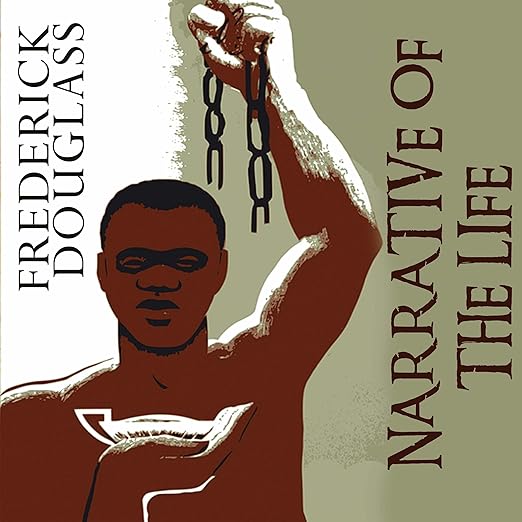
Quick Take
- Narration: Sarah Rife delivers the text with measured clarity and appropriate gravity, though the emotional register could carry more weight in the more harrowing passages.
- Themes: Slavery, literacy as liberation, abolitionism and first-person testimony
- Mood: Controlled and devastating, the restraint of a man who understood that calm language would travel further than outrage
- Verdict: Essential American literature that gains particular resonance when heard rather than read; at under four hours, there is no argument for not starting tonight.
I have read the Narrative of the Life of Frederick Douglass three times in print over the years, first as an undergraduate studying American literature, once again while reviewing an anthology of slave narratives, and once more after a visit to the Frederick Douglass house in Washington, DC, that left me needing to return to the primary text. The audiobook edition narrated by Sarah Rife gave me a fourth encounter with a document I thought I knew well, and what surprised me most was how different it is to hear it. The controlled precision of Douglass’s prose, the way he builds his argument through accumulated specific detail rather than rhetoric, lands differently in the ear than it does on the page.
The Narrative is not primarily a book about suffering, though suffering is recorded in it without flinching. It is a book about the systematic relationship between slavery and ignorance, about how slaveholders maintained control by preventing education, and about how literacy became for Douglass both a personal liberation and a political weapon. This argument structures the entire text, from the early chapters describing his childhood on the plantation to the account of his escape to the North. It is one of the most precisely organized political documents in the American literary tradition, and hearing it read aloud makes that organization more visible, not less.
What the 1845 Publication Moment Means for the Text
It is worth pausing on the context the publisher’s note provides: this text was written in 1845, while Douglass was in Lynn, Massachusetts, and published at significant personal risk. The two introductory letters from William Lloyd Garrison and Wendell Phillips that appear at the beginning of the narrative were included, as the synopsis notes, to argue for the veracity of the account and the literacy of its author. That detail is not incidental. The prefatory apparatus of this book exists because white abolitionist audiences in 1845 required authentication that a formerly enslaved man had actually written what he had written. The book carries its historical context not just as subject matter but as structural feature.
Douglass understood this, and his prose reflects the specific rhetorical situation he was writing into. He is simultaneously documenting his own experience, arguing a political case against slavery, and demonstrating through the quality of the demonstration itself that the case for Black intellectual inferiority was false. Every clear sentence is an argument. Every precise observation is evidence. This is why the Narrative remains a live text two centuries after its publication, not because of the historical record it provides but because of the intelligence and precision with which it was constructed.
Sarah Rife’s Narration and Its Demands
Rife brings a clean, measured delivery to the text that serves its documentary precision well. She does not overperform the emotional content, which is the right instinct for material this serious. Douglass himself wrote with controlled restraint, understanding that the facts would do more work than rhetoric, and Rife respects that choice. Where her narration occasionally falls short is in the passages describing the death of his grandmother and the treatment of enslaved people around him; these sections ask for something more than precision, and the evenness of her delivery sometimes works against the weight the text is trying to carry.
This is not a significant criticism. Any narration of Douglass faces a version of this challenge: the text is simultaneously a political argument and a deeply personal account, and those two registers do not always want the same thing from a voice. Rife handles the documentary sections with authority, and at three hours and fifty-eight minutes, the runtime is short enough that listeners who feel the narration underserves the emotional content can supplement with the text itself, which is freely available in the public domain.
What Eleven Chapters Actually Cover
The narrative’s eleven chapters move from Douglass’s earliest childhood memories, including the almost complete erasure of his parentage and family connections, through his transfers between different slaveholders, his time in Baltimore where his introduction to reading began, the failed escape attempt, the successful escape, and finally his arrival in the North and his first encounters with the abolitionist movement. Each chapter illuminates a different aspect of the institution of slavery and how it operated on the interior life of the people it claimed as property.
The Baltimore chapters, where Sophia Auld initially teaches Douglass to read before her husband’s prohibition of literacy instruction transforms her from a kind woman to a hostile enforcer, are among the most psychologically acute passages in American literature. Douglass does not present this transformation with outrage. He presents it as the predictable result of an institution that corrupts everyone it touches, which is a more devastating argument than any expression of personal anger could provide.
A Free Audiobook of Foundational American Writing
This free audiobook makes one of the genuinely essential texts of American history and literature accessible in a format that suits its urgency. At under four hours, it asks less of your time than almost any other significant document you are likely to encounter, and it returns the investment with interest. Reviewers who described annotating every page are right that this is a text that rewards close reading; but hearing it in Rife’s measured delivery is a different and complementary experience, one that foregrounds the rhetorical structure in ways that silent reading can obscure. If you have not encountered the Narrative before, this is an excellent place to start. If you have, the audiobook will likely show you something you did not see before.
Frequently Asked Questions
Is this edition narrated by Sarah Rife different from other audiobook editions of the Narrative?
There are multiple audiobook editions of the Narrative of the Life of Frederick Douglass. This edition, published by Strelbytskyy Multimedia Publishing in 2023, uses Sarah Rife. Other editions use different narrators, so if you have a strong preference for a particular voice, it is worth sampling before committing.
Does the audiobook include the introductory letters from William Lloyd Garrison and Wendell Phillips?
Yes. The publisher notes that the accompanying reference material is included. The prefatory letters are part of the 1845 text and are important context for understanding the historical reception of the Narrative.
Is the Narrative of the Life of Frederick Douglass appropriate for younger listeners, such as students?
The text describes slavery with factual directness, including accounts of violence and family separation. It is not graphic in the contemporary sense, but it is honest. Most educators consider it appropriate for high school and above, and it is widely taught at that level.
How does the audiobook format change the experience of reading Douglass compared to the print version?
Hearing the rhetorical structure of the prose, including the way Douglass builds arguments through accumulated specificity, is arguably clearer in audio than in print. The controlled restraint of his voice comes through differently when it is rendered as actual voice, even mediated through a narrator.