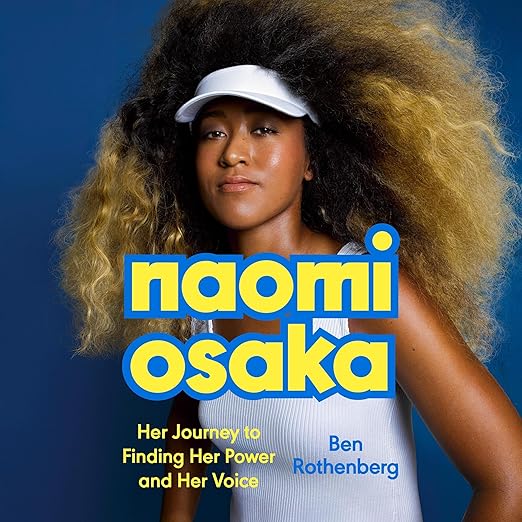
- Narration: Stacey Glemboski brings engaged, well-calibrated attention to Rothenberg's reporting; her pacing through the match sequences and the emotionally heavy mental health passages is particularly strong.
- Themes: Identity at the intersection of race and nationality, mental health and athletic pressure, the hidden backstory of a public career
- Mood: Investigative and richly layered, building steadily across seventeen-plus hours
- Verdict: A rigorously reported biography that adds genuine information and interpretive depth to one of the most discussed athletes of the past decade, even for listeners already saturated in Osaka coverage.
Ben Rothenberg's biography of Naomi Osaka is the kind of audiobook that recalibrates what you thought you already knew about a public figure. I had followed Osaka's career closely since the 2018 US Open final, where her victory over Serena Williams introduced her to most of the world in circumstances that were neither easy nor entirely her own choosing. I assumed I understood her story reasonably well. Seventeen-plus hours later, narrated by Stacey Glemboski, I had to accept that I had understood only the parts the media found most convenient to tell at the time.
Rothenberg is a professional tennis journalist who has spent years covering the WTA tour and has interviewed Osaka, her family, coaches, rivals, and the institutional figures who shaped her career. The biography is deeply reported in a way that the word biography often promises but rarely delivers. The difference here is that Rothenberg has done the primary research: he has the interviews, the travel, the access, and the willingness to follow threads into uncomfortable territory rather than settling for the flattering or the sensational as easier paths through the material.
The audiobook's central contribution is its account of the Osaka family's trajectory before Naomi became a public figure. Leonard Francois, her Haitian-Japanese-American father, drove the family from Japan to the United States in pursuit of a tennis vision modeled explicitly on Richard Williams and his daughters. That backstory, largely unknown even to close tennis followers, reframes everything that came afterward. Osaka's particular style of navigating the spotlight, her public vulnerabilities about mental health, the specific tension between her Japanese and American identities, all of these make more sense against the family history Rothenberg reconstructs with considerable care.
One reviewer who follows tennis professionally said they 'really learned a lot' despite following the sport closely, watching matches, and consuming media extensively. That is a meaningful benchmark: this audiobook is not padding for tennis outsiders. It is adding genuine information and interpretive context even for listeners already saturated in Osaka coverage from the past several years of her career at the top of the sport and in the public conversation.
Glemboski Paces the Point-by-Point Analysis
Stacey Glemboski's narration is well-matched to the material. She brings a quality of engaged attention to Rothenberg's reporting, reading the more emotionally freighted sections, particularly those covering Osaka's mental health disclosures and the French Open withdrawal that brought those issues into global conversation, with appropriate gravity without overdramatizing. The longer set-piece passages covering individual matches, especially the 2018 US Open final, benefit from Glemboski's pacing: she moves through the point-by-point analysis at a speed that works in audio without becoming either rushed or laborious across the full runtime.
At seventeen hours and twenty-eight minutes, the audiobook is a serious time investment. That length reflects the seriousness of Rothenberg's reporting rather than editorial excess. The chapters covering the Osaka family's journey across the world, the behind-the-scenes dynamics of the WTA tour, and the social justice advocacy during the 2020 US Open all require the space he gives them. Glemboski's performance sustains listening engagement across the runtime without the kind of fatigue that longer audiobooks sometimes produce in their middle sections, when both writer and narrator are tested by sheer duration.
Avoiding Both the Stunt and Hagiographic Framing
Rothenberg is a journalist with access and opinions, and the book reflects both. His interpretive framing of events, particularly around the controversies involving coaching, the media, and tournament governance, carries his own perspective and should be read as serious reporting rather than neutral record. That is a feature of good journalism rather than a flaw, but listeners should engage critically with the framing rather than treating the biography as a definitive verdict on every contested moment or relationship in Osaka's career.
The biography was published as Osaka returned to competitive tennis after a year on maternity leave, which means some of the most recent chapter of her career post-dates the research cutoff. Listeners will want to supplement with current coverage for the most recent developments on and off the court, but the biographical foundation Rothenberg builds is not diminished by the passage of time since publication. The family history and the formative years of the career are the core, and those are durable.
The chapters covering Osaka's 2020 US Open advocacy, where she wore masks bearing the names of victims of racial injustice on her way to a title, are handled by Rothenberg with careful attention to the complexity of what that campaign represented. He avoids both the framing that reduced it to a political stunt and the hagiographic framing that treated it as uncomplicated heroism, instead locating it within Osaka's specific history with race and identity as a mixed-heritage athlete representing multiple national affiliations simultaneously. Glemboski's narration of these sections captures the ambivalence and the significance without pushing the listener toward a predetermined response.
Delivering on Sport, Race, Identity, and Pressure
Tennis followers who think they already know Osaka's story are the primary audience and will get the most from the depth of reporting and the access it represents. Sports biography readers who are drawn to athletes at the intersection of sport, race, identity, and public pressure will find this audiobook delivers on all of those fronts without resorting to hagiography or controversy-chasing. Casual fans or listeners with no tennis background can follow the narrative, though some of the match descriptions and tour-politics sections will carry more weight with context. Those looking for a shorter, more impressionistic portrait should know that this is a substantive work of journalism and should be approached as such.
At seventeen-plus hours, does the Naomi Osaka audiobook maintain momentum throughout?
Yes, largely because Rothenberg has the reporting to fill the runtime. The chapters on the family backstory, the 2018 US Open final, and the 2020 social justice advocacy period are all densely informative and do not feel padded. Glemboski's consistent performance helps sustain engagement across the considerable length.
Does this audiobook cover Osaka's career up to the present or does it have a research cutoff?
The biography was published as Osaka returned from maternity leave, so it covers through that period. Recent competitive results and developments post-publication are not included. For current coverage, supplement with tennis journalism after completing the audiobook.