Quick Take
- Narration: Madison Niederhauser maintains consistency and clarity across eight books and thirty-one hours, an impressive feat for survey material that easily becomes monotonous in lesser hands.
- Themes: Divine genealogy and human folly, creation and destruction myths, the cross-cultural grammar of heroic narrative
- Mood: Encyclopedic and educational, with the pacing of a well-organized survey course rather than literary storytelling
- Verdict: A useful omnibus introduction to eight mythological traditions in a single package, with a PDF navigation guide that is essential for managing the volume.
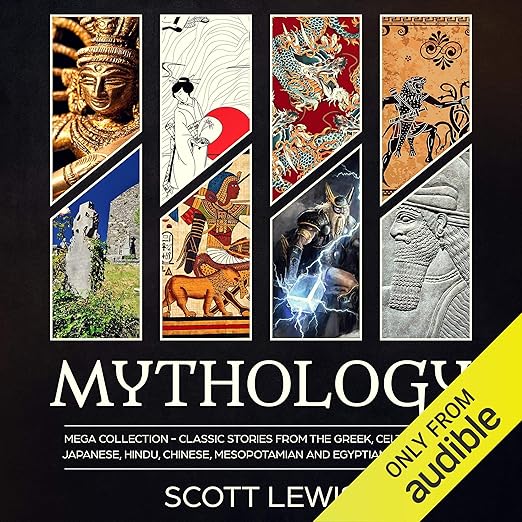
My entry point into mythology was Edith Hamilton’s book, read during a summer when I was eleven or twelve and obsessed with the idea that there were entire systems of gods and stories I had not yet encountered. That experience of discovery, the realization that Greek mythology was only one branch of a much larger human project of making stories about the divine, is exactly what this collection is designed to produce. Scott Lewis’s Mythology Mega Collection bundles eight books from his Classical Mythology Series into a single thirty-one-hour audio package covering Greek, Celtic, Norse, Japanese, Hindu, Chinese, Mesopotamian, and Egyptian traditions. It is, in scope, an ambitious undertaking.
I want to be precise about what kind of book this is before saying whether it is good. This is not mythology scholarship. It is not the kind of close reading you find in Joseph Campbell’s comparative work or in more specialist treatments like E.O. James’s studies of religious mythology. It is an introductory survey written for general audiences who want to know who Thor is and why, what the Trojan War was actually about, and what Egyptian cosmology looked like before the more familiar stories were simplified for school curricula. At that function, it works reliably well.
The Navigation Problem at Thirty-One Hours
The most important practical note for anyone considering this audiobook is that the accompanying PDF, now available in the Audible Library, is not an optional enhancement but a navigational necessity. Eight books in a single audio package means approximately four hours per mythology tradition, and without the chapter-by-chapter breakdown the collection is essentially undifferentiated. Download the PDF before you begin. It contains the table of contents and the structural organization that makes the collection manageable rather than overwhelming.
Reviewer Jacob P, who came to this collection after first reading Edith Hamilton as a child, made a comparison that is worth noting: Hamilton’s Mythology is a richer literary experience for Greek myth specifically, but it does not cover the non-Greek and non-Roman traditions. The value proposition of Lewis’s collection is precisely its breadth, the eight traditions it covers do not overlap with Hamilton, and for listeners who want a single-source introduction to Norse, Celtic, Japanese, Hindu, Chinese, Mesopotamian, and Egyptian traditions, there is no directly comparable audio package at this length and price point.
Niederhauser Across Eight Traditions
Narrating eight consecutive audiobooks in a single session is genuinely challenging work, and Madison Niederhauser’s performance is the production’s main quality anchor. She maintains clarity and appropriate energy across material that ranges from the Greek Olympian family drama to Norse cosmogony to Hindu epics, without homogenizing the different mythological registers into a single flat survey voice. The Greek material, which is probably the most familiar to most listeners, benefits from her ability to convey the soap-opera quality of Olympian interpersonal dynamics without condescension. The less familiar traditions, Mesopotamian and Japanese in particular, are handled with equal attention.
What Four Hours Per Tradition Can and Cannot Do
At roughly four hours per tradition, Lewis’s coverage of each mythology system is introductory by definition. The Celtic section, for example, cannot do justice to the full Arthurian cycle, the Mabinogion, the Ulster Cycle, and the mythological cycle, it picks representative stories and describes them accessibly. The same is true for each tradition. This is appropriate for the stated purpose of the collection, but listeners who already have substantive knowledge of any of the eight traditions will find those sections thin. The value accrues mainly for traditions the listener does not already know.
The student reviewer who found it exactly what they needed for a mythology class, and the parent whose ten-year-old found it easy to follow, are both describing the collection’s authentic audience: people new to comparative mythology who want organized, accessible coverage without scholarly apparatus. The four-star reviewer who came with prior expertise in mythology found it a decent overview rather than a revelatory one, and that assessment seems right to me as well.
Who Should Listen and Who Should Skip
Listen to this if you are new to mythology beyond the Greek tradition and want a single audio package that covers eight traditions in organized, accessible form. Listen to it if you are supplementing a mythology class or want broad cultural literacy about the major mythological systems. Download the PDF before beginning, it is genuinely essential. Skip it if you have existing knowledge of any of the traditions covered and want depth rather than breadth. Skip it if you want literary interpretation or comparative analysis rather than narrative summary. And if Greek mythology is your primary interest, pair this with a more dedicated Greek mythology source for the fuller treatment that subject deserves.
Frequently Asked Questions
Is this collection suitable for younger listeners, or is the content aimed primarily at adults?
The content is accessible to older children and teenagers. The ten-year-old mentioned in the reviews found it followable, and the mythological traditions covered are generally appropriate for middle school and up. Some mythological content (violence, adult themes in certain traditions) is handled at an overview level rather than in graphic detail. Parents familiar with mythology will be able to assess specific traditions; the overall register is educational rather than adult-oriented.
How does this compare to Edith Hamilton’s Mythology as an audio introduction?
Hamilton’s book is a richer literary experience for Greek and Roman mythology specifically, with stronger contextual interpretation and more careful attention to the source texts. Lewis’s collection covers eight traditions including non-Western mythologies that Hamilton does not address. For Greek mythology depth, Hamilton is the better choice. For breadth across multiple world mythologies in a single package, Lewis fills a gap Hamilton does not.
The PDF navigation guide is mentioned as a recent addition, what exactly does it contain and how important is it?
The PDF contains a chapter-by-chapter breakdown of all eight books with structural organization. For a thirty-one-hour collection with no natural breaks between the eight constituent books, this is essential rather than supplementary. Without it, finding a specific tradition or returning to a particular chapter after a break requires searching through undifferentiated audio. Download it before beginning the collection.
Are the eight books in the collection intended to be listened to sequentially, or can they be approached in any order?
They can be approached in any order, each mythological tradition is treated as an independent unit. The collection has no cross-tradition narrative that requires sequential listening. Most listeners will benefit from starting with a tradition they already have some familiarity with (usually Greek or Norse) to calibrate the format before moving to less familiar material.