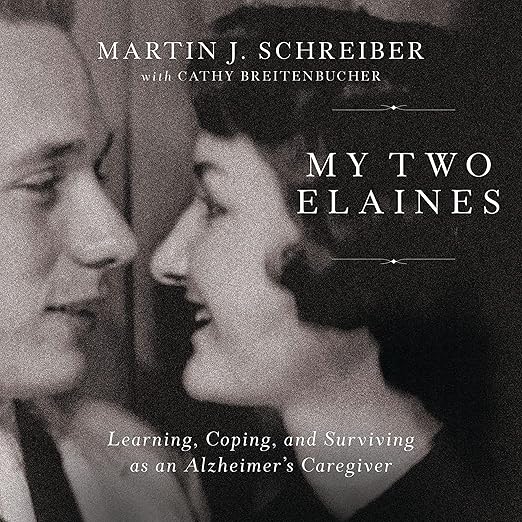
Marty Schreiber reads this one himself, and the audiobook says so before it says anything else: the first line of the description is simply 'Read by the author.' Everything after that depends on the decision. My Two Elaines runs three hours and fifty-nine minutes, and in it the former governor of Wisconsin describes watching his wife move from the woman he first fell for in high school, who diligently supported his political career, to an Elaine who knew she was declining and could no longer remember how a meal was cooked, and finally to an Elaine who did not recognize her husband or their children.
Start with the arithmetic in the title, because it is doing quiet work. The description sets out three states, not two: the woman from high school, the woman aware of her own decline, and the woman who no longer recognizes her family. The title counts two. That choice tells you where Schreiber has drawn the line, and it is the line every caregiver eventually draws, between the person who was and the person who is, with the terrible middle stage refusing to be a category of its own. A book that had called itself My Three Elaines would be a different and colder book.
The structure is openly hybrid, which is rarer than it sounds and harder to bring off. The copy calls it 'one part love story, one part practical advice,' and names three specific devices that carry the second half of that promise: excerpts from Elaine's own journal recording her thoughts and frustrations as the disease progressed, a recurring feature titled 'What I Wish I'd Known,' and a question-and-answer session with neuropsychologist Dr. Michelle Braun. That middle device is the organizing principle of the whole book. Regret converted into instruction is what a caregiving memoir has to offer that a clinical guide cannot, and naming it as a repeating feature keeps the grief from sliding into vagueness.
Reading Aloud His Wife's Journal Entries
The self-narration is the reason to choose the audio edition, and it is worth being precise about why. This is not an author reading his own argument. It is a husband reading aloud his wife's journal entries about losing herself, in his own voice, to strangers. No professional reading could reproduce that arrangement, and no professional reading should try. It is the one situation where an author with no performance training holds an unassailable advantage, because the material is testimony and the person who gave it is the person speaking. What none of the three reviews on this page does is comment on how that sounds in practice, which leaves the single most consequential feature of this edition undocumented by the people who bought it.
Four hours is the right length and I suspect it is a deliberate one. The audience for this book consists largely of people who are exhausted, interrupted constantly, and short of time by definition. A four-hour listen can be finished in a week of short sessions by someone with almost nothing left, which matters more for this title than for most. Nothing about the brevity feels thin, either: a love story, a decline, a set of practical lessons and a specialist interview inside four hours means every section has been cut to what it needs.
The reviews come from readers who plainly needed the book rather than browsed it. One calls it 'a moving and insightful account of one man's journey through the challenging and often heartbreaking landscape of Alzheimer's disease,' and observes that Schreiber 'is no stranger to leadership and resilience' before the sentence about what nothing could have prepared him for is cut off. Another describes it as 'a touching book of one man's trials and tribulations,' a sentence that runs on into the disease itself, adds that it 'Had particular importance to me,' and singles out the physician question and answer section. That combination, emotional recognition plus one concrete useful component, is what the hybrid structure was built to produce.
A Positive Verdict With a Ceiling
The most informative review here is the four-star one, because it comes from a reader with an unusual basis for comparison. Susan Y. reports buying, by the review's own count, 'about 8 to 12 books on those caring for Alzheimer's loved ones' before naming the retailer, calls this 'a well-written book that was interesting to read,' and recommends it to fellow caregivers. Then comes the honest part: 'Why didn't I give it a 5 star?' The answer is a benchmark against another memoir the review names as On Pluto, with the rest of the title cut off mid-word. Read that as a positive verdict with a ceiling. Inside a crowded shelf, this is a good entry rather than the definitive one, and the reviewer who read a dozen of them says so.
Two practical notes. Further resources come as a companion PDF download rather than as part of the recording, so the reference material is not in the audio itself and a listener who wants it has to go and fetch it. And the practical advice, however useful, sits inside a four-hour personal narrative and is not a treatment guide, a legal and financial planner, or a medical text. The copy promises 'permission to feel the full spectrum of emotions, including humor...', which is an accurate description of a memoir's gift and not a substitute for professional guidance on care decisions.
Spouses Come First, the Book Knows It
Spouses come first, and the book knows it. Anyone watching a partner they have known since adolescence become someone else will find their own experience described by a person who has been through the whole arc rather than a portion of it. Adult children, siblings and close friends are served too, as the copy says explicitly, and readers newly facing a diagnosis will get more from four hours here than from a stack of pamphlets, particularly from the recurring hindsight sections that name the mistakes in advance, which is exactly the kind of help nobody thinks to offer until it is too late to use.
Clinical depth is not on offer here, so treat the book as a companion to that reading rather than a replacement, since one interview with a neuropsychologist is an introduction and not a syllabus. Listeners in the rawest early weeks of a diagnosis may want to wait, because the book follows the decline all the way to non-recognition and does not soften the destination. And anyone drawn in by the political biography should reset expectations: the governorship is context for who these two people were, not the subject.
Good to Know
Why does the audiobook matter more than usual for this book?
Because Schreiber reads it himself, and the text includes excerpts from Elaine's own journal about her decline. A husband speaking his wife's written words aloud is not something a hired narrator can reproduce. The material is testimony, and having the person who lived it deliver it changes what the edition is.
Is this a practical caregiving guide or a memoir?
Both, deliberately. The copy calls it one part love story and one part practical advice, and the advice arrives through a recurring feature called What I Wish I'd Known plus a question and answer session with a neuropsychologist. Inside four hours, that is orientation rather than a full care manual.
Are the extra resources included in the audiobook?
Not in the recording itself. The description states that further resources come in a companion PDF download, so anyone wanting the reference material has to retrieve it separately. Plan on doing that if the practical side is why you are buying rather than the personal narrative.
How does it compare with other Alzheimer's caregiver memoirs?
One reviewer is well placed to say. Having bought between eight and twelve books on caring for people with Alzheimer's, that reader calls this well written and interesting, recommends it, and withholds the fifth star only because of a favorite title used as a benchmark, whose name is cut off mid-word in the review.