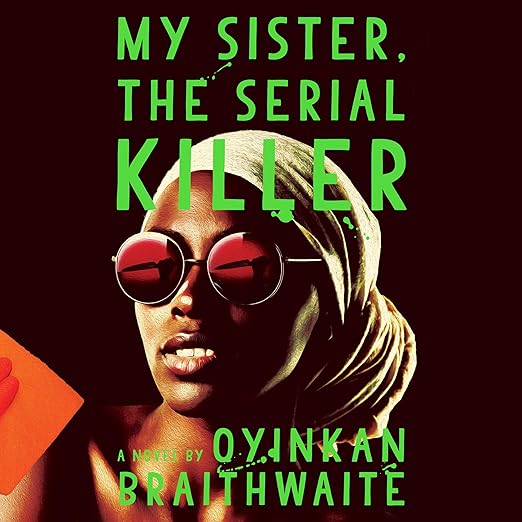
Bleach, a car with a trunk built for exactly this purpose, and a sister who won't stop photographing her own crime scenes: that's the toolkit Korede works with in My Sister, the Serial Killer, Oyinkan Braithwaite's pitch-black audiobook comedy about family loyalty stretched well past reason. At just over four hours, this is a single-sitting listen, and Braithwaite wastes none of that runtime getting to the joke at the center of it: Ayoola's third boyfriend in a row is dead, and Korede is the one who has to clean up.
The premise sounds like straight thriller material, but Braithwaite plays it as deadpan comedy instead, and that tonal choice is the book's whole identity. The New York Times called it "pulpy, peppery and sinister, served up in a comic deadpan", and Marie Claire went further, calling it "the wittiest and most fun murder party you've ever been invited to." Both descriptions land accurately: this is less a whodunit than a character study of a woman who has organized her entire personality around covering for someone she resents.
Reviewer Yvie summed up the central dynamic well, noting that Ayoola "really is a serial killer" with "a thing for murdering her boyfriends." The same review insists, though, that the book stays "not your typical murder mystery." That's accurate. The tension comes less from whether Korede will get caught helping her sister and more from whether she'll finally stop, especially once the doctor she's quietly in love with starts asking for Ayoola's number instead of hers.
Braithwaite's prose, and by extension Oduye's reading of it, works through implication more than explanation; Korede rarely states outright how she feels about what she's doing, and the comedy often lives in the gap between her clipped, practical narration and the horror of what she's actually describing. That restraint asks something of the listener, filling in Korede's suppressed rage and guilt from tone alone rather than being told directly what to feel.
Braithwaite trained originally in creative writing and worked in construction project management before turning to fiction full time, and that practical, structured background may explain the novel's disciplined economy; nothing here feels padded across a runtime built for efficiency rather than sprawl.
Braithwaite's novel also carries real critical pedigree beyond enthusiastic reader reviews: it won the LA Times Book Prize for mystery and thriller and was shortlisted for the 2019 Women's Prize, recognition that places it alongside more conventionally literary fare despite its slim runtime and pulpy premise. That combination, awards-circuit credibility paired with unapologetic genre fun, is part of what makes it such an easy recommendation across different reading tastes.
What Makes My Sister, the Serial Killer Worth Hearing
The novel's short, clipped chapters, one reviewer, T. Fritz, described the effect as giving the book an almost diary-like rhythm from Korede's point of view, translate cleanly to audio, since each one lands as a fast, self-contained beat rather than a slow build. Adepero Oduye narrates with the flat, practical affect Korede's character demands: a woman who has convinced herself competence is the same thing as control, and who delivers even the darkest logistics, the best way to remove blood from car upholstery, say, in the same even register she'd use for a grocery list.
That restraint is what keeps the comedy from tipping into either slapstick or straight horror. Reviewer Elijah Kelly-Taylor placed the story specifically in Lagos, Nigeria, and the setting's texture (hospital corridors, family expectations, the particular social pressure on Korede as the responsible, unmarried sister) comes through in Oduye's delivery without ever slowing the pace down to explain itself for outside readers.
The hospital setting where Korede works, and where the doctor she loves practices, gives the book a second, quieter engine alongside the sibling plot: a woman whose entire professional identity is caretaking and competence, applying those exact same skills to covering up murder at home. That parallel between her day job and her family role isn't spelled out heavily, but it runs throughout, and it's part of what elevates this above a simple dark-comedy premise.
Braithwaite also resists making this a straightforward feminist parable about complicity and patriarchy, even though those threads run throughout; Korede's motivations stay messier and more personal than a clean thematic statement would allow, rooted in specific childhood history with their father as much as any broader social commentary. That specificity keeps the book from feeling like it's delivering a lesson rather than telling a story.
Things to Know Before Starting My Sister, the Serial Killer
At four hours and fifteen minutes, this is a genuinely short audiobook, closer to a novella than a full novel in scope, and listeners expecting the sprawl of a typical thriller should recalibrate expectations before starting. The pacing is tight by design, but it also means Braithwaite doesn't have room for much beyond Korede, Ayoola, and the doctor caught between them; side characters get sketched quickly rather than developed.
One reviewer, T. Fritz, found parts of the plot "predictable" despite enjoying the ride, and that's a fair critique. The premise's central question, will Korede keep protecting her sister, doesn't leave many places to go that a genre-savvy listener won't see coming, and the book leans more on voice and tone than on twists to keep its grip.
Because the book moves so quickly, some listeners may find Ayoola herself remains more symbol than fully realized person by the end, beautiful, dangerous, and largely opaque even to her own sister. That opacity is likely intentional (Korede herself can't fully read her), but listeners wanting deep insight into the killer's own interiority rather than her effect on everyone around her should adjust expectations.
The novel's ending resolves the immediate question driving the plot without wrapping every thread in a neat bow, and listeners wanting a fully closed, tidy conclusion with clear moral consequences dealt out to everyone involved may find the final chapters more ambiguous than a typical thriller resolution.
Who Oyinkan Braithwaite Is Writing For
Fans of dark comedy, unreliable-narrator character studies, and short, sharp literary fiction with real bite will find this a fast, rewarding listen, especially anyone drawn to deadpan menace over jump scares. The Lagos setting and Braithwaite's satirical eye on family obligation also make it a good pick for readers wanting international literary fiction that doesn't read like homework.
This also makes an excellent book club pick specifically because of its length and its genuinely divisive moral questions: how far sibling loyalty should reasonably extend, and whether Korede is a victim of her family role or complicit by choice. A single sitting is enough to finish it, but the questions it raises hold up well past the final page for a group discussion.
Readers who need their thrillers to play fair with tension and dread rather than deadpan comedy should probably look elsewhere.
Quick Take
- Narrator: Adepero Oduye's flat, controlled delivery keeps Korede's dark logistics deadpan rather than tipping into horror or slapstick.
- Subjects: sibling loyalty and resentment, dark comedy, complicity and family duty
- Tone: Pitch-black comic and briskly paced
- Bottom line: A sharp, fast, single-sitting listen for dark comedy fans, though the plot itself holds few surprises for genre veterans.