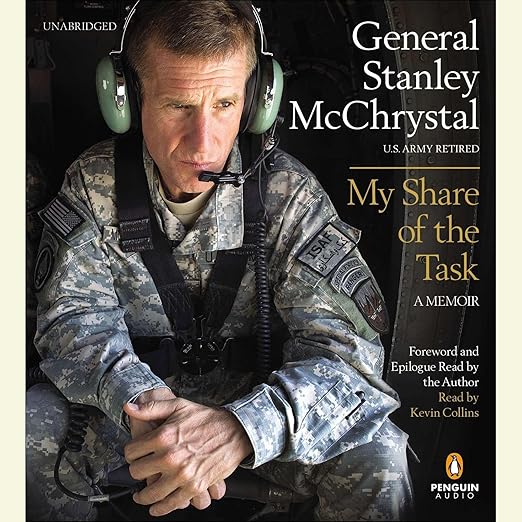
Reviews of this audiobook arrive from three different countries, the United States, Canada, and Italy, which is a fairly unusual spread for a single military memoir and speaks to how far General Stanley McChrystal's reputation travels beyond the wars he actually fought. The book opens on the Ranger Creed's promise to "shoulder more than my share of the task, whatever it may be, one hundred percent and then some," and every review here treats that line as a genuine mission statement for the nineteen-hour account that follows, not just a decorative epigraph.
A specific scene sets the tone for the whole book right from the synopsis: a March 2010 walk through a rural Afghan bazaar alongside President Hamid Karzai, where a Taliban rocket thuds into the ground nearby and McChrystal's response is simply to shrug before continuing to greet townspeople. That single image, choosing to keep listening to local views instead of reacting to a nearby explosion, is presented as typical of an entire career built on staying forward with troops over directing things from a safe distance.
What Stanley McChrystal Delivers
Steve Dietrich's review praises how the book moves across the full range of military experience, "from the grunt at the tip of the spear to the sometimes-unqualified top leadership," calling it a reminder of just how varied a career in uniform can look depending on where you serve. That review goes as far as recommending it as "required reading for both military and political leaders," a strong claim for a single memoir to earn.
Mahnomen Boy's review takes a more skeptical angle worth weighing against that praise. It notes the book was "two years in the making" with real collaboration from a co-author, Sam Ayers, and states plainly that McChrystal's own reading choices are "somewhat calculated to his own ends and limited." That same review still respects the craft on display, calling the result "carefully crafted," but the distinction it draws between an honest memoir and a strategically shaped one is worth sitting with instead of skipping past.
What Stanley McChrystal Gets Right
Peter Sharma's review, written with the benefit of a couple of years' hindsight and noting its own relevance "in 2015," zeroes in on the sections covering the troop surge and how American forces adapted their approach in Iraq and Afghanistan, describing the shift as something U.S. forces figured out how to do effectively even as domestic opinion on the war itself stayed divided. For listeners interested in counterinsurgency strategy specifically, that stretch of the book gets singled out as some of its most substantial material. The synopsis also points to the years McChrystal spent leading the Joint Special Operations Command, from 2003 to 2008, and specifically the hunt for Abu Musab al-Zarqawi, describing weeks of unbroken surveillance and difficult interrogations behind the effort to remove Al Qaeda in Iraq's top leadership. That is the kind of granular operational detail that separates this from a broader, more general leadership memoir.
An Italian-language review from Andrea Margelletti adds a different kind of endorsement, praising the book's detailed account of the Joint Special Operations Command's evolution from a direct-action unit into an intelligence-driven targeting operation, and recommending it specifically to readers already interested in counterinsurgency and counterterrorism doctrine. That a foreign policy audience outside the United States is engaging with this memoir at this level of technical detail says something about how seriously JSOC's operational history is studied well beyond American borders. Kevin Collins narrates the full nineteen-hour-and-ten-minute audiobook for Penguin Audio, carrying that dense operational material alongside the more reflective passages on leadership and command culture in a single continuous reading.
Where Stanley McChrystal Loses Some Ground
Ex-trooper's review, posted from Canada, raises the one moment in McChrystal's career most readers will already have some awareness of, noting it would not have been surprising for the book to mount a lengthy self-justification around "the incident in Paris that was so dramatically reported in Rolling Stone." That same review notes that he does not do this, choosing instead to "let the record speak for itself" rather than relitigating it at length. Readers expecting a tell-all reckoning with that episode should adjust expectations accordingly, based on this account of how the book actually handles it.
A skeptical glance at the rating badge is worth it too. It displays 4.5, and that specific decimal has no way of emerging from just one whole-star score, whatever that single score happened to be. Five real reviewers took the time to write out their reactions in full even though only one vote registers in the count, so the honest move is to read those five accounts directly rather than lean on a badge number that cannot be reconstructed from real whole stars in the first place.
Who Stanley McChrystal Is Writing For
Military history and leadership readers specifically interested in the post-Vietnam army's evolution into the force that fought in Iraq and Afghanistan should find plenty here, along with anyone drawn to firsthand accounts of counterinsurgency strategy and special operations command structure. The international spread of these five reviews suggests the book's appeal extends well past a purely American military history audience.
If you are looking for a memoir that directly confronts or relitigates the controversy that ended McChrystal's active command, Ex-trooper's review suggests you will not find extended argument on that specific point here. And if Mahnomen Boy's read on the book as carefully shaped rather than fully unguarded sits uneasily with you, it is worth factoring that skepticism in before treating this as an unfiltered account rather than a considered one. Readers specifically drawn to the West Point-to-four-star-general career arc, tracing decades from a young officer in the post-Vietnam army to command of all coalition forces in Afghanistan, will find that full span covered rather than just the years that made headlines.
Quick Take
- Read by: Kevin Collins narrates the full nineteen-hour memoir; none of these five reviews comment on the audio delivery, focusing instead on the book's content and honesty.
- At its heart: military leadership, counterinsurgency strategy, special operations history, career reckoning
- Vibe: Measured and analytical, with real weight behind the leadership lessons
- Short version: A substantial listen for military history and leadership readers, especially those interested in Iraq, Afghanistan, and special operations strategy specifically.
Frequently Asked Questions
How thoroughly does this audiobook cover the controversy that ended McChrystal's military career?
Only briefly, according to reviewer Ex-trooper, who notes McChrystal chooses to let the record speak for itself rather than mounting a detailed defense of the Rolling Stone episode. Listeners hoping for an extended reckoning with that specific controversy should expect a lighter treatment than a full accounting.
Is this audiobook mostly about Iraq and Afghanistan, or does it cover McChrystal's full career?
It covers the full arc, from his early post-Vietnam army service and West Point background through his special operations command years, though Peter Sharma's review highlights the Iraq and Afghanistan surge material as especially substantial. The scope spans an entire military career instead of focusing on one conflict.
Does this audiobook read as an honest account or a carefully managed one?
Reviewers disagree somewhat. Steve Dietrich treats it as required reading with real candor, while Mahnomen Boy argues McChrystal's reading choices are calculated and the book overall feels carefully crafted, not fully unguarded. Both perspectives are worth considering before forming your own expectations.