Key Details
- Voice: Emily Beresford keeps Bethany Anne's dry menace and a sprawling supporting cast distinct across a plot that never really slows down.
- Big ideas: alien-tech conspiracy, protective vengeance, found-family urban fantasy
- Atmosphere: Fast, brash, and a little chaotic
- Worth it?: A comfort-food entry for Kurtherian Gambit regulars, not a place for newcomers to start the series.
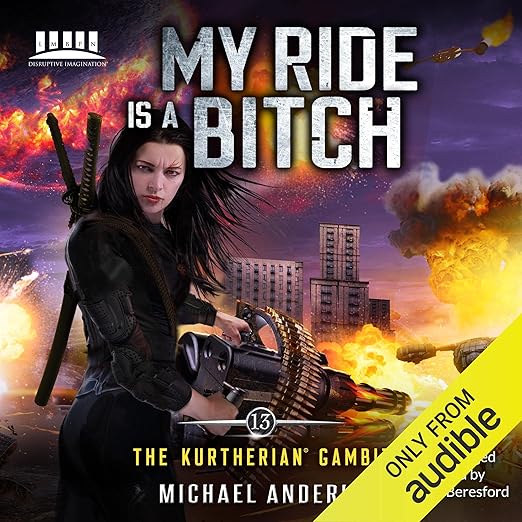
A young girl's letter to the Queen Bitch is the spark that sets off book thirteen of The Kurtherian Gambit, and this audiobook wastes no time turning that plea into a hunt for stolen alien technology. Bethany Anne would rather stay out of governments' business, black ops included, but somebody made the mistake of endangering a child's family to get what they want, and that is never a smart move in Michael Anderle's universe. Anderle has built an entire publishing operation out of throwing his antihero back into other people's messes, and My Ride Is a Bitch keeps that engine running at full throttle across seven and a half hours. Emily Beresford narrates, and the real question for anyone circling this corner of urban fantasy for the first time is whether book thirteen is a reasonable place to climb aboard, or whether it only really works for people already strapped in.
Beresford leans into the pulpy, high-velocity register this series runs on, and that turns out to be the right call for material built on quick scene changes and a large recurring cast. Reviewer Dave Neal calls Anderle 'one of my new favorite authors' and describes his books as populated with characters that 'have you cheering all throughout the books.' Beresford's performance gives that ensemble enough distinct color to justify the compliment even at speed. The plotting stays fast and a little chaotic by design, black ops operatives and rich businessmen circling alien tech while Bethany Anne handles threats to the defenseless with her usual lack of patience for bureaucracy or excuses. Reviewer Jeanne E. gave the book four and a half stars and praised the wild, funny characters, the world building, and the plot twists as reasons the series still works this deep into its run, while also flagging a real production issue worth knowing about going in: a consistent misuse of past and future perfect tense in the underlying prose. Anderle's reputation rests on volume as much as voice: across dozens of interconnected series under the Kurtherian Gambit umbrella, he has built a readership that expects, and gets, a new adventure at a pace few traditionally published urban fantasy authors could sustain. The title itself is a small joke that only really lands once a listener knows Bethany Anne's nickname within her own organization, the Queen Bitch, shortened to TQB throughout the synopsis; My Ride Is a Bitch is playing on that internal mythology rather than being crude for its own sake, a distinction worth knowing before judging the book by its cover alone.
The Best Parts of My Ride Is a Bitch
The appeal here is not subtlety; it is volume: alien conspiracies, black-ops threats, and a protagonist who treats cruelty toward the defenseless as a personal insult. Reviewer Rebecca Hartman admits the language warning attached to this series is accurate, then explains she got hooked anyway, bought the rest of the twenty-one book set, and moved on to a related ten-book spinoff, which says something about how habit-forming Anderle's universe becomes once the door opens. Beresford keeps Bethany Anne's voice consistent across a cast spanning soldiers, bureaucrats, and one very determined young letter-writer, and the comedic timing lands where the synopsis promises it, especially whenever the tone pivots from menace to Bethany Anne's dry exasperation at people who simply will not stop doing stupid things. For anyone who already tracks the Kurtherian Gambit's sprawling internal mythology, book thirteen delivers exactly the beats that keep a long-running series profitable: familiar character dynamics, a threat with genuine stakes for a child, and a resolution built to set up whatever comes next. Comedy is the primary genre tag attached to this entry, and that framing holds up: even the most dangerous plot developments, alien tech falling into the wrong hands, a family under direct threat, get filtered through Bethany Anne's specific brand of exasperated, take-no-prisoners humor rather than played completely straight. That tonal consistency across the whole runtime is a real achievement given how fast the plot moves between black-ops maneuvering, family drama, and full-scale confrontation, and it is a big part of why a series this deep into its run still reads as fun rather than exhausting to its established audience.
Before You Commit to My Ride Is a Bitch
Editing slips are frequent enough to notice even with Beresford's confident narration smoothing over some of the rougher patches. Jeanne E.'s review calls out the tense inconsistency specifically, and that kind of prose wobble is the sort of thing audio narration can only partially disguise, since a narrator reading a mixed-up verb tense aloud cannot silently correct the grammar underneath it. This is also, unmistakably, book thirteen of an ongoing series, so anyone who has not logged time with Bethany Anne and TQB before this entry gets dropped into established relationships, running jokes, and a mythology that assumes familiarity rather than building it from scratch. The language is blunt throughout, in keeping with the reputation Hartman references when she says the content warning is accurate, so listeners sensitive to profanity should expect it early and often. The alien-tech thread introduced here does resolve by the end, but the larger Kurtherian Gambit arc keeps moving regardless, which means this entry functions more as a well-executed chapter than a satisfying stopping point on its own. Worth noting too: this specific entry carries only three visible reviews despite the wider series' evident popularity, twenty-one books deep for at least one dedicated reader, so the 4.6 average here reflects a small, self-selected sample rather than a broad consensus. At seven hours and fifteen minutes, the runtime sits on the shorter side for urban fantasy, which keeps the pacing brisk but also means side characters introduced for this specific alien-tech plot get relatively little room to develop beyond their immediate function in the story.
Who Should Pick Up My Ride Is a Bitch
Kurtherian Gambit veterans are the easy yes here: thirteen books in, this is a comfort-food entry that rewards the time already invested in Bethany Anne's world, and Beresford's narration will likely feel as familiar as the characters themselves by this point. Urban fantasy fans who like their heroines merciless toward anyone who threatens children, and who do not mind a real body count, will find the tone consistent with what draws people to this series in the first place. Newcomers hunting for a standalone entry point should start elsewhere in the catalog, since the emotional shorthand here leans on twelve books of accumulated history rather than reintroducing anyone. The verb-tense inconsistency already noted above is a real, if minor, weight against an otherwise fast and funny ride, and it is worth factoring in before committing to another chunky Anderle installment.