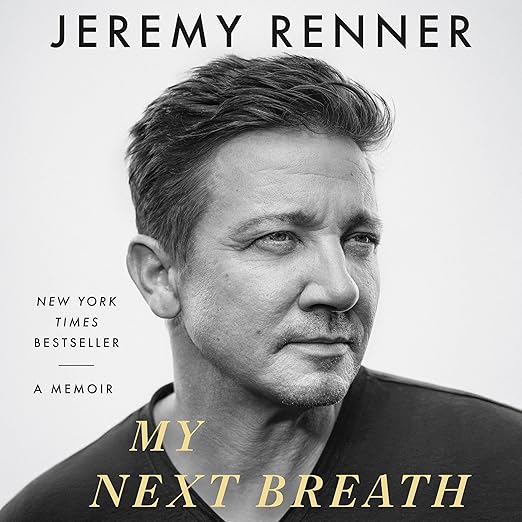
Before You Press Play
- Voice: Renner reads the account firsthand, and the description adds a second voice the credit line omits, a note written and read by daughter Ava.
- Big ideas: Survival and rehabilitation, celebrity stripped back to a body, family as the reason to keep breathing.
- Atmosphere: Raw, close, occasionally hard to sit through.
- Worth it?: Worth the format if the 911 audio is the point for you, and worth skipping if that same audio is the reason to stay away.
Two pull quotes sit inside this audiobook's description, and both of them are about the recording rather than the book. Vulture calls the narration particularly harrowing and notes that the program cuts to 911 calls from the day of the incident, with Renner audible in the background fighting to stay alive. AudioFile describes Renner navigating reflections on life and death with audible emotion, and singles out the original 911 interactions as what enhances the audio. Publisher-selected praise is still publisher-selected praise, but it is unusually specific about what a listener actually gets, and it is the only material on this page that treats the thing as a recording at all.
Five Responses, All About Page Numbers and Photos
Amber B is at Chapter 4, page 59, and mentions looking at the pictures. Rese describes a story that captivates the reader from the very first page. JL Populist writes about not knowing much until reading the book. The five customer entries collected here are, without exception, responses to a physical object with page numbers and photographs in it. That does not make them worthless, but it does mean the star column and the audio edition are only loosely acquainted, and anyone deciding whether to listen is working from evidence about something else.
A Daughter Reads a Note the Narrator Field Omits
Renner reads his own account, which for this particular memoir is closer to a requirement than a nice touch. A fourteen-thousand-pound snowplow crushed him at the start of 2023; he kept breathing for more than half an hour before reaching the ICU, and multiple surgeries and months of rehabilitation followed. A hired reader performing that in a clean studio voice would be a different and much smaller book. The description promises blistering detail, and detail of that kind lands differently when the person supplying it also survived it.
Macmillan Audio produced this from Flatiron Books, and the credit line names one narrator. The description names a second: a note written and read by Renner's daughter, Ava, which appears nowhere in the narrator field. Whether that runs a minute or ten, it changes the shape of the recording, and a listener choosing between formats deserves to know it exists. The 911 tape belongs in the same category. Both are audio-only elements, and both are mentioned in the sales copy rather than in the credits where they would be easy to find.
Playing the 911 Call Is a Risk and a Power
If the 911 recordings are handled with any restraint at all, they are the argument for choosing this format. A memoir about a near-fatal accident can describe the sound of a person struggling to breathe, or it can play it. The second option carries an obvious risk of exploitation and an equally obvious power, and two separate audio-focused outlets in the copy went out of their way to name those moments as the reason the production works. Six hours and thirty-five minutes is not long for a full memoir, which suggests a book built around a handful of very concentrated passages.
Vulture also supplies the sentence most useful to a skeptic, admitting that not every celebrity needs a memoir before concluding that this one is worth it. That skepticism is healthy and the description does little to disarm it: two Oscar nominations, seven Marvel films, the Jason Bourne franchise, a crooked mayor in American Hustle, a bomb technician in The Hurt Locker, a bank robber in The Town. The filmography paragraph reads like a press kit. The accident paragraph does not, and the tonal gap between them is the honest preview of what this book is.
Ava's note is the detail that stayed with me. A recovery memoir written by the patient has a built-in blind spot, since the person on the gurney remembers less than everyone standing around it, and the copy addresses that by handing a section to the daughter. Renner was, by the publisher's account, the second-most-googled person of 2023 for reasons that had nothing to do with acting. A family voice inside the production is the one thing that can pull a story like that back from spectacle toward something a listener can sit with.
The Five Visible Grades Don't Match the Average
Print evidence dominates this listing to a degree that should make you cautious about the star rating. Page numbers, photographs, chapter positions, a French entry praising how smoothly the text reads: the people who left words behind were holding a book. The audio edition has its own qualities that none of those responses could speak to, so the enthusiasm you see may transfer completely or may not transfer at all. Treat the reviews as evidence about the writing and the story, which they genuinely are, and as evidence about nothing else.
JL Populist gives the most balanced account available here, calling the experience horrific, challenging, miraculous, and inspirational in one breath, then locating the book's real strength in the specifics of how survival happened rather than in the uplift around it. That is a useful warning label. Readers looking for a straightforward inspirational arc will find one, since the copy leans hard on endurance, transformation, and finding purpose in adversity. Readers who want the mechanics of an ICU and a rehabilitation calendar will also find those, and the two audiences do not always want the same book.
None of the rating arithmetic on this page holds together either. A 4.5 average is displayed above a counter reading five, and no arrangement of five whole-star votes anywhere lands on a 4.5 average. The five visible entries grade the book at five, five, four, five, and five stars, which is a perfectly coherent picture on its own. The summary number floating above them is not, so use the entries and let the average go.
Every Written Response Is About Ink and Paper
Come to this one if you want a survival account told from inside the body it happened to, and if hearing the emergency call itself strikes you as clarifying rather than intrusive. It suits listeners who follow recovery narratives, anyone who has done long rehabilitation and wants the unglamorous version, and people willing to let an actor they know from franchise work be something else for six and a half hours.
Avoid it if reconstructed medical trauma is a hard limit for you, because the description promises blistering detail and the production reportedly includes the real audio from the day. Avoid it as well if you were counting on other listeners to assess the recording, since every written response here is about ink and paper. Two audio-facing quotes from the publisher's own copy are the closest thing to a verdict on the recording, and both were chosen by the people selling it.
Good to Know
Does the audiobook really include the original 911 calls?
Both outlets quoted in the publisher's copy say so. One describes emergency-line recordings dropped into the narration, with the author's own voice still audible behind them, struggling. The other credits those original interactions with lifting the whole production. Neither source indicates how long such passages run, how often they recur, or where they fall.
Who narrates besides Jeremy Renner?
The credit field lists Renner alone. The description, however, states that the program includes a note written and read by daughter Ava, which makes a second voice part of the production without appearing anywhere in the credits. No runtime or placement is given for that section on this listing.
Do the customer reviews say anything about this audiobook edition?
Not one of them does. Every written response describes a printed copy, complete with page numbers, chapter positions, and photographs. The only assessments of the recording come from the two review quotes the publisher selected for its own description, which is worth keeping in mind while you read the star column.