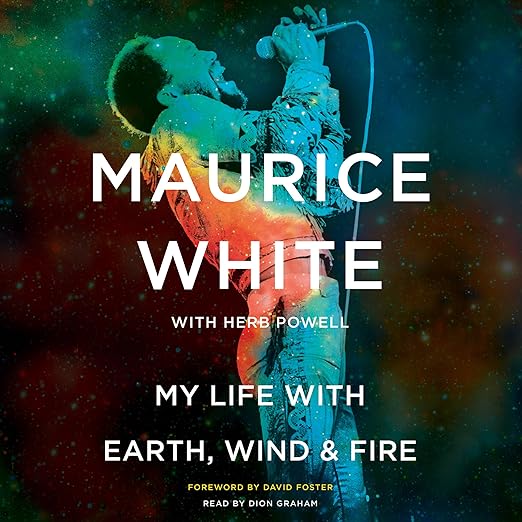
Maurice White was four years old when his mother left him in Memphis, and by his twenties he was building one of the most influential bands in American pop music. That gap, between an unstable, disrupted childhood and the disciplined bandleader who would go on to found Earth, Wind & Fire, is the emotional spine of this audiobook memoir, My Life with Earth, Wind & Fire, tracing a career that reshaped what a horn-driven, genre-blending pop and soul group could sound and look like on a stage.
White traces his own path with real specificity: learning drums alongside Booker T. Jones, relocating to Chicago at eighteen, moving on to Los Angeles after his time with the Ramsey Lewis Trio, founding Earth, Wind & Fire only to watch the original lineup fall apart before rebuilding it into the band that would go on to work alongside Barbra Streisand and Neil Diamond. Rolling Stone once credited the group with changing 'the sound of black pop,' and the memoir traces exactly how that transformation happened from the inside, chapter by chapter, decision by decision.
An Ideal Sitting in the Ether, Waiting
One reviewer, identified as C. L. B., quoted White directly in their review: 'the ideal was just sitting out there in the ether, waiting to be picked up by someone with the courage to take it on,' a line that captures the reflective, almost spiritual register White brings to describing his own creative process throughout the book. That same reviewer called the memoir 'powerful, poignant, prophetic,' language that signals this is written for genuine EWF devotees as much as casual music-history readers.
A second reviewer, writing as The Careful Observer, framed White among a rare category of artist who 'thinks in sounds,' expressing real awe at the memoir's ability to translate that kind of musical genius into readable prose. A third review, submitted in Japanese by a longtime fan still processing White's death years later, described being unable to fully move on from the loss and expressed gratitude for the dreams his music gave them, a genuinely moving reminder of how far this band's reach extended beyond the American audience the memoir mostly addresses directly.
Major music memoirs, Keith Richards' Life, Bruce Springsteen's Born to Run, tend to succeed or fail based on how honestly the artist handles their own mythology, and White's account of watching his original Earth, Wind & Fire lineup collapse before he rebuilt the band from scratch suggests real willingness to sit with failure rather than smoothing the story into an uninterrupted rise. That rebuilding arc, not just formation and success, gives the memoir genuine narrative shape rather than a simple chronological victory lap.
An Audie Award for Narrating a King Biography
Dion Graham narrates, and while his catalog runs heavily toward middle-grade and young-adult nonfiction, he also won the Audie Award for his narration of King: A Life, Jonathan Eig's biography of Martin Luther King Jr., proof he can carry the reverent, historically weighted register a major cultural figure's story demands. That same instinct, finding a subject's cadence without slipping into impersonation, is exactly what a memoir this attentive to White's own philosophical voice requires.
Changing the Sound of Black Pop, by Design
The book's foreword comes from David Foster, a strong signal of the memoir's standing within the music industry itself rather than just among fans, and White's own faith runs as a throughline across the entire account, from early hardship through the band's commercial peak to his Parkinson's diagnosis and his final public performance at the 2006 Grammy Awards. That faith framing gives the memoir's later, harder chapters a genuine sense of resolution rather than simple decline.
The synopsis credits the band with blending pop, R&B, soul, funk, and disco into one sound, and White's memoir traces the specific creative decisions behind that genre-blurring approach rather than treating it as an accident of taste. Understanding how deliberately White pursued that fusion adds real weight to Rolling Stone's assessment that the band changed the sound of Black pop, since the memoir frames that shift as intentional craft rather than lucky timing.
White's work alongside artists as different from Earth, Wind & Fire's own sound as Barbra Streisand and Neil Diamond signals a career that extended well beyond fronting his own band, into production and collaboration across genres with little obvious connection to funk or soul. The memoir's willingness to cover that breadth, rather than narrowing entirely to the band's own discography, gives listeners a fuller picture of White as a working music-industry figure, not just as a bandleader.
Physical Decline Handled With the Same Faith-Inflected Steadiness
This memoir goes deep on band personnel history and the internal mechanics of the music industry, the original lineup's collapse, the process of rebuilding, specific recording and touring decisions, material that will reward longtime fans far more than casual listeners who only know the band's radio hits. Listeners wanting a breezier celebrity memoir focused mainly on fame and hit songs should know this leans toward a more reflective, occasionally dense account of the actual work behind the music.
The book's back half covers real physical decline, White's Parkinson's diagnosis and the gradual loss of his ability to perform, and that material is handled with the same faith-inflected steadiness as the rest of the memoir rather than melodrama, but it is genuinely difficult content. Listeners who knew White primarily through the band's celebratory live shows should be ready for a more somber final act.
White's path from Memphis through Chicago, where he learned drums alongside Booker T. Jones, and later Los Angeles by way of the Ramsey Lewis Trio, covers considerable geographic and stylistic ground before Earth, Wind & Fire even forms, and listeners expecting the memoir to open directly on the band's formation should be ready for a fuller account of the years that shaped White before he ever assembled the group.
For Fans Who Want the Story Behind the Music
Listen if you are an Earth, Wind & Fire fan wanting the founder's own account of the band's rise, internal struggles, and legacy, or if you have a broader interest in the history of American funk, soul, and disco told from inside the industry rather than through a critic's retrospective lens.
Skip it if you want a light, hit-song-focused celebrity memoir rather than a reflective account grounded in faith, personnel history, and real professional struggle. This is a memoir for listeners genuinely invested in the story behind the music, not just the music itself.
Is the My Life with Earth, Wind & Fire audiobook narrated by Maurice White himself or a narrator?
Dion Graham narrates. White wrote the memoir before his death, but Graham, an Audie Award winner, performs the audiobook itself.
Does this audiobook cover Earth, Wind & Fire's entire discography and history?
It focuses more on White's personal journey and the band's internal history, from its founding and early breakup through its commercial peak, rather than a song-by-song discography rundown.
Is prior knowledge of Earth, Wind & Fire's music necessary to enjoy this memoir audiobook?
It helps but is not required. The memoir stands on its own as a story about creative ambition, faith, and resilience, though longtime fans will get the most out of the personnel detail.
How does the audiobook address Maurice White's Parkinson's diagnosis and final performance?
It covers his diagnosis and his final public performance at the 2006 Grammy Awards with the same faith-inflected steadiness that runs through the rest of the memoir, rather than framing it as pure tragedy.