Quick Take
- Narration: Sarah Kempton delivers a clear, measured performance that suits the documentary nature of David-Neel’s account, though she sometimes underplays the raw physical drama of the mountain passages.
- Themes: Female independence and defiance of convention, spiritual pilgrimage, the forbidden and the forbidden body
- Mood: Austere, awe-inducing, and quietly triumphant
- Verdict: A genuinely historic travel record that puts contemporary adventure writing to shame in both scope and nerve.
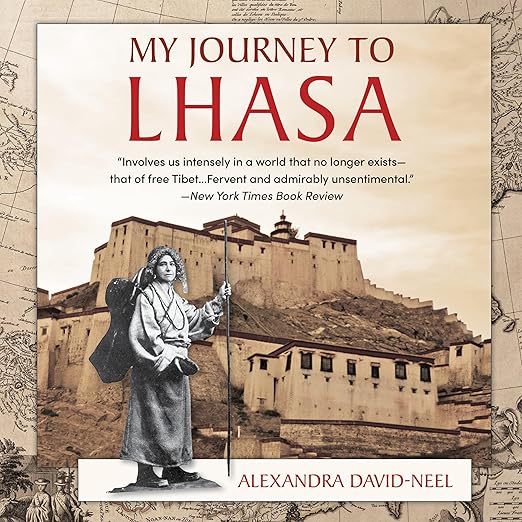
I finished this one on a rainy Tuesday afternoon, somewhere around the third hour of Kempton’s narration describing Alexandra David-Neel crossing a gorge on a rope over a chasm of indeterminate depth, and I had to set down whatever I was doing and just listen. Not because the writing is especially pyrotechnic, David-Neel’s prose is spare and functional, the account of a scientist and Buddhist scholar rather than a literary stylist, but because the sheer physical reality of what she was describing became impossible to hold at arm’s length. She was fifty-five years old. It was around 1924. And she was somewhere in the Tibetan Himalayas, disguised as a beggar, doing something that no Western woman had ever done.
That context is everything when you listen to My Journey to Lhasa. This is not a travel memoir in the modern sense, with its introspective passages and carefully curated moments of personal growth. David-Neel was not on a gap year. She was a French-Belgian Buddhist scholar and ordained lama who spent years living and studying in Asia before attempting the forbidden city, and she writes about the journey with the same matter-of-fact precision she would bring to a scholarly monograph. The effect is oddly more dramatic than any dramatization could achieve.
Our Take on My Journey to Lhasa
What strikes me most listening to this account is how completely it dismantles any romance you might bring to the idea of Himalayan travel. David-Neel describes sleeping on snow, begging for food, traveling by starlight to avoid military patrols, and sheltering with a companion, Yongden, through conditions that would defeat most modern trekkers with all their Gore-Tex and satellite communicators. One reviewer called it a “veritable traveler boot camp,” and that feels right. But it is never a survival narrative in the contemporary vein. David-Neel doesn’t wallow in her own suffering; she records it and moves on, which is itself a form of extraordinary fortitude.
The book also serves as an irreplaceable window into pre-invasion Tibet, a world that was already circumscribed for foreigners and that would within decades be radically transformed. She describes the religious life of the country, the architecture, the people she encounters with the sharp curiosity of someone who is simultaneously a traveler, a scholar, and a practitioner within the tradition she is observing. That dual perspective gives the book a texture that pure travel writing rarely achieves.
Why Listen to My Journey to Lhasa
The audiobook format works better for this material than you might expect. Kempton’s narration is controlled and unhurried, which matches David-Neel’s own voice on the page. There is no sentimentality, no performative wonder, just the account, delivered with appropriate seriousness. Where the narration is less successful is in the more physically intense passages, where a slightly wider dynamic range might have served the material. But for a historical travel record of this kind, the clean, scholarly delivery is more honest than a dramatized approach would be.
The eleven hours also feel appropriate for a journey that, in reality, took months of sustained hardship. David-Neel’s account is detailed without being padded, and the cumulative weight of the miles and the obstacles builds into something genuinely moving by the time she describes arriving in Lhasa and being received by the Dalai Lama. One longtime reader described returning to the book after thirty years and searching for it across multiple libraries in multiple languages before finally tracking it down online. That kind of loyalty across decades tells you something about what the book achieves.
What to Watch For in My Journey to Lhasa
This is not a book for listeners who need constant action or escalating stakes. The pacing is that of a journey on foot through some of the most inhospitable terrain on earth, steady, episodic, occasionally punctuated by genuine danger but never structured for dramatic effect. Some passages focus heavily on Buddhist religious practice and the spiritual landscape of Tibet in ways that demand a degree of patience from a general reader. David-Neel is writing as a scholar, and the ethnographic and religious material is presented with the same weight as the physical adventure.
It is also, by contemporary standards, a text of its time. Her observations about the Tibetan people carry the mixture of deep respect and occasional condescension that marked even the most enlightened European ethnographers of the early twentieth century. Neither quality dominates, but both are present, and they are worth noticing. The adventure, however, transcends its era entirely.
Who Should Listen to My Journey to Lhasa
This audiobook is the right fit for listeners who find themselves drawn to genuine exploration rather than adventure tourism, readers of Apsley Cherry-Garrard, Eric Shipton, or the drier passages of Freya Stark will feel at home here. If you have any interest in Tibet before the Chinese occupation, the Buddhist traditions of the Himalayan region, or the history of women who simply refused to be told where they were not permitted to go, this is essential. Those looking for immersive narrative storytelling or emotional interiority should look elsewhere; David-Neel is writing a record, not a confession.
Frequently Asked Questions
Do I need prior knowledge of Buddhism or Tibetan culture to appreciate this audiobook?
Not required, but some familiarity enriches the experience. David-Neel explains what she observes, but she writes as an ordained lama and scholar, so she doesn’t slow down to define basic concepts. A brief background read on Tibetan Buddhism beforehand would pay dividends.
Is Sarah Kempton’s narration suited to the book’s style?
Yes, on balance. Her delivery is measured and clear, matching David-Neel’s own documentary tone. She doesn’t theatricalize the danger or the hardship, which is the right call for this material. Some listeners may wish for slightly more expressive range in the physically intense sections.
How does this compare to other early twentieth-century Himalayan travel writing?
It is unique in several respects. Unlike most Himalayan accounts of the era, it focuses on inhabited Tibet rather than the purely physical challenge of the mountains, and it is written from within the Buddhist tradition rather than from the outside looking in. The gender dimension, a fifty-five-year-old European woman making this crossing alone and in disguise, gives it a dimension that has no real parallel.
Is the book historically accurate, or was David-Neel later disputed?
Her account has been broadly accepted as authentic, though some scholars have questioned specific details about her Buddhist credentials and ordination status. The core journey itself, the disguise, the arrival in Lhasa, is not seriously disputed. Treat it as a firsthand account that deserves the same critical engagement any memoir would.