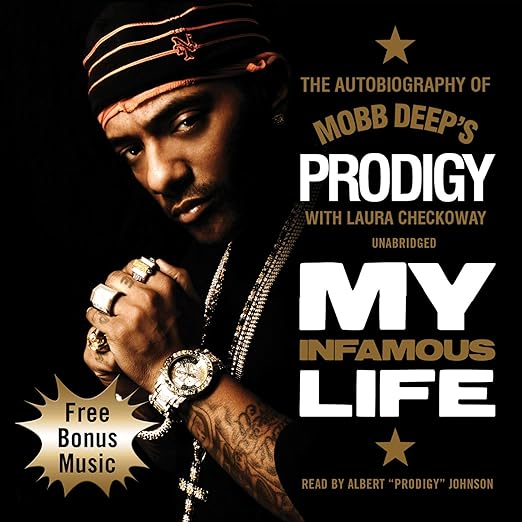
Prodigy narrates his own memoir, which means My Infamous Life arrives as an audiobook with no distance between the text and its subject. Albert Johnson, one half of Mobb Deep, co-wrote this account with journalist Laura Checkoway and reads it himself across thirteen hours and forty-seven minutes, and that decision determines everything about how the material lands. The Queensbridge projects, the formation of Mobb Deep, the Infamous album's cultural weight, the feuds with Jay-Z and Nas and Tupac, the sickle-cell anemia that shadowed his entire life, the prison sentence that many believe was facilitated by a rumored NYPD hip hop task force: all of this is delivered in the voice that put Shook Ones Part II into the American musical bloodstream.
The family background Prodigy excavates here is genuinely surprising to anyone who knows him only from the Queensbridge persona. His grandparents were part of music royalty; his early childhood included private schools and proximity to figures like Diana Ross and Dizzy Gillespie. The family tragedy that redirected his life into the projects is not narrated with melodrama but with the flat facticity of someone who has processed it many times and still finds it incomprehensible. That contrast between the privilege of his origins and the conditions that shaped his art is one of the book's most significant structural threads, and Prodigy's voice carries it with authority precisely because he is the only person who could tell this particular story.
Self-narration in memoir is a gamble. Professional audiobook narrators have skills that most authors lack, and the performance quality gap is usually audible. In Prodigy's case, the calculus reverses. His voice is not a professional instrument in the conventional audiobook sense, but it is an instrument with decades of work behind it. The cadence of his delivery reflects the same rhythmic intelligence that makes his recorded verses compelling, even in prose. Reviewer DaveSincere reports reading the book in its entirety in under twenty-four hours, which in audio terms translates to sustained engagement across multiple sessions. Reviewer QueenNyla's description of Prodigy taking you into his world as if going down memory lane right alongside him captures exactly what self-narration at its best achieves: the sense that you are receiving testimony rather than a performance.
The hip hop feuds documented here are treated with the same directness as everything else. Prodigy doesn't frame the East Coast-West Coast rivalry with academic distance or nostalgic softening. He was inside it. His account of his conflicts with Jay-Z and Nas, his relationships with Puff Daddy, Russell Simmons, Chris Lighty, and Irv Gotti, and his perspective on the business infrastructure behind the Golden Era's music provides the kind of unmediated primary source material that hip hop historians have been working around for decades. These are not reconstructed conversations or reporter's summaries; they are first-person accounts from a participant who had no reason to position himself favorably on every question.
The Strengths
The thirteen-hour runtime is substantial for a music memoir, but Prodigy's life is genuinely substantial material. The sickle-cell anemia narrative is woven throughout rather than confined to a single chapter, which gives the book an unusual structural coherence: every phase of his career and every decision made under conditions of physical risk was shaped by a condition that regularly hospitalized him and altered his relationship to mortality in ways that illuminate choices that might otherwise seem purely circumstantial. The memoir's subtitle frames this as the dark side of hip hop's Golden Era, and the audiobook delivers on that framing without reducing the era to a cautionary tale. There is genuine love here for the music and for the specific people who made it.
Prodigy died in 2017 from sickle-cell anemia complications, which gives the audiobook an additional weight it didn't carry at original publication. Listening to him narrate his own life now is an archival act as much as an entertainment one. His voice is the document, not just the delivery mechanism, and that distinction matters for how this audiobook should be approached.
Weak Spots in My Infamous Life
Listeners unfamiliar with Mobb Deep's catalog should approach this audiobook as an invitation to return to The Infamous and Hell on Earth afterward. Prodigy references specific tracks and albums throughout, and the emotional weight of those references is proportional to how much the listener already knows. The prison narrative occupies a significant portion of the latter sections and is delivered with the same directness as everything else: no self-pity, no exculpatory framing, and no pretense that the choices leading to it were anyone else's. This is a memoir that takes its subject's own agency seriously even when that agency produced damaging outcomes.
Recommended For
Hip hop listeners who want primary source testimony from inside the 1990s New York scene are the natural audience for this audiobook. Music memoir readers familiar with accounts like Ice-T's Ice and Jay-Z's Decoded will find this sits comfortably in that company, though Prodigy's directness is more unfiltered than either. Listeners who need a traditionally crafted literary memoir with polished prose should look elsewhere; the value of this audiobook is inseparable from its roughness. A performance delivered by someone who has nothing left to prove and no particular interest in being liked is a rare thing in a genre that usually requires a measure of audience management, and Prodigy provides none of that management here.
Before You Listen
Does Prodigy narrating his own audiobook add to or detract from the experience?
It adds significantly. His vocal cadence reflects the same rhythmic intelligence as his recorded music, and the self-narration creates a testimonial quality that a professional narrator could not replicate. The lack of conventional polish is part of what makes it feel credible.
Does the My Infamous Life audiobook cover the East Coast-West Coast rivalry in detail?
Yes, in considerable detail from a participant's perspective. Prodigy addresses his conflicts with Jay-Z, Nas, Tupac, and others with the directness of someone who was inside those conflicts rather than observing them from a distance.
Is this audiobook accessible to listeners who are not already Mobb Deep fans?
Yes, though familiarity with the music adds depth to the references throughout. The life story is compelling on its own terms, particularly the contrast between Prodigy's privileged origins and his Queensbridge years.
How does the audiobook handle the sickle-cell anemia dimension of Prodigy's life?
It is woven throughout rather than isolated in a medical chapter. The condition's effect on his decision-making, physical risk tolerance, and perspective on mortality runs through the entire narrative as a structural thread rather than a sidebar.