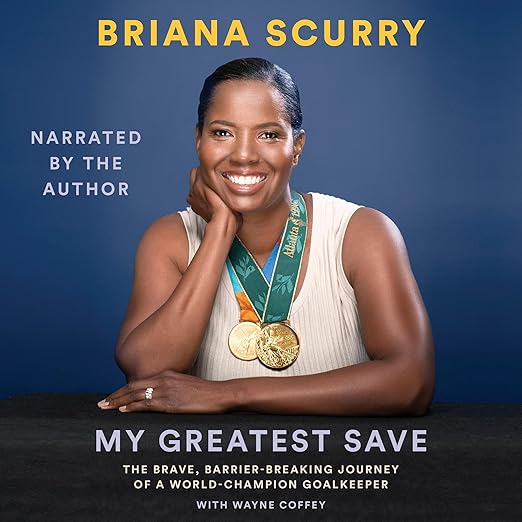
The Short Version
- Narrator: Briana Scurry self-narrates, and the effect is immediate and irreplaceable, with her directness and emotional composure making the most difficult passages genuinely moving.
- Subjects: Athletic trailblazing, traumatic brain injury, the cost of excellence, queer identity in sport
- Tone: Candid and emotionally generous, without ever tipping into sentimentality
- Bottom line: Scurry's memoir transcends the sports autobiography form, and her willingness to describe the worst of what happened to her after 2010 makes this audiobook something genuinely worth your time.
Briana Scurry made one of the most famous saves in American soccer history during the 1999 Women's World Cup penalty shootout, a stop that helped win the tournament and cemented the legacy of the "99ers." My Greatest Save, her memoir in audiobook form, begins with that achievement and then traces what came after: a second Olympic gold, a debilitating head injury in 2010, a spiral into depression and debt, and the moment she stood at the edge of a waterfall and considered not returning from it. Scurry self-narrates, and the choice is essential to the audiobook's impact. Her voice carries twelve years of professional discipline and two years of profound crisis, and she speaks about both without any detectable need to protect herself from the listener's judgment.
My Greatest Save Isn't the 1999 Shootout
The memoir's structure is honest about its own title. "My greatest save" is not the 1999 shootout stop, and Scurry signals this early. The save the book is really about is the decision to choose life at her darkest moment. That framing shapes the entire emotional architecture of the book. Every chapter about the triumphs of the US Women's National Team reads differently once you know where the narrative is going, and Scurry is clearly aware of this. She builds toward the crisis with the same control she brought to the goal line.
As the only Black player on the USWNT during its peak years, and the first player on the team to be openly gay, Scurry's memoir carries a historical dimension beyond her athletic achievement. She navigates these aspects of her experience with the same directness she brings to everything else, not dwelling on them for effect, but not minimizing them either. Reviewers note that the book avoids the typical autobiographical trap of rendering the subject as incapable of error, and this extends to how Scurry discusses her relationships, her finances during the post-injury period, and the decisions that compounded her difficulties after leaving the game.
Self-Narration Is the Gamble That Pays Off
Self-narration in memoir is a gamble, and it pays off dramatically here. One reviewer described Scurry's writing style as breezy and direct, from her lips to your ears, and that phrase captures exactly what the audio format adds. The brain injury section, which covers the temporarily totally disabled diagnosis and the subsequent collapse of her professional and personal life, is handled with a composure that makes the content land harder rather than softer. Scurry does not perform distress. She describes it with the same precision she presumably brought to analyzing penalty kicks, and that discipline in the telling is devastating in the best way.
At 8 hours and 16 minutes, the runtime is well-proportioned for the arc of a life this eventful. The early chapters covering the 1996 Atlanta Olympics, the first time women's soccer was played at the Games, have the energy of someone recounting a genuinely historic experience that they were young enough to absorb without full awareness of its significance. By the time Scurry reaches the 1999 World Cup, the listener has enough context to understand why that penalty save mattered the way it did.
Suicidal Ideation Is Present and Not Softened
The memoir covers suicidal ideation directly and in some detail. Listeners who may be vulnerable to that material should know it is present before they begin. Scurry handles it with care, and the framing is ultimately one of survival and recovery, but the passages are not softened. For most listeners, this candor is the memoir's greatest strength; for some, it will require a different moment to engage with properly.
The book is specifically a soccer memoir and a personal recovery account. It does not attempt to be a broader social commentary on women's sports, race in athletics, or LGBTQ representation, though it touches all three. Readers who want analytical depth on those themes will find Scurry's treatment personal rather than structural. That is not a flaw; it reflects what kind of book she chose to write. But the expectations should be calibrated accordingly. One reviewer noted losing track of Scurry over the years after the USWNT's peak period, and the memoir does the useful work of accounting for that gap. For a generation of soccer fans who grew up watching the 99ers and lost the thread of what happened to their heroes afterward, this audiobook fills in a history that deserves to be known.
One element of Scurry's memoir that reviewers consistently highlight is the writing style itself, described as breezy and direct in a way that is less common in sports biographies than the genre's conventions might suggest. Many athlete memoirs are produced through collaboration with professional writers, and the result sometimes reads as a polished but mediated version of the subject's voice. Scurry's memoir has the quality of someone who chose their words deliberately rather than approving a draft someone else wrote. Whether this reflects sole authorship or an unusually close collaboration, the effect is a voice that feels continuous from the first chapter to the last, which matters across eight hours of listening.
Voice as an Intimacy Channel for This Story
Soccer fans, sports memoir readers, and anyone interested in the intersection of athletic excellence and traumatic brain injury will find this audiobook compelling. Listeners drawn to honest accounts of mental health crisis and recovery, rather than sanitized versions, will find Scurry's level of candor rare and valuable. The self-narration makes it a stronger audio choice than print for readers who respond to voice as an intimacy channel.
Approach with awareness of the content warnings above, and set aside a quiet stretch of listening time for the second half of the book. My Greatest Save is the kind of memoir that works best without interruption.
Does Briana Scurry narrate her own audiobook, and does it make a difference?
Yes, Scurry self-narrates, and it transforms the listening experience. Her directness and emotional composure give even the most difficult passages a quality of authenticity that a professional narrator could not replicate. The sections covering her 2010 head injury and subsequent crisis are particularly powerful in her own voice.
Does the My Greatest Save audiobook cover Scurry's mental health crisis in detail?
Yes. The memoir addresses suicidal ideation directly, including a moment at a waterfall that the title phrase ultimately refers to. Scurry handles the material with care and without dramatization, but it is present and substantive. Listeners who may be sensitive to this content should know it is a central part of the book's arc.