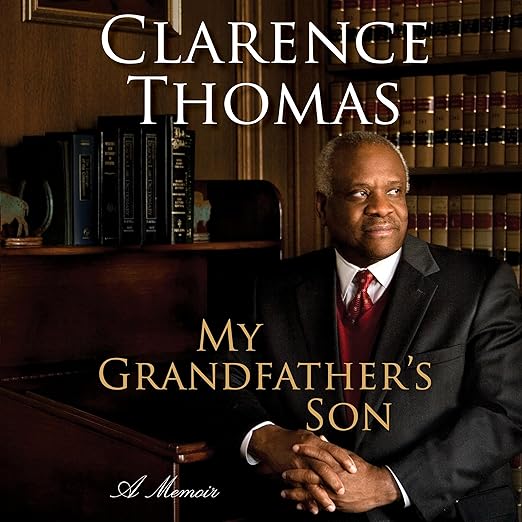
Clarence Thomas narrates his own memoir, and that choice alone tells you what kind of audiobook this is: not a polished third-party retelling of a controversial public life, but the man himself, unfiltered, walking a listener through the parts of his story he says he holds dearest. The title itself points to the memoir's emotional anchor, a Supreme Court Justice built, by his own account, largely by his grandfather's hand rather than his own early advantages.
The synopsis does not soften the material: the book covers his 1991 Senate confirmation hearing and the accusations brought by former aide Anita Hill directly, along with the depression and despair that period caused him and the people closest to him. Reviewer Staring Down the Dragon Fan put it plainly: 'Justice Thomas bares his soul as to the man behind the robes, warts and all,' pushing back specifically against critics who dismissed his candor as 'whining.'
The grandfather in the title is Myers Anderson, who raised Thomas for much of his childhood in Georgia after his own father left, a fact widely documented across Thomas's public life and central enough to his own account of himself that it became the memoir's title rather than a single early chapter.
The depression Thomas describes following the Hill hearings gets real space in the book rather than a passing acknowledgment, and reviewer Staring Down the Dragon Fan's insistence that this candor should not be read as 'whining' points at something genuine: describing the psychological toll of a public ordeal honestly is different from simply complaining about it, and the memoir draws that distinction carefully.
Faith gets its own dedicated space in the memoir alongside the more heavily discussed legal and political material, and Thomas describes that spiritual dimension as inseparable from how he ultimately made sense of the Hill hearings rather than as a separate, compartmentalized chapter of his life.
What Makes My Grandfather's Son Worth Hearing
Self-narration is the entire argument for choosing this audiobook over reading the memoir in print. Hearing Thomas describe his own hardest year in his own voice, rather than through a narrator's interpretation of his words, closes a gap a hired performer simply cannot close on material this personal and this contested.
Reviewer Mr. G. Regis offered maybe the most compelling evidence of the book's persuasive power: a UK-based reader who came in with impressions shaped by what he called 'the liberal media,' expecting 'some type of kneejerk sellout,' and came away glad to have read it, with his perception genuinely changed. That kind of shift, from a skeptical starting point to a warmer one, says more about the memoir's honesty than a five-star rating from an already-sympathetic reader would.
Self-narrated political memoir has become its own small tradition, with figures across the political spectrum choosing to read their own books rather than hand them to a professional narrator, and the reasoning is consistent every time: on material this personally costly, in Thomas's case decades on the Supreme Court following one of the most contentious confirmation hearings in modern history, a listener wants the author's own voice carrying the weight of it.
Thomas's early childhood in Pin Point, a small Gullah community near Savannah, Georgia, gives the memoir's opening chapters a specific, well-documented regional and cultural texture before the narrative moves into his education, his career, and eventually his nomination to the Court.
Things to Know Before Starting My Grandfather's Son
This is a genuinely polarizing figure's own account of a genuinely polarizing period in recent American legal history, and listeners should expect the reception to split along the same lines the man himself has always split public opinion. Reviewer A Work in Progress, who admitted to reading mostly nonfiction 'with the sole purpose of learning something,' found the delivery both 'engaging and enlightening,' evidence that the book works even for readers approaching it clinically rather than as fans.
Only two ratings back the strong 4.8 average despite three substantive written reviews attached to the listing, a data mismatch worth noting rather than over-interpreting; the written reviews here are unusually detailed and worth weighing more heavily than the raw number. At eleven hours and fifty-three minutes, the runtime is a manageable single-memoir length rather than a sprawling multi-volume commitment.
The 2007 publication date is worth keeping in mind for another reason too: the political and media landscape surrounding the Court has shifted substantially since then, so listeners should expect a memoir speaking from and to its own specific moment rather than anticipating current events.
The prose style throughout stays plain and direct rather than reaching for literary flourish, consistent with Thomas's own account of himself as someone who values clarity over rhetorical polish, a register that suits self-narration specifically since it reads closer to spoken testimony than performed literary prose.
The chronological scope runs from his early childhood in Georgia through the 1991 confirmation battle and its aftermath, giving listeners the full arc of how a specific upbringing shaped the man who later faced that specific ordeal, rather than starting the story at the hearing itself.
Who Clarence Thomas Is Writing For
Readers interested in contested legal history, the Anita Hill hearings specifically, or the broader question of how a sitting Supreme Court Justice frames his own most difficult public moment are the clear audience. Listeners who value self-narrated memoir as a format, hearing the author's actual voice rather than a performer's interpretation, will find that argument especially strong here.
Listeners looking for a neutral third-party biography rather than a first-person account should look elsewhere, since this book is unapologetically Thomas's own framing of his own life. For anyone willing to sit with one of the most controversial figures in modern American law telling his own story in his own words, this audiobook delivers exactly that, unfiltered and, per multiple reviewers, genuinely moving.
Listeners specifically interested in the Supreme Court's internal culture, or in how a justice's personal history might inform his approach to the law, will find this memoir stops short of judicial philosophy or case analysis; it stays focused on personal history up to the 1991 confirmation rather than his subsequent decades of opinions.
Key Details
- Read by: Clarence Thomas narrates his own memoir, closing the gap between author and performer on deeply personal, contested material.
- At its heart: Self-made identity, the Anita Hill hearings, faith and family under public scrutiny.
- Vibe: Candid, emotionally raw, unapologetically first-person.
- Short version: A compelling self-narrated memoir for readers willing to hear a polarizing public figure's own account of his hardest year.